


 Francais
 Deutsch
 Italiano

Refine Your Search
John-F.-Kennedy stock footage and images
- Showing 2329 to 2334 of 3762 results more
 Hide
Color Sound

The CH-21B takes off, flies over and lands on a helicopter pad at Pentagon and VIP's board the helicopter.
CH-21B takes off, flies over and lands on a helicopter pad at Pentagon. Man boards the helicopter. He shuts the door. Helicopter takes off. Trees on the helicopter pad. Cars pass on the ground. Other cars parked on the ground. Houses and trees in the background. VIP's talk at the helicopter pad. The Secretary of State, John Foster Dulles with the Secretary of Defense Charles E Wilson and other VIP walks along the side of Pentagon. Mr Dulles boards CH-21B.
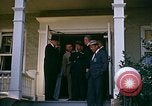
President Eisenhower and other dignitaries come out of the Summer White House at Newport in United States.
United States diplomatic, intelligence, and military officials stand on the porch of Summer White House at Newport United States. United States VIP's on the sidewalk. They depart the White House and cross the street to a large lawn. U.S. Secretary of the Navy Thomas Gates, Admiral Burke, Mr. John Foster Dulles, members of CIA and others leave the summer White House. Gates confers with two reporters. Mr Dulles and Admiral Burke on the walkway. Gates speaks with newsmen outside the White House. Dulles walks up and stops before Mr Gates. Secretary of State Christian Herter descends the steps holding crutches, stopping and speaking to Haggerty. Naval aide talks to Herter. Haggerty lights a cigarette. Herter stands alongside Limousine as crutches are given to an aide. He steps into the car. Eisenhower's naval aide confers with someone in the rear of the car. Eisenhower steps from the doorway of the Summer White House.
U.S. 3rd Infantry Division troops raise U.S. flag and exhibit parade at Zeppelinfeld in Nurnberg,Germany.
American soldiers raise a large U.S. flag to cover a German Swastika emblem on top of the Tribune at Zeppelinfeld in Nuremberg (Nurnberg),Germany. U.S. 3rd Infantry Division soldiers gather around the stadium in large numbers and exhibit a parade. Commander of the U.S. 7th Army Lieutenant General Alexander M Patch, Major General John W O'Daniel and other officers review the troops from the speaker's platform. (World War II period).

"Carlson's Raiders," of the U.S. Marine corps, return to Pearl Harbor, on two submarines, after their Makin Raid in World War II
The return of "Carlson's Raiders," to Pearl Harbor following their successful Makin Raid in World War 2. View from a high point overlooking a wharf at Pearl Harbor, as the USS Nautilus (SS-168) approaches. The wharf is crowded with a military honor guard, a reception committee of high ranking naval officers, and other well-wishers. (Unrelated sequence inserted, of a surfaced submarine, as it fires its deck gun and smoke arises in the sea from a burning ship in the distance.) Scene shifts back to Pearl Harbor, again. This time it shows the USS Argonaut (SS-166) docked, and Admiral Chester Nimitz boarding the submarine and shaking hands with Lieutenant Commander John R. Pierce, USN, its Commanding Officer. Major James Roosevelt, USMCR, (President Roosevelt's son) who is Executive Officer of the Second Raider Battalion (Carlson's Raiders) salutes Nimitz, who then shakes hands with him. Scene shifts again, to deck of the USS Nautilus, where Admiral Nimitz, holding Japanese war trophies from the Makin Raid, discusses them with a young officer from the Second Raider Battalion. View of arms and equipment of the Marines on the submarine deck. Sailors transport a wounded Marine on a litter. Marine Raiders begin to leave the submarine and walk past a military honor guard with rifles at parade rest.
Historical events of 1935 including Stresa Front, U.S. anti-war demonstrations, FDR in Jacksonville, Easter Parade, Female flyers
Scenes showing various historical events that took place in April 1935, during the Great Depression. In Stresa, Italy, on the banks of Lake Maggiore, leaders of Britain, France and Italy confer on German rearmament, in violation and defiance of the Versailles Treaty. (There they sign the "Stresa Front"). Images show the French and British delegations arriving by boat and walking near the port at Stresa, including British Prime Minister Ramsay MacDonald, French Prime Minister Pierre Etienne Flandin, and French Foreign Minister (President of the Council of Ministers) Pierre Laval. U.S. College students across the country join in anti-war, pacifist demonstrations a few years before World War 2. They are seen marching with banners and anti-war signs and cartoons. One banner reads, "It is the task of the 20th century to make this world a brotherhood." Also "War is Hell....Who want to go to hell?" and "War is Stupid". President Franklin Roosevelt returns from a two week cruise. He arrives in Jacksonville Florida. Local officials and crowds in Jacksonville greet him and cheer. Boy Scouts in a line greet the President. Views of Franklin Roosevelt in an open car and on ships and docks. Al Smith and Herbert Hoover share the speaker's stage in New York lending their support in fundraising for the Salvation Army during the Depression. Scenes from the Easter Parade in New York City. Crowds gather, filling double-decker open air buses. Al Smith seen with his wife. Postmaster General James Farley and Irish tenor singer John McCormack are seen on Fifth Avenue in New York. Amelia Earhart completes a 1700-mile flight from Burbank, California to Mexico City. Scenes of her in Mexico City in a car laden down with celebrating Mexican officials. Aviatrix Bernadine King sets a new record for upside down endurance flying. She is seen getting into her plane, and her plane is seen upside down in the air.
Film depicting some of the tragic human aftermath during and after World War I
A film looking at some of the tragic human costs of World War 1 ("The Great War"). Opening slates read, (in French) "What the war has left behind it." "9 million dead." Then, a vast battlefield cemetery is shown,filled with rough wooden crosses. Camera pans over parts of it. Another, better tended cemetery is seen with finer crosses. Then another battlefield graveyard, with freshly dug graves and rough markers is shown. Slate reads, "The sea, a vast tomb." Another slate reads, millions of crippled," followed by scenes of Allied soldiers and medics, carrying their gear, across a barren battlefield. One rough cross is seen.In next scene it is clear they are scouring the battlefield for wounded and dead. Stretcher bearers make their way cautiously across ditches and makeshift bridges as they retrieve the wounded. Two assist a walking wounded soldier with bandaged eyes. Wounded seen being brought into a sandbagged brick building serving as a hospital. A field ambulance also takes patients from the hospital. A convoy of field ambulances carry wounded from the battlefields. A two-stacker British hospital ship steaming at high speed away from a French port, headed for England. Wounded British war veterans being moved in wicker wheel chairs outside a substantial building. Uniformed attendant picks one up bodily and places him into another wicker wheel chair that allows his legs to be outstretched. The attendant covers him with a blanket. Next, that veteran is seen, conversing with a men, in an outdoor area, where other wheel-chair bound veterans are enjoying small flower gardens and socializing in the sunshine. A white-coated caregiver assists a stooped veteran who takes many small steps to walk. Next is seen the famous 1919 painting by John Singer Sargeant, of blinded soldiers on the battlefield, titled, "Gassed." (It is now in the British Imperial War Museum.) Slate reads "They'll never see again," and several blind veterans are seen in dark glasses walking outdoors in the company of others. Blind veterans, injured in gas attacks, are seen making baskets by hand.
CRITICALPAST.COM: About Us | Contact Us | FAQs - How to Order | License Agreement | My Account | My Lightboxes | Shopping Cart | Advanced Search | Featured Collections | Website Terms & Conditions | Privacy Policy ©2026 CriticalPast LLC.
License Agreement |
Terms & Conditions |
Privacy Policy
©2026 CriticalPast LLC.