


 Francais
 Deutsch
 Italiano
Refine Your Search
John-F.-Kennedy stock footage and images
- Showing 2383 to 2388 of 3759 results more
more Hide
Hide
Historical events of 1935 including Stresa Front, U.S. anti-war demonstrations, FDR in Jacksonville, Easter Parade, Female flyers
Scenes showing various historical events that took place in April 1935, during the Great Depression. In Stresa, Italy, on the banks of Lake Maggiore, leaders of Britain, France and Italy confer on German rearmament, in violation and defiance of the Versailles Treaty. (There they sign the "Stresa Front"). Images show the French and British delegations arriving by boat and walking near the port at Stresa, including British Prime Minister Ramsay MacDonald, French Prime Minister Pierre Etienne Flandin, and French Foreign Minister (President of the Council of Ministers) Pierre Laval. U.S. College students across the country join in anti-war, pacifist demonstrations a few years before World War 2. They are seen marching with banners and anti-war signs and cartoons. One banner reads, "It is the task of the 20th century to make this world a brotherhood." Also "War is Hell....Who want to go to hell?" and "War is Stupid". President Franklin Roosevelt returns from a two week cruise. He arrives in Jacksonville Florida. Local officials and crowds in Jacksonville greet him and cheer. Boy Scouts in a line greet the President. Views of Franklin Roosevelt in an open car and on ships and docks. Al Smith and Herbert Hoover share the speaker's stage in New York lending their support in fundraising for the Salvation Army during the Depression. Scenes from the Easter Parade in New York City. Crowds gather, filling double-decker open air buses. Al Smith seen with his wife. Postmaster General James Farley and Irish tenor singer John McCormack are seen on Fifth Avenue in New York. Amelia Earhart completes a 1700-mile flight from Burbank, California to Mexico City. Scenes of her in Mexico City in a car laden down with celebrating Mexican officials. Aviatrix Bernadine King sets a new record for upside down endurance flying. She is seen getting into her plane, and her plane is seen upside down in the air.
Film depicting some of the tragic human aftermath during and after World War I
A film looking at some of the tragic human costs of World War 1 ("The Great War"). Opening slates read, (in French) "What the war has left behind it." "9 million dead." Then, a vast battlefield cemetery is shown,filled with rough wooden crosses. Camera pans over parts of it. Another, better tended cemetery is seen with finer crosses. Then another battlefield graveyard, with freshly dug graves and rough markers is shown. Slate reads, "The sea, a vast tomb." Another slate reads, millions of crippled," followed by scenes of Allied soldiers and medics, carrying their gear, across a barren battlefield. One rough cross is seen.In next scene it is clear they are scouring the battlefield for wounded and dead. Stretcher bearers make their way cautiously across ditches and makeshift bridges as they retrieve the wounded. Two assist a walking wounded soldier with bandaged eyes. Wounded seen being brought into a sandbagged brick building serving as a hospital. A field ambulance also takes patients from the hospital. A convoy of field ambulances carry wounded from the battlefields. A two-stacker British hospital ship steaming at high speed away from a French port, headed for England. Wounded British war veterans being moved in wicker wheel chairs outside a substantial building. Uniformed attendant picks one up bodily and places him into another wicker wheel chair that allows his legs to be outstretched. The attendant covers him with a blanket. Next, that veteran is seen, conversing with a men, in an outdoor area, where other wheel-chair bound veterans are enjoying small flower gardens and socializing in the sunshine. A white-coated caregiver assists a stooped veteran who takes many small steps to walk. Next is seen the famous 1919 painting by John Singer Sargeant, of blinded soldiers on the battlefield, titled, "Gassed." (It is now in the British Imperial War Museum.) Slate reads "They'll never see again," and several blind veterans are seen in dark glasses walking outdoors in the company of others. Blind veterans, injured in gas attacks, are seen making baskets by hand.
Civil rights demonstrations, racial tensions, and school integration in America in the early 1960's.
African American men and women carry signs and demonstrate for equal rights outside a restaurant or store in the United States for civil rights. Jesse Jackson leads crowd in his "I am somebody" chant. A sign in the gathered crowd reads, "Jesse Jackson Black Jesus". Views of the March on Washington for Jobs and Freedom on August 28 1963, highlighting civil rights issues for African Americans. Next scene is during the Selma to Montgomery march and shows Martin Luther King Jr. and his wife Coretta Scott King marching next to James Michael Letherer (Jim Letherer) of Saginaw, Michigan. (Letherer, who lost his right leg to cancer as a child, did the entire march on crutches.) Next scene shows African American people as they riot and flip over a car during racial riots. A building burns during race riots. Ernest Green talks to others at the headquarters for the Apprenticeship Program of the Workers Defense League, funded by the A. Philip Randolph Education Fund. A white man enters a voting booth. White and black people at a polling place. Narrator says that African American voting is increasing in America. Images of of Mayor Carl Stokes,a black political leader in Cleveland, Ohio; Jesse Jackson, Preacher; and Ernest Green (Ernie Green), Youth Organizer and Executive. View of grounds of the Washington and Lincoln Memorial teeming with protestors against inequality and segregation during the March on Washington for Jobs and Freedom in 1963. View of United States Supreme Court building and point of view shot as camera approaches interior chamber of the Supreme Court. Black students outside a school. Exterior view of John Philip Sousa Junior High School in Washington DC shows integrated student body. View of white students demonstrating against integration at Little Rock. Interior view of integrated elementary school classroom with both white and black children. Curb side sit-in demonstration in a southern city. Picketing demonstrators outside the S&W Cafeteria hold signs that read, "Christian Morality Condemns Segregation" and "All Men are Created Equal." African American demonstrators at the lunch counter of the S&W Cafeteria are served a meal by the waitress, along side white patrons at the lunch counter. View of a swimming pool that has been closed by a municipality rather than allow integration.
U.S. troops aboard the transport ship Leviathan at Hoboken in New Jersey during World War I.
Documentary on World War I, titled 'Flashes of Action - Actualities of the World War'. Commander in chief of the American Expeditionary Forces, General John J. Pershing poses at Lucey in France during World War I. U.S. troops embark upon the U.S. Army transport ship' Leviathan' at Hoboken in New Jersey. Distant ships underway in sea. Troops dance and stage friendly boxing bouts aboard USS Wilhelmina and transport ship Tendores.
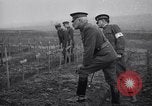
General Pershing visits cemetery; Australian, British and New Zealand troops in a wrecked French town during World War I.
Opening few seconds show American General John J. Pershing viewing a grave marker at a fresh cemetery in France during World War I. Next scene shows Australian troops dig trenches in France during World War 1. Australian troops at a destroyed railroad yard. Group of French men and women and children civilians pose for the camera, while British troops stand in background. Close up of an old French woman. The elderly French woman is talking and appears to be expressing thanks to the Allied troops and potentially grief from the devastation of the war. Soldiers on foot pass by a bomb wrecked French town with buildings reduced to piles of rubble from shelling. British troops and supplies on horse carts pass by the streets of the demolished town. British lancer cavalry regiment passes by on horseback, with lances raised. New Zealand soldiers march on railroad tracks to board a train.
Harry S. Truman, president of Old Trails Association, is honored at site of Madonna of the Trail statue in Lexington, Missouri.
Dignitaries and people gather at the NSDAR Memorial to the Pioneer Mothers of the Covered Wagon Days in Lexington, Missouri. The memorial (one of 12 identical ones) was established by the National Society of the Daughters of the American Revolution (DAR), and created by sculptor August Leimbach. Harry S. Truman, then Missouri's director for the Federal Re-Employment program (part of the Civil Works Administration), and President of the Old Trails Association, speaks to Mrs. John Trigg Moss, Chairman of the National Old Trails Committee. Mrs. Moss, in 1927, had designed the memorial that was sculpted by Leimbach, and dedicated in 1928. View of "Madonna of the Trail" inscribed on the main statue. Harry S. Truman, who later in 1934 was elected Senator of Missouri, holds up two miniature bookend models of the statue, which are being given to him as a gift for serving as President of the Old Trails Association. (Truman had also delivered the keynote address at the statue unveiling 6 years earlier). View from behind the statue with the Lexington Bridge, a seven-span truss bridge on Route 13, crossing over the Missouri River.