


 Francais
 Deutsch
 Italiano
Refine Your Search
John-F.-Kennedy stock footage and images
- Showing 2431 to 2436 of 3759 results more
more Hide
Hide
Various "firsts" in U.S. aviation history from 1918 through 1924; early history of flight and vintage flight scenes
Shows several aviation "firsts" accomplished by U.S. Army Air Service aviators in the period from 1918 through 1924. A close formation of biplanes in flight. President and Mrs. Woodrow Wilson chat with Major Fleet, Officer in charge, on the occasion of the first air mail flight, inaugurated on May 15,1918 between Washington DC and New York.The mail is loaded into the Curtis JN-4 aircraft. Pilot in the cockpit. The aircraft takes off and in flight. Air Service. Mention of aviators helping spot forest fires. Smoke rising from forest fires and mountain ranges. In 1920, U.S. Army Captain St. Clair Streett is seen with some of his Squadron who flew four De Havilland DH-4 aircraft 9,000 miles, from New York City to Nome, Alaska. Two of the men play with pet dogs. Their itinerary is painted on the side of one of the aircraft, along with the names of pilot and mechanic (C.E. Crumline and J.E. Long). In 1923 the first non stop coast-to-coast flight was made in the Fokker T-2 aircraft. . A sign on the aircraft reads 'Army Air Service non stop coast to coast'.First Lieutenants Oakley O.Kelly and John A. Macready board the aircraft, at Roosevelt Field, Long Island, New York, on May 2, 1923. Their Fokker T-2 in flight. Their arrival at Rockwell Field, on Coronado Island (San Diego) California. In 1924, Lt. Russell Maughan is seen boarding his P-1 Hawk airplane at Mitchel Field, on Long Island, New York, and taking off , bound for Crissy Field at the Presidio, San Francisco, California. His goal is the first dawn-to-dusk, coast-to-coast flight. Views of his P-1 Hawk airplane flying over Manhattan, New York City.
The start and the finish of the U.S. Army Air Service Pan American Goodwill tour in 1926-1927
Glimpses of airplanes and crews that made the Pan American Goodwill flight that covered 22,000 miles to 21 Central and South American nations, in 1926. Aerial view of hangars and runway at kelly Air Base, Texas, as one of the five Loening OA-1 Amphibious aircraft takes off from the runway on Dec. 21, 1926.The five aircraft seen in flight over a city, are: The New York, with crew: Maj. Herbert Dargue and Lt. Ennis Whitehead; The San Antonio with crew: Capt. Arthur McDaniel and Lt. Charles Robinson; The San Francisco with crew: Capt. Ira Eaker and Lt. Muir Fairchild; The Detroit, with crew: Capt. Clinton Woolsey and Lt. John Benton; and The St. Louis, with crew: Lt. Bernard Thompson and Lt. Leonard Weddington. President Coolidge presenting the pilots with with citations for the Distinguished Flying Cross at Bolling Field, Washington, D.C., on May 2, 1927, at the opening of the Pan American Air Commission Conference.
A review of U.S. efforts, Post World War II, to place atomic weapons under international control.
Film opens showing logo of the U.S. Arms Control and Disarmament Agency. Glimpse of several U.S. warships, ostensibly disarmed after World War II, berthed together. View on deck of one, from under triple guns. Aircraft being destroyed in explosions after the war. A troop transport ship returning American servicemen back home at the end of World War 2. Views of the deck jammed with servicemen waving to loved ones who are waving back to them from a dock. Bernard Baruch giving a speech at the first session of the United Nations Atomic Energy Commission, at Hunter College, New York In presenting a proposal for International control over the spread and development of nuclear weapons and technology, He begins: "We are here to make a choice between the quick and the dead." (The proposal was rejected by the Soviet Union.) View of the United Nations building in Manhattan, New York City. Delegates at a UN session in the building. Boys and girls in a typical U.S. school class room. Younger children being weighed and measured in school. The teacher smiling and watching as happy children leave the school building at the end of school day. Another view, from across the East River, of the UN building in New York, with other Manhattan skyscrapers and buildings behind it on a sunny day. Flags of the United Nations on display outside the UN building. Views of the U.S. Capitol building in Washington, DC. President Lyndon Johnson addressing a joint session of Congress on November 27, 1963. Behind him are seated President pro tempore of the U.S. Senate, Carl Hayden, and Speaker of the United States House of Representatives, John William McCormack. A submarine traveling on the surface of the water. An American B-52 Strategic bomber in flight. An American Atlas ICBM descending into a launch silo slowly. View of the missile as it goes down into silo and as silo cover slowly moves into place to cover nuclear missile. A sunset view over ocean water.

Wedding of Duke of Kent at York Minster in City of York, England.
The wedding of Prince Edward, the Duke of Kent, and Katharine Worlsey at the York Minster (Deangate, York YO1 7HH, United Kingdom). A crowd waits for the royal dignitaries during the wedding of Prince Edward, Duke of Kent, in the City of York. A man distributes British flags. Douglas Fairbanks Jr. and Noel Coward arrive to attend the royal wedding. Queen Elizabeth II, Prince Philip, and young Prince Charles arrive at the cathedral. The bride, Katharine Worlsey, walks down the aisle in a wedding dress of white gossamer silk gauze designed by John Cavanagh. Katharine Worlsey is wearing the Kent Diamond and Pearl Fringe Tiara, securing her veil. Katharine Worlsey is escorted by her father, Col. Sir William Arthington Worsley of Hovingham. The Queen mother talks with the Queen of Spain, Victoria Eugenie of Battenberg. Princess Margaret and her husband sit in the cathedral, both watching the bride’s entrance. The wedding ceremony was performed by the Archbishop of York Michael Ramsey. Wedding rites proceed. Prince Edward and Katharine Worlsey walk out of the aisle together.
Mobility and advanced weaponry in battlefield drills in Fort Bragg, North Carolina.
Soldiers of the 1st ABG, 187th Infantry Regiment 82nd ABN in battle drills during the Cold War. U.S. Army soldiers leave foxhole and run to XM-28 Davy Crockett gun to prepare it for firing. They return to foxhole. Davy Crockett gun is fired, delivering a conventional munition. Explosion is seen in the distance. (The M-28 is a tactical nuclear recoilless smoothbore gun for firing the M388 nuclear projectile). Jeep towing Little John Missile.
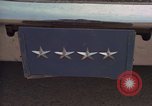
Major General Joseph J Nazzaro and part of his staff enter and leave several shops at U-Tapao Air Base in Thailand.
Four star ID plate on car and placard inside car with names of General Joseph J Nazzaro and Major General Crumm. A two star ID plate on another car with names of Major General John S Samuel and Major General Kenneth E Pletcher on the windshield. Major General Nazzaro and part of his staff entering and leaving several shops on the flight line.
CRITICALPAST.COM: About Us | Contact Us | FAQs - How to Order | License Agreement | My Account | My Lightboxes | Shopping Cart | Advanced Search | Featured Collections | Website Terms & Conditions | Privacy Policy ©2026 CriticalPast LLC.
License Agreement |
Terms & Conditions |
Privacy Policy
©2026 CriticalPast LLC.