


 Francais
 Deutsch
 Italiano
Refine Your Search
John-F.-Kennedy stock footage and images
- Showing 2815 to 2820 of 3759 results more
more Hide
Hide
Don Budge, Gene Mako, Frank "Frankie" Andrew Parker pose in New York City holding the Davis Cup
Professional tennis players return to New York after winning the Davis Cup. American tennis players John Donald Budge (Don Budge), Gene Mako, Frank "Frankie"' Andrew Parker and other players pose holding the Davis Cup. Buildings in the background. A close up of Gene Mako, Frankie Andrew Parker, and Don Budge aboard a ship in New York Harbor.
Albert Lebrun and William Christian Bullitt attend the dedication ceremony of the American Memorial in Montfaucon, France.
The American Memorial dedicated by U.S. Army General John J. Pershing for the American troops participating in the Meuse-Argonne offensive in Montfaucon, France. People crowd during the dedication ceremony. U.S. soldiers parade holding guns. The American Memorial and the flag of France in the background. President of France Albert Lebrun and U.S. Ambassador to France William Christian Bullitt, Jr. attend the ceremony. Pershing standing with French Generals. The American Memorial in the center and the flag of the U.S. and France on either side of the memorial. People crowd around the memorial.
Allied military leaders meet at headquarters of Ninth Army's XVI Corps headquarters during World War II
A U.S. Army staff car displaying a bumper plate with three stars, arrives at a building in Nieuwkerk, Netherlands, being used as headquarters of the U.S. Ninth Army's XVI Corps. Military policemen guard the entrance. Occupants step from the car. Next, Ninth Army Commander, Lieutenant General William H. Simpson, is seen standing in front of the building, with XVI Corps Commander, Major General John B. Anderson (momentarily hatless). In next scene both generals pose (Anderson now wearing his steel helmet). As the two converse, a British staff car drives up. The two American generals salute, as British Field Marshal Bernard L. Montgomery steps from the car. Next, Montgomery stands in the street, removing his overcoat (with a little difficulty), as he chats with the two U.S. generals. A military photographer, in the background, takes pictures. The three leaders continue their conversations on the sidewalk in front of the building. Closeup of Marshal Montgomery speaking as two army photographers are seen, along with some town dwellings, in the background.

U.S. Olympic team arrive in Los Angeles, United States after the Olympic games in Melbourne, Australia.
America's Olympic contenders return in Los Angeles, United States from the Olympic games at Melbourne. The America's Olympic team members climb down a ladder. American weightlifters Paul Anderson carrying Charles Vincci on his shoulders climbs down the ladder. A close up of American Oarsman John B. Kelly. Basketball player Bill Russell. A close up of Anderson waving. All the players including Anderson seated together. American athletes Glenn Davis and Greg Bell stand together. Olympic athletes Bob Richards, Charles Dumas and Tom Courtney stand together. Parry O' Brein meets his family members.
The Canadian Army returns back after military exercise Operation Muskox in Edmonton, Alberta, Canada.
Operation Muskox in Edmonton, Alberta, Canada. Canadian Army men and vehicles during Operation Muskox, the largest military exercise in the Canadian Arctic. Men and military snow mobiles on a snow covered area. A man wearing winter gear on a snowmobile. A dog in the driving, wind-blown snow. The 4 and 1/2 ton snowmobiles are covered with snow. Tents in the background. A man inside a snow mobile which serves for transportation and as a home, a office and a headquarters. The man reading a newspaper and drinking from a cup. A man having a haircut. The snow mobiles moving in the snow. One of them pulling a trailer. The vehicles and the men move along a road during their return journey after traveling 3200 miles in the expedition. Two men standing beside a vehicle enjoying a bottled drink, possibly beer. Army men atop the vehicles are greeted by a large crowd in Edmonton. View of downtown Edmonton street. The Operation Muskox treaded snowmobiles moving along the city street. People gathered on the sides of a road. John C. Bowen, Lieutenant Governor of Alberta, shaking hands with Lieutenant Colonel Patrick Douglas Baird, who led the Canadian Army in the Cold War expedition. Other officers standing behind them.
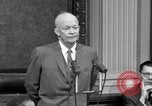
U.S. President Dwight Eisenhower answers queries of newsmen during his 130th press conference in Washington DC, U.S.
U.S. President Dwight Eisenhower during his 130th press conference in Washington DC, United States. Donald J. Gonzales, a newsman, says that when the President said he was unaware of the possibility of a Soviet statement on ending nuclear weapon tests, the U.S. Secretary of State John Foster Dulles said just on the previous day that this has been discussed in the previous days. The pressman asks the President for his reaction to the Soviet announcement. The President replies that he did not say that he was unaware of anything about it but did not have any proof that it was going to occur. He says that he cannot say anything more than what the Secretary said after complete discussions. The President further says that they had discussed this as a possibility on their own side, that is unilateral abandonment of tests and decided that it was not good for the United States at that time. Pressmen seated during the conference. Another pressman, Henry N. Taylor, gets up and puts forward a query to the President. He asks that last week the President had told them that he was convinced any nuclear test could be detected if there was a test ban. Yet the President, in the response to Russia, says test bans could be evaded in secrecy. The pressman asks the President if he could clear it. President Eisenhower says that the U.S. Secretary of State Dulles might have said that they are not certain there have not been tests, particularly underground tests or so small and in remote regions where there would not be debris and instruments would not be sensitive enough to pick them up. The President says he does not believe that explosions can happen in huge megaton character and not have evidence of it. Cameramen taking pictures. The President shakes hands with the officials and meets the pressmen.
CRITICALPAST.COM: About Us | Contact Us | FAQs - How to Order | License Agreement | My Account | My Lightboxes | Shopping Cart | Advanced Search | Featured Collections | Website Terms & Conditions | Privacy Policy ©2026 CriticalPast LLC.
License Agreement |
Terms & Conditions |
Privacy Policy
©2026 CriticalPast LLC.