


 Francais
 Deutsch
 Italiano
Refine Your Search
John-F.-Kennedy stock footage and images
- Showing 2851 to 2856 of 3759 results more
more Hide
Hide
Hall of Heroes in the Pentagon and Medal of Honor recipients from World War I
The U.S. Medal of Honor and World War 1. A flurry of Newspapers covering Election of Woodrow Wilson; the assassination of Archduke Ferdinand; German troops on the march; the sinking of the Lusitania by a German submarine; and outbreak of a World War. Film reenactments of armed soldiers marching quietly through a town in the evening; soldiers in trenches of No-mans-land; an American soldier in a trench during enemy shelling; German soldiers firing machine guns; American troops charging through obstacles and smoke; and hunkered down in a deep trench. Scene shifts to the Hall of Heroes in the Pentagon, Arlington, Virginia, where names of 95 Medal of Honor recipients from World War 1 is highlighted. John Charles Daly mentions several of these heroes, and points to the name of Alvin C. York, who as a Corporal,acting alone, brought in 132 prisoners during that war.
Color scenes of WWII including Pearl Harbor, D-Day, and Pacific campaign.
Montage of scenes dealing with Japanese attack on Pearl Harbor in World War 2. Bombs exploding and ships on fire; Japanese airplane diving from formation; a jeep driving past a burning airplane; hangars burning; Sailors firing anti-aircraft guns from an American ship; A New Orleans class American Cruiser firing her 8-inch guns; A South Dakota Class battleship firing her 16-inch guns; Group of American M3 Stuart light tanks in a field; U.S. Aviation Cadets marching between rows of Boeing Stearman Model 75 training biplanes; American soldiers marching in huge formations; Paratroopers in training jumps from towers; U.S. soldiers climbing down netting on side of troop transport ships to board small landing ships in the Pacific.; Marines in a landing craft carrying a large American flag; Landing craft in an amphious assault; Troops coming ashore from a Higgins boat, during training; An amphibious invasion task force at dusk; Troops wading ashore during the invasion of France in World War II, with barrage balloons aloft and support ships offshore. Staged scene of soldier on transport ship using flash light to read letter from home. Capital warships firing heavy guns and soldiers descending rope nets to enter landing craft. Soldiers landing on shore from Higgins Boats during training, and then on the shores of Normandy during the D-day invasion. American tank crew on an M26 Pershing tank. Major General George Patton with 1st Armored Division patch on his uniform sleeve. General George Marshall. General Dwight D. Eisenhower decorating an officer. Lieutenant General Henry (Hap) Arnold. Paratroopers jumping en masse from C-47 transport planes. German forces retreating in trucks along a road. Japanese General Yoshijirō Umezu, Chief of the Army General Staff, signing Surrender document aboard the USS Missouri, ending World War II, in the pacific. Glimpse of troop ship arriving in a U.S. harbor. View of U.S. military cemetery. Scene shifts to John Charles Daly, speaking in front of wall with names of Medal of Honor recipients, in the Hall of Heroes at the Pentagon, Arlington, Virginia, in 1968.
Medal of Honor recipients listed in Hall of Heroes at the Pentagon. New names added in Vietnam War
John Charles Daly stands in the Hall of Heroes, at the Pentagon, Arlington, Virginia, U.S.A. Behind him is a display containing names of the American military recipients of the Medal of Honor. He points to a section of a display listing 131 names added during the Korean War. He then moves to the latest section of the display, covering the period 1964 and subsequent, in the Vietnam War. At this point, the film begins to depict scenes from the Vietnam conflict. An American soldier holding a rifle is silhouetted against a light sky background. U.S. soldiers firing M-16 rifles. shadow cast by a Bell UH-1 Iroquois (Huey) helicopter flying overhead. Soldier firing machine gun from M113 armored personnel carrier (APC). U.S. gun crews firing 105mm howitzer; 175mm self-propelled gun; M107 Howitzer; and battery of howitzers in the field. Army troops inside a helicopter. View from below of CH-47 helicopter (Jolly Green Giant) landing and troops leaving its rear door. A patrol of American soldiers firing their weapons as they move forward. Soldiers dealing with difficult terrain. One stepping through deep mud. Infantry patrol moving and taking cover. A soldier using field radio. A UH-1 flying over palm trees. Infantry moving through jungle accompanied by M113 APC. Explosions and fire. Soldiers boarding a Huey helicopter, as the ship's gunner delivers covering fire by machine gun. Soldiers having a smoke while airborne in the helicopter.
Medal of Honor display in Hall of Heroes at the Pentagon, Arlington, Virginia, United States
John Charles Daly stands in the Hall of Heroes, at the Pentagon, in front of large replicas of the Medals of Honor. He extols the courage of Medal of Honor recipients whose names appear on the wall behind him. Camera backs away, revealing the three types of medals flanked by American flags and with the words: "Hall of Heroes," displayed above them. Camera retreats down the hall away from the display to a fade out.
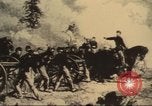
Union soldiers print the first issue of Stars and Stripes newspaper during the Civil War in the United States.
The history of the Stars and Stripes newspaper. Union soldiers print the first issue of Star and Stripes newspaper in a captured press in the U.S. on 9th November,1861 during the Civil War. World War I scenes show soldiers disembarking from a ship and advancing on a battlefield. Commanding Chief of the American Expeditionary Force John J. Pershing writes for the newspaper. Soldiers greet the Chief and wish him luck. After the end of World War I newspaper publication is ceased. During World War II the newspaper publication starts in London, England in 1942. Publication of the Pacific Stars and Stripes newspaper after the end of hostilities in Europe. Headlines in various editions of the Stars and Stripes.
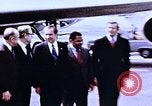
U.S. President Richard Nixon tours the proposed Gateway National Recreation Area in New York and New Jersey
Presidential tour of proposed Gateway National Recreation Area in New York and New Jersey. U.S. President Richard M. Nixon, standing in front of the Presidential Aircraft at Newark Airport, Newark, New Jersey, with Governor William Thomas Cahill, of New Jersey, Governor Nelson Rockefeller, of New York, Mayor Kenneth Allen Gibson, of Newark, and Mayor John Lindsay, of New York City. The President's helicopter maneuvering over the proposed Gateway National Recreation Area. President Nixon speaking about the project in Hangar 14 at Newark Airport, Newark, N.J. Seated on the stage are: Governor Cahill, Secretary of Interior, Rogers C.B. Morton, Governor Rockefeller, Mayor Gibson, and Mayor Lindsay. The President shakes hands with the Governors and Mayors after concluding his remarks.
CRITICALPAST.COM: About Us | Contact Us | FAQs - How to Order | License Agreement | My Account | My Lightboxes | Shopping Cart | Advanced Search | Featured Collections | Website Terms & Conditions | Privacy Policy ©2026 CriticalPast LLC.
License Agreement |
Terms & Conditions |
Privacy Policy
©2026 CriticalPast LLC.