


 Francais
 Deutsch
 Italiano
Refine Your Search
John-F.-Kennedy stock footage and images
- Showing 2965 to 2970 of 3759 results more
more Hide
Hide
Henry Ford cooks waffles and wipes utensils during a camp in Maryland, United States
Henry Ford founder of Ford Motor company and others camp in Maryland, United States. Henry Ford and others crank on a Ford motor car. He cooks waffles supervised by Chef Fisher. Bishop William F. Anderson stands and observes him. Thomas Alva Edison, an American inventor comes and eats a waffle offered to him by Henry Ford. Thomas Alva Edison and Bishop William F. Anderson talk and laugh. Henry Ford with others as they wipe the utensils.
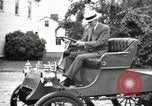
Henry Ford in an old 1903 Ford Model A car, and several old cars lined up in a row and being driven in Detroit, Michigan.
Henry Ford in Ford motor cars in Detroit, Michigan. Henry Ford, founder of the Ford motor company, seated in a 1903 Ford Model A car (a 1903-1904 model). Ford Model T car parked beside a Model A car. Views of several old cars lined up in a row and being driven, including a 1905 Ford four seater "Model F" and a 2 seater Model F. Ford model A car at the end of the line. Building and trees in the background.
U.S.and Soviet efforts at disarmament during Reagan-Gorbachev era
Film opens with U.S.President Ronald Reagan commenting about mistrust between America and the Soviet Union. View of President Ronald Reagan and Soviet General Secretary Mikhail Gorbachev signing the arms control agreement banning the use of intermediate-range nuclear missiles, at the White House in Washington, DC on December 8, 1987. A Soviet RT-2PM Topol mobile ICBM moving on its carrier vehicle. A U.S. intermediate range missile being launched. Another view of U.S.President Reagan and Soviet General Secretary signing the Intermediate-Range Nuclear Forces Treaty (INF Treaty) on December 8, 1987, to become effective on June 1, 1988. Views of ICBMs being test launched from silos. A Soviet Tupolev Tu-95 strategic bomber in flight, seen from the side and from underneath. A U.S. Navy heavy cruiser, armed with cruise missiles. Closeup of a cruise missile rising from the ship and firing across it toward a target. Illustration of a seaborne missile fired from a warship. General Secretary Gorbachev in a group, including his wife, Raisa, visiting a Soviet Navy submarine. Major General William F. Burns, Head of the Arms Control and Disarmament Agency (in civilian clothes), is seen raising doubt about the feasibility of the Soviet suggestion to use scientific methods for checking from a distance about arms control compliance. Artist conception of satellites being shot down in space. Secretary of State, George Schultz and his wife, Helena Maria, descending steps from an airplane upon landing at Moscow, in the Soviet Union to confer with Soviet leaders in Moscow on Nov. 4, 1985, in preparations for the meeting between President Reagan and Mikhail S. Gorbachev, the Soviet leader, later in the month in Geneva, on November 19th and 20th. Negotiating teams assembling in a meeting room in Moscow. Secretary Schultz and Soviet Foreign Minister, Eduard A. Shevardnadze conversing. William F. Burns, saying, " I think we are well on the road to achieving a useful, good, and balanced treaty." Views of civilians killed by chemical weapons in the Iran-Iraq war. Soldiers in protective gear associated with chemical weapons. One soldier decontaminating a tank using a water hose. Tanks moving in Europe. U.S. troops firing an antiaircraft gun. Scenes of World War II showing conventional arms being used on tanks and from landing craft. Afghan fighters carrying a wounded comrade. Glimpse of soldiers in a trench firing a mortar and one firing a machine gun, during the Iran-Iraq war. An armored personnel carrier moving across a muddy field. More views of Reagan and Gorbachev signing the INF treaty in 1987. A U.S. spokesman noting that the USSR has not changed the offensive nature of its force structure and deployment patterns.
Drogue Chute landing tests at Eglin Air Force Base in Okaloosa County, Florida
Tests of aircraft for Strategic Air Command Escape and Evasion mission, conducted at Eglin Air Force Base in Okaloosa County, Florida. A C-47F aircraft performs maximum perfornance landing employing a drogue chute to aid in stopping. Several views of the C-47F landing in rough terrain, trailing drogue parachute behind. As the plane lands, the parachute opens up and plane comes to an abrupt halt using reversed propellers and brakes as well.
Planes of the 18th Fighter Bomb Wing of the U.S. Air Force refueled in Korea.
F-51 aircraft of the USAF 18th Fighter Bomber Wing, being refueled at Chinhae Base (K-10) in Korea. . A partially completed aircraft hangar. A soldier stands near it. Gasoline trucks being driven out of the hangar. The sign on the hangar reads 'Refueling, We fuel them, You fly them'. Several F-51s from 2 Squadron of the South African Air Force (SAAF), attached to the 18th Wing, being refueled. They display their logo, a winged tiger, and motto, "Sursum Prorsusque." (Upward and Onward). Close view of the hose of gasoline truck as it unwinds. Meter in operation. An airman refuels one of the P-51s. Pilot in the cockpit.Smoke comes out of the nose section as the aircraft start engines. (Korean War)
U.S. Army's 'Round the World Flight in 1924, using Douglas World Cruiser aircraft
Documentary about the U.S. Army's flight around the world in 1924, employing four Douglas World Cruiser aircraft. A flag of United States. Crowds gather around around. the four Douglas World Cruisers, named Boston, Chicago, New Orleans, and Seattle, as they prepare to depart from Seattle, Washington, on their expedition. One of the aircraft taking off. All the aircraft in flight over Seattle Washington. Major Frederick F. Martin Commander of the flight. An animated map shows the aerial expedition's route and locations of various accidents and incidents that beset them along the way. View of one Douglas World Cruiser in flight, equipped with floats. The expedition was completed by the Cruiser,Chicago, crewed by pilot, Lt. Lowell Smith and Lt. Leslie Arnold; and by the New Orleans, crewed by pilot, Lt. Erik Nelson and Lt. Jack Harding, who are seen being congratulated by expedition Commander, Major Frederick F. Martin upon their completion of the mission in Seattle, on September 28, 1924.
CRITICALPAST.COM: About Us | Contact Us | FAQs - How to Order | License Agreement | My Account | My Lightboxes | Shopping Cart | Advanced Search | Featured Collections | Website Terms & Conditions | Privacy Policy ©2026 CriticalPast LLC.
License Agreement |
Terms & Conditions |
Privacy Policy
©2026 CriticalPast LLC.