


 Francais
 Deutsch
 Italiano
Refine Your Search
John-F.-Kennedy stock footage and images
- Showing 3061 to 3066 of 3759 results more
more Hide
Hide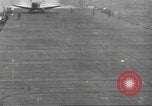
USS Enterprise under attack by Japanese airplanes during the Battle of Santa Cruz in World War II
U.S. Naval fleet underway in the Pacific Ocean during the Battle of Santa Cruz Island of World War 2. Aft section of the flight deck aboard the USS Enterprise (CV-6). The ship is under attack by Japanese airplanes and men take cover. Smoke arising from a Japanese bomb strike obscures the scene. The smoke engulfs the flight deck with stranded U.S. Navy SBD Dauntless near the stern. Sailors on the Enterprise firing 5 inches guns. An explosion rocks the ship and the SBD airplane at the stern falls into nearby gun sponson. Several men are in prone positions on the stern of the flight deck. One lone sailor runs forward, the length of the flight deck. Personnel running with fire hoses. SBDs and U.S. Navy F4F Wildcat parked on the flight deck. Anti-aircraft cruiser USS San Juan and battleship USS South Dakota are visible steaming along Enterprise's port side.
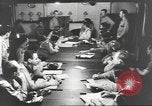
U.S. Navy personnel fire AA guns and USS Lexington (CV-2) underway and hit during Battle of Coral Sea
Activities of U.S. Navy personnel underway in the Pacific Ocean on U.S. Navy aircraft carriers during World War II. Officers seated at a conference table discuss plans as one officer writes on chalk board. An aircraft carrier underway in the Pacific. This is likely the USS Lexington (CV-2) or the USS Saratoga (CV-3). Sailors gather near an aircraft parked on the flight deck. Sailors working in the radio room of a U.S. Navy aircraft carrier. U.S. Navy and Japanese enemy aircraft flying overhead during the Battle of the Coral Sea. A smoking ship in the distance following attack. A sailor watching the enemy aircraft through binoculars. Huge splash in water behind U.S. Navy ship during attack. Sailors firing anti aircraft guns from the ship. Flak bursting in the sky. Pilots in cockpit of a U.S. Navy Douglas SBD Dauntless on flight deck. U.S. Navy F4F-3 aircraft (Grumman Wildcat) parked on the flight deck of a carrier. Explosion followed by smoke billowing upward as the USS Lexington (CV-2) is hit by torpedoes from Japanese torpedo bomber aircraft. USS Lexington is seen listing to port, smoking, and on fire. (Audio narration present only on a brief part of clip.)
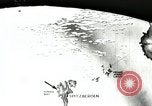
Film shot by Lieutenant Commander Richard Byrd, while circling over the North Pole, with pilot Floyd Bennett, in their Fokker tri-motor airplane.
Byrd arctic expedition to fly an airplane over the North Pole, in 1926. Animated map illustrates the planned Northward course of Lieutenant Commander Richard Byrd and pilot Floyd Bennett, headed to the North Pole, in their Fokker tri-motor airplane. The starting point is Kings Bay, Spitsbergen, Norway, where they took off on May 9, 1926. A slate states that, "Byrd circles the Pole, checking observations and photographing." Scene shifts to images being recorded by Byrd from inside their Fokker F-VII Tri-motor airplane, the "Josephine Ford." One shows the big "F" in the name "Fokker" on underside of the right wing. From there, the camera pans back over the frozen wasteland below, with parts of the aircraft also seen. Another shot shows the aircraft tail (empennage) with mountains in background amidst snow-filled valleys while the airplane is in a gentle right-hand turn. Underside of engine is seen with arctic scenery, passing below.
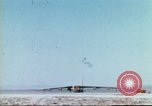
First unpowered drop flight of X-15 aircraft, piloted by Scott Crossfield at Edwards Air Force Base in California.
U.S. Air Force X-15A aircraft first unpowered drop flight and landing in California, United States on June 8, 1959. United States Air Force Boeing NB-52A aircraft with X-15 under its wing, taxis and takes off from Edwards Air Force Base, California. American X-15 aircraft in captive-carry position, mated to pylon under wing of Boeing NB-52A aircraft. The aircraft taxis and takes off from the runway. Chase planes U.S. Air Force F-104A flies along NB-52A aircraft. X-15 releases from NB-52A aircraft in mid flight. Radar dish antenna records course of the flight. Pilot seated in the cockpit of F-104A aircraft. Technicians look at plotting boards and flight monitors. Pilot Albert Scott Crossfield converses with ground crew members. X-15 piloted by Crossfield lands at Rogers Dry Lake in California.
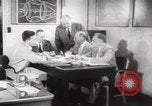
General Electric producing the first American jet airplane engine. Bell Aircraft building first U.S. jet powered airplane.
General Electric Company engineers work on designs for America's first jet aircraft engine during World War 2. In the company's plant, at Lynn, Massachusetts, machinists make parts for the engine and others assemble it. Company executives conversing about the enterprise. On April 18, 1942, the first engine produced is rolled into a test cell for operational testing. Engineers pull down the door to the test cell displaying the words: "Fort Knox." Engineers at control panel of the test cell. View into the test cell. GE Project manager, Donald F. Warner, actuates toggle switch to "on" position, and the engine ignites. Flame seen in rear of the engine. Complete change of location. View of Bell Aircraft company buildings. Bell engineers working on design of an airplane designated, XP-59A (Airacomet) to be powered by the new General Electric jet engine (later designated J-31 by the military). Views of the Bell engineering and production activities at secret facilities in Buffalo, New York. Two Bell workers expressing reservations about airplanes without propellers. A main intersection street scene in Schenectady, New York. Pedestrians walking and shopping. An F.W. Woolworth store on the corner. Copy of the Schenectady Gazette Newspaper, with headline about 500 planes raiding Berlin. A man buying a copy of the paper.
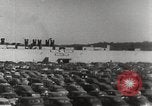
The new (circa 1951) GE jet engine plant at Lockland, Ohio. Engines being assembled. Various aircraft using GE engines
Views of the new (1951) GE jet engine assembly plant at Lockland Ohio. Animated description and U.S. map showing numerous suppliers across the country that contribute parts for the jet engines assembled at the GE Lockland plant.Views inside the plant, with engines being assembled. GE staff members, including chief engineer, Donald F. Warner, are seen in the plant. Various U.S. jet warplanes taking off, including: Hughes XF-91; North American F-86D Sabrejet ; Martin XB-51; North American B-45 Tornado; Boeing B-47 Stratojet bomber; and Convair B-36.
CRITICALPAST.COM: About Us | Contact Us | FAQs - How to Order | License Agreement | My Account | My Lightboxes | Shopping Cart | Advanced Search | Featured Collections | Website Terms & Conditions | Privacy Policy ©2026 CriticalPast LLC.
License Agreement |
Terms & Conditions |
Privacy Policy
©2026 CriticalPast LLC.