


 Francais
 Deutsch
 Italiano
Refine Your Search
John-F.-Kennedy stock footage and images
- Showing 307 to 312 of 3762 results more
more Hide
HideColor Sound
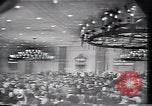
President Kennedy accepts mementos and leaves after his Chamber of Commerce breakfast speech in Fort Worth, Texas.
United States President John F Kennedy's Chamber of Commerce breakfast speech at Hotel Texas (815 Main St, Fort Worth, TX 76102) in Fort Worth, Texas. A crowd seated in the Crystal Ballroom. President Kennedy and First Lady Jacqueline Kennedy seated on the stage. The couple stands to greet the crowd after President Kennedy's speech has concluded. Attendees applaud. A COC member presents a Texan cowboy hat and a memento to the President and First Lady. He and the First Lady accept the mementos and thank the COC. The presenter invites a member of the clergy to deliver a closing prayer. He addresses the attendees. President Kennedy praying with his head bowed. President Kennedy greets the preacher. The President and the First Lady greet the dignitaries as they bid them farewell and leave the stage. These events took place on the morning of President Kennedy's assassination.
President Kennedy's casket lies in state in the U.S. Capitol and is carried to St. Matthew's Cathedral for Pontifical Funeral Mass.
Funeral services for former U.S. President John F. Kennedy in Washington DC. A horse-drawn caisson with President Kennedy's flag-draped casket moves along Pennsylvania Avenue and heads for the U.S. Capitol (First St SE, Washington, DC 20004, United States). United States President Lyndon Johnson, former President Kennedy's wife Jacqueline Kennedy and his brother Robert Kennedy get off a car outside the Capitol. President Kennedy's casket lies in state in the Capitol Rotunda. President Johnson places a wreath in front of the casket. Jacqueline Kennedy moves towards the casket along with her daughter Caroline. Thousands lined up outside the Capitol to view the casket. People cry in the Rotunda of Capitol. The cortège to Saint Matthew's Cathedral (1725 Rhode Island Ave NW, Washington, DC 20036, United States) shows dignitaries and leaders from all over the world walking along a road. The casket is carried by pallbearers into the cathedral for a Pontifical Funeral Mass followed by dignitaries. Priests conduct the ceremonies in the cathedral. Richard Cardinal Cushing conducts the Pontifical Requiem Mass. The casket is carried back to the caisson by the pallbearers.
President Kennedy raises his glass for a toast, thanking citizens for wine in Wiesbaden, Germany
United States President John F. Kennedy attends a function during his official visit in Wiesbaden, Germany. Dignitaries gather and clap as President Kennedy, West German Defense Minister Kai-Uwe von Hassel and their entourage arrive at the grand ballroom of the Kurhaus (Kurhauspl. 1, 65189 Wiesbaden, Germany). President Kennedy raises his glass for a toast surrounded by crowd. President Kennedy and the crowd drink wine. President Kennedy gives a speech, thanking the citizens of Hesse for wine and a keg of brandy given to him as a birthday gift. Crowds of attendees clapping their hands as President Kennedy speaks and drink. Attendees talk and mingle at the function. United States and German officials talk to President Kennedy.
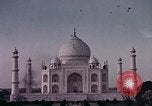
Jacqueline Kennedy visits various places in India and Pakistan during a tour of South Asia.
United Sates President John F. Kennedy's wife Jacqueline "Jackie" Bouvier Kennedy visits South Asia. The Taj Mahal (Dharmapuri, Forest Colony, Tajganj, Agra, Uttar Pradesh 282001, India) in Agra. Two men row a boat in the Yamuna river and Taj Mahal in the background. The Lake Place (Lake Palace Rd, Old City, Brahmpuri, Udaipur, Rajasthan 313001, India) in Udaipur. A woman washes clothes in the Lake. First Lady Jackie Kennedy visits an Indian hospital. She meets young children receiving treatment in the hospital. Traditional welcome being given to Jackie Kennedy by the people of Pakistan during a fair. Young children applaud. First Lady gets down from a cart. Military band plays music. Mrs. Kennedy seated on a podium with other people. Horse and camel perform dances at the fair. Pakistan President Ayub Khan gifts a horse to Jackie Kennedy.
An interview with Senator Abraham Ribicoff about the death of former president Kennedy
Interview with Connecticut Senator Abraham Ribicoff, who was United States Secretary of Health, Education and Welfare in the Kennedy Administration. Shortly after President Kennedy's assassination. He talks about his visit to the White House to pay last respects to former president John F. Kennedy. He speaks high of Kennedy's term in the office as the President and ensures that newly appointed President will carry forward Kennedy's philosophy and work towards a better nation. The secretary also supports the idea of passing impending legislation in the name of former president Kennedy to pay homage to him.
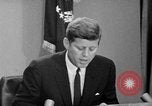
U.S. President Kennedy asks for support of citizens and business leaders to end racial discrimination in the United States
Second part of U.S. President John F. Kennedy's speech in Washington DC following events at the University of Alabama when two African American students, Vivian Malone and James Hood, attempted to enroll. United States President Kennedy seated at desk and speaks over a microphone. The President speaks about ending racial discrimination and importance of equality and civil rights in the United States. He says that it's time for the Congress to act. President Kennedy says that he will ask the Congress of the United States to act, to make a commitment it has not fully made in this century to the proposition that race has no place in the American life or law. The President talks about the necessary measures that Congress can provide. President Kennedy, in his speech, asks the Congress to enact legislation giving all Americans the right to be served the facilities which are open to the public. He talks about, and scenes are shown from his recent meeting with business leaders in the white house, together with Vice President Lyndon Johnson, as Kennedy urged them to take voluntary action to end workplace discrimination. The business leaders in a large room of the White House. The President says that he has also asked the Congress to authorize the Federal Government to participate more fully in lawsuits designed to end segregation in public education. He also speaks about giving employment to African Americans. President Kennedy, in his speech, pays tribute to those citizens of the North and South who have been working in their communities to make life better for all. The President asks for support of all the citizens so that discrimination can be removed. Many television cameras and cameramen. The President gets up from the desk and leaves.
CRITICALPAST.COM: About Us | Contact Us | FAQs - How to Order | License Agreement | My Account | My Lightboxes | Shopping Cart | Advanced Search | Featured Collections | Website Terms & Conditions | Privacy Policy ©2026 CriticalPast LLC.
License Agreement |
Terms & Conditions |
Privacy Policy
©2026 CriticalPast LLC.