


 Francais
 Deutsch
 Italiano
Refine Your Search
John-F.-Kennedy stock footage and images
- Showing 3175 to 3180 of 3759 results more
more Hide
Hide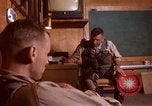
U.S. Marine Corps pilots discuss aerial tactics in office at Da Nang Airbase, Vietnam
United States Marine Corps Pilots of VMF (AW) 232 (Red Devils), conversing at an office in a trailer, at Da Nang Airbase, South Vietnam. Major B A Martin in flight suit sits at a desk. He briefs another pilot, Captain Herb Jellander. Major Martin writes on a pad. Captain Jellander smiles and converses with Major. Major Martin mark positions on blackboard, explains and then rubs it off. He returns to his desk. ( Note: In July, 1967, Major Bruce A. Martin's F-8E was hit by enemy fire and he was forced to eject. He parachuted safely and was picked up.) (Vietnam War period).
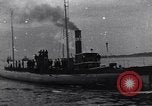
The German Merchant Submarine, Deutschland, arrives with merchant cargo in Baltimore, Maryland, during World War I.
The German merchant submarine Deutschland being assisted by the tugboat "Thomas F Timmins" into Baltimore Harbor (Maryland) on July 9, 1916. Her crew stands on deck and she flies the German flag. The Captain (Paul Koenig, sometimes spelled König, or Konig) and crew pose on shore for a photograph, behind a sign reading: Deutschland, Bremen. (Note: This commercial submarine was operated by the North German Lloyd Line. Submerging to avoid British patrols, she was able to carry valuable cargoes through the British (and other Entente Powers) WWI blockade. On this first trip to the U.S. She carried industrial dyes and gemstones. The Deutschland left Baltimore about 3 weeks later and returned safely to Bremen with with cargo of nickel, tin and rubber.)
Soldiers of the White Russian Army sit and eat amidst snowfall; French air squadron scene; Various French heavy artillery in action.
Soldiers of the Tsar's Russian Army encamped amidst heavy snowfall during World War I in Russia. Their guns are grouped and erected on ground. Soldiers line up for meal at field kitchen wagon. In Mediterranean area, military supply trucks move on road. At French airfield, officer smokes a cigarette, while standing by a Squadron flag on which is written: "F: 52". The pennant carries a War Cross decoration. Also shown is a Crescent and Star pennant with War Cross decoration. A bi-wing aircraft is visible in background and one is in a steep descent for a landing. A battery of French heavy guns fire from trenches. An artilleryman installs a fuse in a 12cm round, places it in the 12cm gun and the crew fires it. They eject the spent shell and reload and fire again. French gun crew loads and fires a Big Bertha gun. French gun crew aims a 320mm railway gun.
Some rocket motor designs of 1930s and speculation about future of rocketry
Liquid Rocket motor design drawings of various pioneers in the field, from the American Rocket Society, including: Constantin Paul van Lent (aka Constantin Tselentis,aka Constantin Lent, aka Dr. Constantin Paul van Lent) 1936; Alfred Africano, 1937; Reed,1937; Wild,1938; H.F. Pierce and Nathan Carver, 1938. Slates refer to the post World War I period through about 1938, as the beginnings of rocket flight, and the immediate subsequent period as the second phase of achievement that could lead to high altitude and long range rocket missiles and even manned spaceships. Slate suggests that future of rocketry is limited only by our imagination. Next are imaginary, science fiction scenes like a science fiction movie, showing a major city, in Germany, as a rocket ship travels away from it, and eventually showing Europe, and the earth from outer space, as the rocket travels into the blackness, beyond. Slate comments about eternal longings related to human flight.
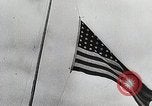
United States and Soviet soldiers meet at the Elbe River during World War II.
U.S. flag being lowered as bugler sounds and narrator alludes to the death of U.S. President Franklin D. Roosevelt, near the end of World War II. American troops and tanks rolling through German cities identified by narrator as Madeburg, Nuremberg and Leipzig, at end of World War 2 in Europe. U.S. troops cleaning out last vestiges of resistance in street fighting. Numerous German citizens lining sidewalks in city and waving white flags. On April 25, 1945, U.S. Army Second Lieutenant William Robertson with soldiers Frank Huff, James McDonnell and Paul Staub, meet Soviet Lieutenant Alexander Silvashko and several Soviet soldiers on the remnants of the Elbe bridge of Torgau. A U.S. Army Brigadier General mingling with Soviet officers. On April 26,1945, Major General Emil F. Reinhardt Commander of the U.S. 69th Infantry Division, walks with Soviet Major General Ruskovof the Soviet 58th Guards Rifle Division near Torgau. They are accompanied by other U.S. and Soviet officers. U.S. and Soviet officers exchange mutual salutes. U.S. and Soviet soldiers mingle, as a Soviet soldier plays accordian and some drink toasts, smoke cigarettes, and pose together. View of the Nazi party rally grounds in Nuremberg where a U.S. soldier is seen near the huge Swastika atop the Zeppelin Grandstand. Flashback views of Nazi rally there. Heinrich Himmler, Adolf Hitler and Viktor Lutze at the rally. Three American soldiers walking along the same walkway in the rally grounds. Explosion seen as the Nazi swastika symbol atop the Zeppelinfeld grandstand in Nuremberg is blown up by American troops.
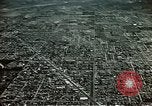
Industrial areas and structures of Los Angeles in California.
Aerial views of Los Angeles in California. The San Fernando Valley, Hollywood motion picture studios, and farms. Landmarks and trademarks: Electrical transmission towers, View of Hoover Dam and of hydroelectric power transmission facilities from Hoover Dam. Towers, factories, large scale industry, Oil Derricks, towers of gasoline and petroleum refining. An automobile assembly line engaged in production of 1950's four-door sedan cars. A worker at a tire manufacturing factory. Steel mill operations. Large steam locomotive wheels at factory. Aerial view of many oil wells and derricks near Los Angeles California. The U.S. flag near tower electrical tower. Douglas DC-6 transport Aircraft at production factory, including planes for commercial airlines such as Philippine Airlines and KLM. North American F-86 jet fighter aircraft at factory field. Workers exiting aircraft factory.
CRITICALPAST.COM: About Us | Contact Us | FAQs - How to Order | License Agreement | My Account | My Lightboxes | Shopping Cart | Advanced Search | Featured Collections | Website Terms & Conditions | Privacy Policy ©2026 CriticalPast LLC.
License Agreement |
Terms & Conditions |
Privacy Policy
©2026 CriticalPast LLC.