


 Francais
 Deutsch
 Italiano
Refine Your Search
John-F.-Kennedy stock footage and images
- Showing 3667 to 3672 of 3762 results more
more Hide
Hide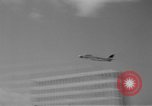
General Hood, President Batista and spectators watch aerial show as USAF planes perform in Cuba.
USAF Major General Reuben Columbus Hood Jr. visits Cuba during his goodwill tour. An USAF F-86 as it flies in low over beach, makes a climb. Spectators watch diamond-shaped formation of the Thunderbirds. The formation as it banks and completes a barrel roll. Several views of the Thunderbirds performing. General Hood and President of Cuba, Fulgencio Batista y Zaldivar. Views of the president. Views of the secret Police. American flag flying full mast, palm tree in the foreground. Several views of spectators. The Cuban flag flying full mast. Coast line of Havana, Cuba. Street scene along the beach area of Havana, Cuba.
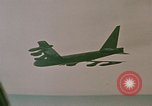
Film principally about the use of Strategic Air Command B-52 bombers supporting American ground forces during the Vietnam War.
The film begins showing an airborne B-52 bomber and then a copilot in the cockpit. View down through the bomb bay of a B-52. View from another Aircraft of a B-52 dropping numerous conventional bombs on enemy positions in Vietnam. The open bomb bay is shown again, only this time clusters of bombs are seen dropping from it. Aerial view of the ground as the many bombs strike creating a line of explosions and smoke. Closeup of a crew member wearing an oxygen mask. Another view of bombs being dropped and exploding on the ground. Bomb bay on a bomber being closed after it has finished a mission. More aerial views of bomb strikes and damage on the ground. View from cockpit of a B-52 following another that is leaving condensation trails. An Air Force officer working on the ground with mechanics. An Air Force sergeant working with a Navy technician in a headquarters. Strategic Air Command (SAC) crew members in flight suits descend from an aircraft upon arriving at an Air Force Base. An Air Force General presenting a major with some type of an award. A B-52 taxiing on an airfield. An F-104 Starfighter aircraft taxiing on an airfield. War supplies for American forces being offloaded from a ship in Vietnam. An Air Force drill team marching. A mechanic replacing a bulb on a large high outdoor light. Brief glimpse closeup of some school children. Air force personnel rescue a person from a flooded house. The Air Force drill team, seen earlier, spinning their rifles. Air Force ground crews moving a thousand pound bomb on a trolley and installing it into a B-52. View from a Boeing KC-135 Stratotanker as it refuels a B-52 in flight. View of the tanker hooked up to the B-52.
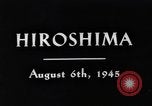
Effects of the atomic bombing of Hiroshima, Japan, in World War II, and early international efforts to control atomic weapons
Film showing city of Hiroshima, Japan, before and after the August 6, 1945 dropping of the atomic bomb over the city in World War 2. Sequence opens on what the narrator says is August 5, 1945, the day before the event (but the footage is likely from before that date). Camera pans over the city of Hiroshima before the atomic bomb destroyed the city. Japanese air raid lookouts are seen on watch for allied bombers. View of atomic bomb detonation as seen from aircraft high overhead (this is actually a view of the Nagasaki blast, not the Hiroshima blast despite narrator's comments). Next, the complete destruction of the city of Hiroshima is seen from camera at low altitude showing the four and one half square miles of the city flattened and burned. A Japanese hospital still functioning, with red cross flag on it. Hospital workers retrieving wounded victims of the bombing. Ambulatory victims clustered in doorways and halls. Shadow image of a large industrial valve wheel burned onto wall behind it. Similar image of a ladder burned onto a wall. The decorative pattern on a woman's dress burned onto skin of her back. Japanese physicians treating victims of thermal and radiation burns. Views of various victims, including some children, and their respective injuries. Scene shifts forward one year, to August 6, 1946. Children are lined up outside a school building, and then seen inside their classroom. Disfiguration and wounds on children resulting from injuries are still evident on the children at their desks. Sequence shifts again, this time to an early United Nations meeting with delegates grappling with the issue of controlling nuclear power and atomic weapons. Closeup view of American delegates, including James F. Byrnes (Secretary of State)and James B. Conant, President of Harvard University in the assembly. Closeups of representatives from South Asian nations. Closeup of USSR delegation, headed by Foreign Minister, Vyacheslav Molotov. Signs identifying delegates from Colombia, Egypt, Iraq, Bolivia, China. Final sequence shows several U.S. atomic scientists in their respective laboratories, including Enrico Fermi and Vannevar Bush. United States representative to the UN, Warren Austin, speaking about the so-called Baruch Plan, for international control of atomic weapons. (Principal author, Bernard Baruch, is standing behind speaker's left shoulder.) USSR delegation, headed by permanent representative, Andrei Gromyko, who is seen presenting the Soviet plan. View of explosion and mushroom cloud during U.S. Operation Crossroads atomic bomb test in the Pacific.
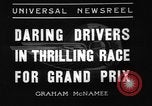
Formula One motor cars skid on slippery automobile race course; Rudolf Caracciola wins Grand Prix in Monte Carlo, Monaco.
Formula One car Grand Prix motor racing in Monte Carlo, Monaco. Motor race starts. Auto racers drive F1 motor cars on automobile race course. Spectators watch the race. Race course turns into slippery one due to rain. Motor cars collide and skids. Rudolf Caracciola wins the race. Large crowd standing around him.
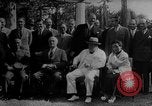
Mixture of scenes from Cairo and Teheran converences with glimpses of Soviet troops on the move and views of bombers and landing craft as well as an atomic test in the Pacific ocean.
Opening scene shows Chinese Generalissimo Chiang Kai-shek seated with U.S. President Franklin D. Roosevelt, British Prime Minister Winston Churchill, and Madam Chiang in their Cairo meeting at a residence of the American Ambassador to Egypt, Alexander Kirk, on November 25, 1943, during World War 2. Foreign ministers of the countries stand behind their leaders. Closeups of the three Country's leaders. Scene jumps to Teheran, with Soviet Leader, Joseph Stalin, President Roosevelt, and Prime Minister Winston Churchill, seated on a veranda of the Soviet Embassy. Suddenly scenes of tanks, trucks, and Soviet troops moving on the Eastern front are seen. Some of the troops move by horse-drawn sleighs through the snow. A line of U.S. Army Air Forces B-17 bombers taxiing on an airfield. View from a B-17 in flight. View f as a cluster of bombs falls from B-17 and explodes on the ground. Animated map illustrating paths of aircraft attacks against the German Atlantic Wall from England. Landing craft underway in an amphibious assault. Brief view from a ship of a post-war test atomic explosion in the Pacific ocean
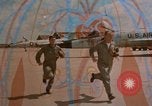
U.S. Air Force film advocating physical training and good fitness like walking, cycling, swimming and sports in the United States.
Discussion of United States Air Force (USAF) Aerobic physical fitness programs and its benefits in the United States. U.S. air force pilots scramble at air base and are seen running to their Convair F-102 Delta Dagger aircraft parked in a line. The pilots quickly enter the aircraft. Dramatization of Air Force pilot landing in jungle with parachute and evading capture due to good physical fitness condition. Off duty situations involving physical exertion: Two men pushing a stalled car. A man in front yard of house in suburban neighorhood is shoveling sand and lifting a heavy sand bag. Depiction at night of phone ringing and man wakes up and talks on phone. Cars drive on highway. An exhausted man suffering heart attack is sitting in car. Heart attack patients lying on beds in a ward of a hospital. A nurse assists a patient with recovery and therapy. Two women ride bicycles and men swim in a swimming pool for exercise. People exercise in a gym and use weight lifting equipment and exercise machines. A man running and playing tennis. Personnel doing aerobic exercises like walking, running, cycling, swimming, stationary running, playing hand ball, tennis, basketball and squash for physical fitness.
CRITICALPAST.COM: About Us | Contact Us | FAQs - How to Order | License Agreement | My Account | My Lightboxes | Shopping Cart | Advanced Search | Featured Collections | Website Terms & Conditions | Privacy Policy ©2026 CriticalPast LLC.
License Agreement |
Terms & Conditions |
Privacy Policy
©2026 CriticalPast LLC.