


 Francais
 Deutsch
 Italiano

Refine Your Search
John-F.-Kennedy stock footage and images
- Showing 3751 to 3756 of 3762 results more
 Hide
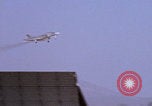
VF-124 squadron support crew engage in various talks at NAS Miramar, California
Grumman F-14 Tomcat fighter aircraft landing at the Naval Air Station Miramar (Miramar Way, San Diego, CA 92145, United States), California. A man walks past a fuel tanker. A mechanic in front of dashboard. Squadron support crew with parachutes. A man communicates from a control tower. Crew shows a new helmet to an airman. A petty officer and a woman system maintenance officer tour the survival equipment room where pilots suit up before a flight. The pilot raises his concern about a mask to crewman.

Petty officer and woman officer assist flight mechanic; technician picks up equipment
A U.S. Navy petty officer wearing a flight helmet talks to a newly hired female officer on airfield at Naval Air Station Miramar, California (Miramar Way, San Diego, CA 92145, United States). The petty officer rests his arm over a machine. A mechanic repairing on a fighter aircraft calls the petty officer for help. The petty officer turns the machine on. The female officer turns a toggle switch on at the request of the mechanic, after the petty officer appears confused by the request. Hose attached to a Grumman F-14 Tomcat fighter. Electronics technician adjusts an equipment. Technician wipes his forehead in relief. A woman in an office hands over a piece of equipment to a technician. She removes a piece of paper from the board beside her and gives it to the technician to complete the check-out form.
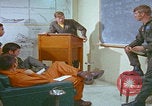
United States Navy VF-124 squadron pilots discuss test flight during a meeting
United States Navy VF-124 aircraft pilots hold a squadron briefing at NAS Miramar (Miramar Way, San Diego, California 92145, United States). Diagrams and blackboard on the walls are seen. The squadron pilots discuss the test flights with the F-14 fighter for the day. African American pilot looks at his notes during the orientation. Pilot talks behind the podium.

Crewman directs a taxiing B-57B bomber carrying bombs at Bien Hoa Air Base during the Vietnam War
United States Air Force Major Howard F. O'Neal climbing into Martin B-57B Canberra tactical bomber cockpit in Bien Hoa Air Base during the Vietnam War. Thick dark smoke ejected from sides of engines of a B-57 bomber as crewmen watch. Ordnance seen consists of 500-lb and 750-lb bombs. A crew man directs a taxiing B-57B (BA-910) bomber aircraft. The bomber makes a turn as it taxis.

Marines and M50 Ontos tank destroyers move on desert road near Fallon, Nevada
United States Marine Corps soldiers in training, during Vietnam War, sit on top of military vehicles driving on desert road in Nevada. A pair of M50 Ontos tank destroyers moving on desert road. Aerial view showing military trucks and vehicles on road in Nevada. Sign reads “Historical Marker”. View of the Sand Mountain historical marker (Nevada Historical Marker 10: Sand Mountain, 85F37HGP+3M, NV, United States) 20 miles east of Fallon, Nevada along U.S. Route 50.
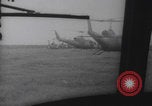
Various scenes depict Vietnamese children, soldiers in the Vietnam War, and President Johnson delivering a speech
Rear view of United States Army Bell UH-1 Iroquois “Huey” helicopters during the Vietnam War. U.S. Army helicopter pilot and soldier crew member in cockpit. South Vietnamese soldiers using a field phone. Republic F-105 Thunderchief fighter bombers in flight. Aerial bombing of Vietcong positions. An officer points to a map. Hand traces marked positions on the map. Vietnamese civilians evacuate from their homes. An injured civilian is taken on a helicopter. A Vietnamese child cries. Vietnamese children wash their hands and dries them with washcloths. A girl combs her hair. A boy lays a tablecloth and glass on the table. A girl holding a bowl of biscuits. A boy is given a biscuit and eats it. “I do not find it easy to send the flower of our youth, our finest young men, into battle,” says United States President Lyndon B. Johnson during a news conference at the White House on July 28, 1965. Photographs of various young American men of different backgrounds, some with their girlfriends or working. A photograph of American teenagers or young adults. Communist Chinese leader Mao Zedong smiling. A portrait of North Vietnamese leader Ho Chi Minh over a flag of North Vietnam. View of a ship’s bow. The United States Navy aircraft carrier USS Wasp (CV-18) or USS Lexington (CV-16). A Douglas A-4 Skyhawk fighter jet takes off from aircraft carrier. A pair of bombers dropping bombs over Vietnam. Bombs falling from bomber. Aerial view of bombs exploding in North Vietnam. A USMC LVTP-5 amphibious armored personnel carrier. United States Marines land on beach head and moving in jungle. “This, then, my fellow Americans, is why we are in Vietnam.” President Johnson ends his speech.
CRITICALPAST.COM: About Us | Contact Us | FAQs - How to Order | License Agreement | My Account | My Lightboxes | Shopping Cart | Advanced Search | Featured Collections | Website Terms & Conditions | Privacy Policy ©2026 CriticalPast LLC.
License Agreement |
Terms & Conditions |
Privacy Policy
©2026 CriticalPast LLC.