


 Francais
 Deutsch
 Italiano
Refine Your Search
Kaiserslautern Germany 1962 stock footage and images
- Showing 991 to 996 of 6816 results more
more Hide
Hide
Contestants participate in the Water Skiing Championship on Moselle River in Germany.
Water Skiing on Moselle River in Germany. Contestants go through all sorts of stunts behind their speeding boats. Contestants jump from a raised platform. 'Martini' written on the board. Contestants jump one after the other. Spectators watch the show.
German President Paul Von Hindenburg visits old war veterans and celebrates his birthday in Germany.
German President Paul Von Hindenburg and Frederick William Victor Albert of Prussia in Germany. Paul Von Hindenburg visits wounded veterans. Old 1871 veterans stand in a line as the President shakes hands with them. German President Paul Von Hindenburg, dressed in a uniform, celebrates his birthday.
Generals Dwight Eisenhower, Omar Nelson Bradley and Bernard Law Montgomery confer in Germany.
Generals confer in Germany. Dwight David "Ike" Eisenhower, General in the United States Army; Omar Nelson Bradley, U.S. Army commander; and Bernard Law Montgomery, 1st Viscount Montgomery of Alamein seated with other dignitaries confer. Map in the background. Photographers take photos. Generals Eisenhower and Montgomery come out from building and stand in pose.
U.S. Army 9th Air Force planes strafe German positions and The 104th Division enters Eschweiler and smaller villages in Germany.
Activities of American First Army during offensive into Germany in World War 2. U.S. Army Air Force 9th Air Force planes strafe German positions near the town of Stolberg, then U.S. Army troops attack with machine guns (view from machine gun being fired at houses), heavy guns like the self-propelled 155 mm Gun Motor Carriage M12; and massed American 3rd Armored Division tanks acting as artillery in attacking Stolberg. Civilian refugees seen removing their belongings out of the battered city. An American soldier guards a German POW who assists a civilian in moving a loaded cart down a street. View of collapsed building and wreckage after the attack as Stolberg is cleared by forces of the U.S. Army 104th Division, facing booby traps and mines. U.S. forces blast structures that could not be safely cleared. After two weeks of attack, the American flag raised in the city. The 104th Division enters Eschweiler and smaller villages; mined buildings are detonated as tanks move through the towns. Mop up operations last two days as German snipers are cleared. Captured German prisoners are led through the town under U.S. Army guard. U.S. Infantry troops ride on tanks on streets of city. Soldiers carrying bedding walk on street on way to a dry night's sleep. Roadblocks are cleared by U.S. Engineer battalions, including an overhead bridge blown-up by retreating Germans. Units of the 104th Infantry and 3rd Armored division continue eastward and are seen fighting German forces in Weisweiler.
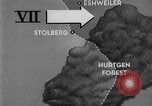
U.S. 4th and 8th infantry divisions enter Hurtgen Forest and 5th and 8th Inf. divs enter into Kleinhau to attack in Germany.
Activities of American first Army in Germany, advancing eastward in late 1944 during World War 2. Animated map shows: 4th and 8th infantry division move out from Stolberg and enter into Hurtgen Forest . U.S. 4th Infantry attack with field guns and artillery. Field gun amidst pile of shells fires toward Hurtgen Forest. 4th Infantry Division troops crawl up a hill in the Hurtgen Forest, sometimes pinned down under enemy German fire. Armor comes to their aid and casualties are treated by medical corps personnel. U.S. Army tanks arrive to support the infantry and they continue forward, where footage shows U.S. mortars and artillery bombing Grosshau, and point of view shot of a U.S. Army machine gun firing at a target in the town of Grosshau. Animated map shows: 5th and 8th Inf. Divisions enter into Kleinhau. Kleinhau is bombarded by a heavy volley of U.S. Army rockets and artillery from units of the 5th and 8th Infantry Divisions. Allied fighter bombers in flight over the area. Artillery is loaded and fired at close-range on target of Kleinhau which was then captured. U.S. Army Soldiers around the ruined buildings of Hurtgen, eating and drinking during a break. Infantry division move towards another towns. U.S. Army soldiers take a moment to relax during the long drive eastward. U.S. soldiers fire mortars from positions along the west bank of the Ruhr.
Munitions manufacturing in Germany during World War I. Initial Forging of heavy ingots
Munitions manufacture in Germany. Steel workers use chain hoists to move a 1650 kg steel ingot into a furnace. Another ingot, weighing 6000 kg is taken from the furnace and placed under a drop forge. Men maneuver the ingot as it is being hammered. it gradually reduces in circumference and increases in length. The useless end is cut off by placing a steel cutter under the forge hammer. The forged piece is conveyed to the next stage of manufacture.
CRITICALPAST.COM: About Us | Contact Us | FAQs - How to Order | License Agreement | My Account | My Lightboxes | Shopping Cart | Advanced Search | Featured Collections | Website Terms & Conditions | Privacy Policy ©2026 CriticalPast LLC.
License Agreement |
Terms & Conditions |
Privacy Policy
©2026 CriticalPast LLC.