


 Francais
 Deutsch
 Italiano
Refine Your Search
Kaiserslautern Germany 1962 stock footage and images
- Showing 3559 to 3564 of 6816 results more
more Hide
Hide
Funeral of United States General George Patton and key moments and accomplishments during his life.
On the life of U.S. General George S Patton Junior (with narration by Ronald Reagan). Fight at the Siegfried Line during World War 2. U.S. 3rd Army cross the Siegfried Line. General Patton with his officers. Patton's troops cross the Rhine. American soldiers in the streets of Germany. Patton presents the Medal of Honor to a soldier. Patton sees dead people at a concentration camp in Germany. Patton's army moves towards Denube Valley. Civilians in the streets. Patton with officers. Written on a wall 'Hitler is kaput'. Trucks loaded with soldiers. A gun thrown on a pile of guns on the ground. Patton in a barge. A welcome ceremony for General Patton on his return to US: A parade along Broadway in Los Angeles on June 9, 1945, as over 1 million citizens welcome General Patton home and cheer. Shops and offices on Broadway in Los Angeles. Patton waves at the people from an open jeep. Patton and General Doolittle in Los Angeles. General Doolittle makes a speech at a ceremony and introduces General Patton. Patton addresses the gathering and talks about the war and the accomplishments of the Third Army. He notes that from aerial view, Germany and Austria "look like hell from the top." And "that's what any place that the 8th Air Force and the Third Army worked on looks like." Also Patton says, "You must remember this. That from Brest, to various towns in southern Germany and Austria whose names I can't pronounce, but whose places I have removed," (laughter in crowd), "the trail of the Third Army and the 19th Tactical Air Command and the 8th Air Force is marked by more than forty thousand white crosses; forty thousand dead Americans." View of a military cemetery graveyard. General Patton lays flowers at the grave of one of his soldiers. Patton watches a race at Soldiers Field Academy. He shakes hands with the winners. Soldiers carry Patton's coffin wrapped in American flag. Patton's grave with flowers on it. Two soldiers stand beside it. Patton's statue at the West Point Military Academy.
Tactics used by the Nazis to prove and sustain their theory of racial supremacy.
U.S. Army training film depicts racial theories used by the German Nazi party. Clip includes mix of actual footage and actor portrayals. Actors portraying Nazi leaders Adolf Hitler, Hermann Goring and others at their office. Next scene is authentic footage of book burning by Nazi soldiers. Actor portraying prisoner in jail cell. Actual view of people in Germany migrating with their belongings. Several views of University students crossing a bridge over River Lahn, and buildings of Philipps University of Marburg in Marburg Germany during the late 1930s or early 1940s. View of news commentator speaking at microphone of BBC radio. Cover page of an edition of The New York Times as example of media banned in Nazi Germany. Actual footage of Goebbels speaking and addressing a group. Footage of champion African American boxer Joe Louis fighting in the boxing ring. His fights were banned to be seen in Germany. View of scientist Albert Einstein walking in a garden area outdoors and then on a footpath toward what appears to be Nassau Hall of Princeton University in New Jersey, USA. Remainder of clip shows dramatized scenes with actors, as follows: Catholic priest and a judge express fear from hatred spread by Nazis and oppose Nazi theories. They were put into concentration camp. A teacher in class disapproves Nazi theory of racial supremacy. Nazi soldiers arrest him. (World War II period).
German war criminals are executed by Allied occupying forces in 1945, in World War 2
View from above, of the surrounding walls and courtyard of a prison in Rheinbach, Germany. Ground view inside the prison yard, where German civilian Matthias Gierens is being escorted to the gallows by U.S. military police, and accompanied by a German Catholic priest, on June 29, 1945. They ascend the gallows and final charges and sentence are read to Gierens. Next scene shows bodies stacked up at the Bergen-Belsen concentration camp operated by Nazi Germany. Scene returns to the gallows, and a hood is placed over Gierens' head. View of Allied army officer witnesses, in formation, at parade rest. Noose is placed over Gierens' hood. View of a a bird flying overhead, trapdoor opens, Gierens drops, and noose tightens. Next is an unrelated scene of several German soldiers being executed. They are seen hanging from four gallows in a line in a public square while a large crowd, possibly Soviet citizens, looks on. (Notes: Regarding the execution of Gierens in the opening scene: German civilian Matthias Gierens was a 37 year old railroad worker. He was executed for the August 15, 1944, murder near Priest, Germany, of a downed American airman, who was later identified as U.S. Army Air Forces 2nd Lieutenant Lester E. Reuss. Gierens and three other German civilians, Peter Kohn, Peter Back, and Matthias Krein, were convicted on June 2, 1945 in Ahrweiler, Germany, of the murder. Their trial was the first Allied trial in Germany of civilians charged with a war crime.)
British officials meet in England as Adolf Hitler prepares his troops in Germany during World War II.
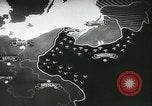
The first phase of German assault on France and the Low Countries during World War II. Animated maps illustrate Czechoslovakia and Poland defenses against Germany, and the East Prussian Corridor. Civilians including children flee war violence. German troops and tanks parade. England: UK Prime Minister Neville Chamberlain addresses a gathering. Britain's Foreign Secretary Lord Halifax (Edward Fredrick Lindley Wood, 1st Earl of Halifax), Winston Churchill, Leon Blum, and other officials. Germany: Hitler arrives at the Reichstag in Berlin. He addresses the Nazi officers and officials. A sign for the custom border district at Kreis. Bullet ridden walls and bomb damaged buildings. German troops load and fire artillery. German Panzer tank units invade Poland in 1939. Hitler looks through an artillery periscope. Black smoke rises due to numerous explosions.
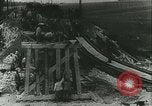
Railway bridges repaired in Germany, and trucks manufactured at the Citroen plant in Paris, France during World War II.
Germany and German occupied France during World War II. Germany: German engineers repair a railway bridge. The men weld and assemble parts. German officers inspect the bridge. A train crosses the bridge. The German officers watch. In Paris: Trucks are assembled at the Citroen automobile plant. Men assemble truck engines. A woman works on a truck. Trucks on the assembly line.
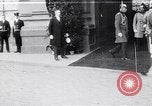
Scenes depicting social activities in Germany, Hungary, and Austria, before World War I.
Social life of wealthy in Germany, Hungary, and Austria before World War 1. Kaiser Whilhelm II of Germany and his wife, Empress Augusta, in Berlin. The Empress The enters their open back limousine, followed by the Kaiser, who is dressed in military uniform with Prussian style helmet. They drive off while German Officer salutes. Complete change of scene shows well-dressed crowd of spectators gathered in Budapest, Hungary, to watch a horse race. Some spectators use binoculars. View of horses in final stretch and crossing finish line. Next scene shows "Flower Day" in Vienna Austria. Wealthy citizens crowd shopping area and contribute to help the poor. Finely dressed pedestrians walking in shopping and commerical areas. They receive flowers as token of contribution. Some men wear flowers in their lapels. Little girls with baskets of flowers participate in the activities, standing in front of the Cafe Scheidl and "Zum Fenstergucker" house near corner of Kaerntner Strasse and Walfischgasse next to the Opera House. A street car decorated with garlands of flowers is a center of the activity. Women on the top deck of the street car reach down with small nets on long poles to retrieve contributions from passersby.
CRITICALPAST.COM: About Us | Contact Us | FAQs - How to Order | License Agreement | My Account | My Lightboxes | Shopping Cart | Advanced Search | Featured Collections | Website Terms & Conditions | Privacy Policy ©2026 CriticalPast LLC.
License Agreement |
Terms & Conditions |
Privacy Policy
©2026 CriticalPast LLC.