


 Francais
 Deutsch
 Italiano
Refine Your Search
Kaiserslautern Germany 1962 stock footage and images
- Showing 409 to 414 of 6816 results more
more Hide
Hide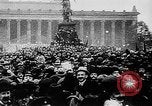
Montage of scenes from immediate Post-World War I Germany and into the 1930s
A crowd of Gernan civilians is seen gathered in front of the Alte Nationalgalerie in Berlin, Germany. Glimpses of Leaders, of the German Communist Spartacus League, including Rosa Luxemburg. Scenes of unrest during the Spartacist uprising (Spartakusaufstand) in January, 1919. Scenes of post-World War poverty, hardship and deprivation for German citizens during time of hyperinflation, with German people shown living in improvised housing, cooking outdoors, scavenging for coal. A sign is displayed for the Winterhilfswerk (WHW) Winter Relief program run in the 1930s by the Nationalsozialistische Volkswohlfahrt (National Socialist People's Welfare). It states its aim against Hunger and Cold (Gegen Hunger u Kalte). Uniformed persons with swastika arm bands, including Joseph Goebbels, and Hermann Goering, of the National Socialist German Workers' Party (Nazi Party), are seen surrounded by enthusiastic German citizens. Closeup of hot meal being dispensed and people eating. A sign in the background refers to the People's Welfare Program. People gathered in an outdoor food dispensing station, under a banner reading: "Berlin isst heute sein eintopfgericht" (Berlin is eating its stew today). Another glimpse of hot food being ladled into a dish. Adolf Hitler stands and gives a haranguing speech from a table where Nazi party members are seated. A banner on the front of a steam locomotive announces Winter Aid donation related to East Hannover (Winterhilfe Spende gau Ost-Hannover). Another sign refers to the 1936-1937 Winter Relief program (WHW) donation related to East Hannover (Gau Ost-Hannover Gifhorn W.H.W. Spende). Railroad train box cars are seen transporting contributions, from various places in Germany, to the program.
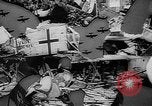
Scenes of Germany during period from 1919 to 1938 showing military resurgence and territorial expansion
Germany's military resurgence from the end of World War I through its reoccupation of the Rhineland in 1936 and union with Austria in 1938. German war materiel piled up in scrap yards and aircraft engines being destroyed in accordance with the Treaty of Versailles after World War 1. Smoke stacks of war plants being toppled, aircraft hangars being destroyed, and warships being scuttled. German postwar armored cars for training. A soldier flexes the rubber gun barrel on one of them. French forces, including Colonials, occupying Coblenz (Koblenz) in accordance with the Treaty of Versailles, after World War I. French soldiers on guard at the railroad station as a train pulls in. French colonial troops tending to their horses. A British soldier standing guard in front of a building displaying a placard with the Union Jack and word:"General Headquarters, British Army of the Rhine, No.1 Building." French troops stationed in front of their headquarters and patrolling fences across railroad tracks at their occupational boundary. A large film slate announcing that the Rheinland is again free, followed by scenes of German troops re-occupying the Rhineland in 1936. Local citizens cheer the troops, who parade through a city and along the banks of the Rhein River. German sentries posted at The "Deutsche Eck" in Koblenz beside the monument of Kaiser Wilhelm I. Sign demarking boundary of Austria. Border guards opening the gates and German troops entering as crowds cheer. Adolf Hitler speaking before a huge crowd,immediately following the Anschluss (union of Germany with Austria) on 12 March 1938.
Monastery Church in Dietramszell community and Paul von Hindenburg inspects his estate in Lederhosen in Germany.
Life of German Field Marshal and President Paul von Hindenburg in Germany. A monastery church in Dietramszell community (Salesianerinnenkloster Dietramszell, Klosterpl. 1, 83623 Dietramszell, Germany). Paul von Hindenburg inspects his estate while wearing Bavarian Lederhosen. People walks along with Hindenburg. Trees in the background. Circa late 1920s.

Spectators cheer the racers as they ride motorcycles and drive cars on frozen lake Eibsee in Germany.
Winter sports activities in Germany. Racers ride motorcycles with and without side cars on the frozen Lake Eibsee in Bavaria, Germany. Either side of the race track is covered with snow. Spectators cheer the racers. A second race features motorcycles with sidecars. Some crash into snow banks around turns. Final scenes show sports cars including Porsche cars driven on the ice at high speed during a race.
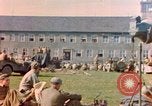
Men sit and listen to Commanding Officer on the Victory in Europe Day at the American airfield in Germany.
Activities on the Victory in Europe Day, World War II at an American airfield in Germany. The Administration buildings at the American airfield in Germany. Men sit and listen to Commanding Officer (CO) on Victory in Europe Day (VE Day). Men seated on grass. Officer speaks on phone. Air force personnel standing at the back. The Commanding Officer speaks over phone. Signboard reads "Spearshaft C P" in the background. Men disperse. CO talks to men over phone.
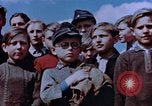
In war torn Germany, young German boys smoke cigarettes and pose for group photo a field and beside autobahn (WW2)
Activities of children in Germany near end of World War II. German boys from war torn Germany smoke cigarettes in a field. Trees in the background. The boys play and run down a hill. Children lined up beside an autobahn. A tower in the background. German boys in a group pose for photographs. Some children smile; other boys look melancholy and tired.
CRITICALPAST.COM: About Us | Contact Us | FAQs - How to Order | License Agreement | My Account | My Lightboxes | Shopping Cart | Advanced Search | Featured Collections | Website Terms & Conditions | Privacy Policy ©2026 CriticalPast LLC.
License Agreement |
Terms & Conditions |
Privacy Policy
©2026 CriticalPast LLC.