


 Francais
 Deutsch
 Italiano
Refine Your Search
Kaiserslautern Germany 1962 stock footage and images
- Showing 4441 to 4446 of 6816 results more
more Hide
Hide
Mix of moving images and still photos showing events in life of German rocket pioneer, Reinhold Tilling
Film opens showing large cloud of white smoke rising from a rocket propelled rail car. That is followed by a series of still pictures showing various designs of German rocket pioneer, Reinhold Tilling. Next, the airplane used to test fire Tilling's rockets at altitude, in 1933, is seen, with rockets slung beneath its wings. Pilot is seen climbing into the airplane cockpit. This is followed by series of photographs taken from the ground as rockets are fired from the plane. The airplane is seen small, at altitude, in some. Scene shifts to fire raging at one of Reinhold Tilling workshops, at Osnabruck, Germany, where he and two assistants were fatally injured when gunpowder charges they were compressing for rocket engines, exploded on October 10, 1933. Slate (in German) reads German rocket pioneer engineer Reinhard Tilling shot one of his rockets, on Tempelhof Feld near Berlin, 800 meters into the air. The rocket landed 500 meters away from the launch site, on November 13, 1932. Change of scene shows men standing in a boat on Lake Dümmersee as they retrieve a Tilling postal rocket from the water. Its wings are extended in the glide position. Views of other boats on the lake and of men holding several folded postal rockets.
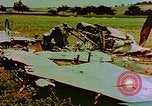
German farmers work in field around wreckage of American P-47 , a month after end of World War II in Europe
Wreckage of U.S. Air Forces P-47D-30, tail number 44-33495, of the 368th Fighter Group, 397th Fighter Squadron in a field, near Munnerstadt, Germany, a month after the end of World War 2, in Europe. Women work around the wreckage, turning hay. Street scene in a nearby small German village. Workers come home from fields. Buildings on either side of the street. Civilians move on an ox cart. Person carries hay in a wooden hand cart. Water running from faucet in the village square. (Reportedly, the pilot of the P-47 was William T. Wright, who was killed in the crash, on April 15, 1945.)
Nazi concentration camp victims, and emaciated Prisoners of war. Massacre in Lublin, Poland
Concentration camp survivors of Bergen-Belsen and Nordhausen in World War II. Some victims lying inside a building and two sitting outside a tent. U.S. soldiers with red crosses on their helmets, place one survivor on a litter. Another survivor is carried to ambulance by other survivors dressed in striped prisoner uniforms. Views of emaciated concentration camp survivors. Scenes of war in Germany. Aircraft drops bombs. Tanks fire guns at buildings in cities. Rescuers carry concentration camp survivors on stretchers. Views of healthy, well-fed local German citizens who live only a few kilometers from a concentration camp, where atrocity victims were starving and suffering. Prisoners of war cooking food over fires at a prison camp. They show their bodies after surviving maltreatment at Nazi camp. Rescued prisoners being provided medical treatment. View of Lublin Castle, Poland. Rooms filled with dead bodies of forced laborers killed by the Nazi German forces. Women weep looking at the dead bodies.
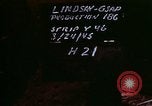
P-47 aircraft of the 365th Fighter Group strafe German cities during World War II.
Film opens with a slate reading: "Strip Y 46 3/24/45." This refers to Allied Advance Landing Ground, "Y-46 Aachen, Germany." The ensuing film shows numerous gun camera footage clips from U.S. Army Air Force P-47 aircraft of the 365th Fighter Group operating from Y-46 during 16 March through 13 April, 1945, near the end of World War 2. The clips show strafing attacks by the P-47s on German cities. Several of the final attacks seem to be hitting the same city located on a river.
Montage of German rocketry scenes from 1930s through World War II. Nazi surrender. Atomic bomb. Japanese surrender
German rocket pioneer, Gerhard Zucker, attempting to develop postal rockets in the 1930s. Location is Wadden Sea off Cuxhaven, on April 9, 1933, where Zucker follows Nazi Sturmabteilung (also called SA or Stormtroopers) carrying the mail rocket across wet sands. The rocket is set up on a launch stand. Zucker and an assistant ignite the 8 side rockets and the mail rocket takes off. It noses up and loops over backwards, falling to the sand. German Stormtroopers lift up the damaged device. Next, is seen a later, more modern, rocket trial ending in failure. Two German engineers display a model similar to the pulse-jet-powered "buzz bomb" (V-1) employed by the Nazis in World War 2. A brief glimpse of similar American machine on sand flat, as narrator states German acknowledgement of knowledge gleaned from Dr. Robert Goddard's work. A German V-1 flying bomb (aka Doodle Bug) being launched in 1944, during World War 2. View of British houses of Parliament, London, England; an air raid shelter sign in City of Westminster. Londoners waiting out a raid in the shelter. Scenes of fire and destruction during German bombing of London, as narrator speaks about the more advanced German V-2 ballistic missiles employed later in the war. Londoners trudging through debris amongst bombed out buildings. Change of scene to U.S. infantry and armor advancing deep into Germany. Narrator refers to them overrunning rocket bases and other vital war-making facilities, near the end of the war. Glimpse of large number of German prisoners of war. Documents of military surrender being signed by Field Marshal Wilhelm Keitel, in Berlin, May 8, 1945. Closeup of Keitel. Scenes of American forces operating in Pacific theater. Aerial view of atomic bomb explosion. Japanese surrender ceremony on September 2, 1945, aboard the battleship USS Missouri. U.S. soldiers and other service personnel return home and greeting loved ones at end of war. Aerial view of Pentagon building and surrounding area in Arlington Virginia near Washington DC. U.S. troops boarding a ship in San Francisco, bound for war again, this time in Korea (1950).

U.S. officials question Nazi prison doctors at the Hadamar Prison Camp (Euthanasia Centre) towards the end of World War II.
U.S. officials inspect the Hadamar Prison Camp or Hadamar Euthanasia Centre in Germany after its liberation by the U.S. Army towards the end of World War II. Men dig graves to remove corpses for autopsy. U.S. officials question Nazi prison doctors, including Adolf Wahlmann with head nurse Karl Willig, about poisons used to kill the inmates.
CRITICALPAST.COM: About Us | Contact Us | FAQs - How to Order | License Agreement | My Account | My Lightboxes | Shopping Cart | Advanced Search | Featured Collections | Website Terms & Conditions | Privacy Policy ©2026 CriticalPast LLC.
License Agreement |
Terms & Conditions |
Privacy Policy
©2026 CriticalPast LLC.