


 Francais
 Deutsch
 Italiano
Refine Your Search
Kaiserslautern Germany 1962 stock footage and images
- Showing 5035 to 5040 of 6816 results more
more Hide
Hide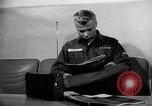
The story of AFN ( American Forces Network) Radio. Founding announced in 1942. First broadcast in 1943; growth in 1944.
U.S. Army soldier reads newspaper while listening to radio. Soldiers doing their respective chores, listen to AFN (American Forces Network) Radio. General Marshall and General Eisenhower announce the creation of AFN, in 1942. July 4, 1943, the first broadcast of AFN. General Eisenhower mingling with paratroopers of the 101st Airborne Division, on the eve of D-day. U.S. B-26 aircraft in flight. United States soldiers aboard landing craft and wading ashore at Normandy, France, on D-day, June 6, 1944. Soldiers tuning radios in the field. United States Sherman tanks and infantry move along country road in France. Audio includes portions from AFN broadcasts, including an announcer saying "You are listening to AFN Paris. This is the American Forces Network, on the road to Berlin." Road sign points to St. Lo. Group of U.S. soldiers gathered around a jeep with a radio, listening to AFN, in Germany. (World War II period).

Church in Pisinimo, Arizona with traditional Native American Indian artwork, located on reservation of Tohono O'odham
Milestone arrow with Pisinimo written on it. Cactus plant with a cross over it in front of a church. View of a Native American Indian carpet that includes two swastika symbols, used commonly by the American Indian before its use by Germany. The murals on ceiling include 'The Last supper' done in traditional, centuries old geometric pottery design. Indian priests walk out of the church, located on the Tohono O'odham reservation (sometimes previously called the Papago Reservation), wearing white robes.
Montage of scenes during World War II on the Western front during January 1945
January, 1945, on the Western front during World War 2. Troops of the U.S. 8th Infantry Division test new white camouflage coveralls for use in snow. They patrol in snow covered forest areas on the Western Front. A sergeant makes outdoor field adjustments to the coveralls using a knife and captured German sewing machine. He helps a soldier who tries on his new coverall. The material used is from old mattress covers. Several soldiers are seen putting on the camouflage coveralls. Scene shifts to U.S. troops with a jeep towing a 20mm Italian dual purpose gun for use in Germany. On January 2, 1945, they set up and fire the gun at targets a half mile away. In Belgium, U.S. Army engineers of Company B, 238th Engineer Battalion, improvise remote controlled bazooka shells as road blocks. They set them up on fence posts and fire them by ordinary flashlight batteries. U.S. soldiers from a Signal Company of the 99th Infantry Division are seen using a Weasel vehicle (officially designated an M29C light cargo carrier) to lay communication cables through snow in the 1st Army Sector, Belgium. Views of the wire spool on back of the weasel, and soldiers pulling wire from it.
Hitler Youth play rugby and boxing for recreation after working on annexed farms in Poland.
Recreation for Hitler Youth after a day's work on Polish annexed farms near Germany. A group of young boys play a game similar to rugby. They line up in front of an instructor. They toss a ball back and forth. Two Hitler youth participate in a boxing match while other boys crowd around and cheer
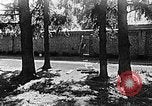
Boys and girls of Hitler youth learn farming skills on annexed Polish farms.
Hitler Youth working on Polish farms annexed by Germany. Girl gives grain to hen at a farm. Woman cleans poultry farm. Instructor instructs a group of young boys and makes them stand at attention, and then dismisses them to chores. The boys are seen milking cows. Woman gets rabbit from a hutch, holds a rabbit in her lap and brushes its fur. Women place wet clothes on clothesline for drying. Woman milks a cow and instructs a girl how to milk the cow.

United States Army soldiers use sound deception to deceive the German in Film 'Sonic Deception'.
Film 'Sonic Deception' shows the use of sounds to deceive the enemy (sometimes described as the "Ghost Army" in World War 2). Dramatization shows United States troops crossing river in small boats and arriving on beach. They establish beachhead on river bank and defeat German troops located there, having arrived by suprise. Film recounts through actors how a German spy at a German army corps headquarters informs about the presence of United States tanks and trucks. Film demonstrates how sound recordings were used by U.S. soldiers to create false impression of troop activities including bridge building and tank and vehicle movements, in order to serve as a decoy and mislead Germany enemy forces about U.S. Army activities. Dramatization shows German officials consulting and looking at maps. German soldier looks through binoculars and informs officials through phone. Tanks cross a bridge and artillery on field. Actual scenes of front gate of Army Experimental Center station headquarters at Pine Camp in Great Bend, New York (upper New York State). U.S. Army soldiers are shown recording via microphone the sounds of actual bridge construction at the center. The microphone routes to a recording truck where a turntable for pressing recordings is running, creating a phonograph recording of the bridge building decoy sounds. Recording of other sounds is shown, including sound of a bulldozer at work, sounds of men unloading trucks, and sounds of tanks crossing a bridge. Soldier is seen selecting a phonograph record from the Army Experimental Station Library.
CRITICALPAST.COM: About Us | Contact Us | FAQs - How to Order | License Agreement | My Account | My Lightboxes | Shopping Cart | Advanced Search | Featured Collections | Website Terms & Conditions | Privacy Policy ©2026 CriticalPast LLC.
License Agreement |
Terms & Conditions |
Privacy Policy
©2026 CriticalPast LLC.