


 Francais
 Deutsch
 Italiano
Refine Your Search
Kaiserslautern Germany 1962 stock footage and images
- Showing 5173 to 5178 of 6816 results more
more Hide
Hide
American sends supplies to European countries under Marshall Plan; blockade of Berlin by Soviet Union
American food, machine, tools and other supplies loaded in ships for Europe under Marshall Plan. German citizens in West Berlin Germany busy rebuilding after World War 2 destruction. Men at construction sites and boys and men moving equipment, bricks, steel, lumber, cement, and wheel barrows. Communists demonstrate in Soviet east Berlin. Men and women climbing fences at a building while a crowd pushes forward. Communists blockade Berlin. East German police officers in a human chain move a crowd. A blockaded area dividing the city. Industrial production stopping due to power failures. Closeup of analog power dial moving to zero from a power cut. A light in a factory turning off. Goods piled up idle in train stations, unable to be moved. A blocked border crossing at Helmstedt, and a line of trucks with food supplies at the crossing, stopped and unable to pass. Truck drivers discuss the impasse with a Russian guard.
Images of signed affidavits by U.S. military personnel verifying authenticity of images of German Concentration camp scenes
Camera shows close up of two certificates of affidavit signed by Lieutenant Colonel George Stevens and Lieutenant Kellogg. The first affidavit by U.S. Army Signal Corps Colonel Stevens cites Stevens' work from 1 March 1945 to 8 May 1945 photographing concentration camps and prison camps liberated by Allied forces. It is read aloud by George Stevens (or by a narrator reading the text of the affadavit). The second affidavit, signed by U.S. Navy Lieutenant E.R. Kellogg, and witnessed by Captain John Ford, is also read aloud. It cites Kellogg's expertise in motion picture and photographic techniques through his employment with Twentieth Century Fox Studios in California from 1929 to 1941. He attests that he has thoroughly examined the concentration camp liberation films of the Army Signal Corps and found them to be unaltered, genuine, and true copies of the originals in the U.S. Army Signal Corps vaults. A map shows the location of concentration camps in Germany and other parts of occupied Europe under Nazi control. (World War II period).
German invasion of Denmark on April 9, 1940, in World War II
In spite of Non Aggression treaty with Denmark, signed by Germany, May 31, 1939, German ships carrying army troops dock in Copenhagen and offload troops, tanks and equipment in the midst of local citizens, as part of surprise invasion of Denmark, on April 9, 1940, in World War 2. Some local citizens running away from the dock area. View of German troops marching along a street in Copenhagen, as local people line the sidewalks, watching.
World heavyweight boxing champion Max Schmeling arrives in New York for a boxing bout against Jack Sharkey.
Max Schmeling arrives in New York, United States. World heavyweight boxing champion from Germany Max Schmeling with a dog in his arms. He smiles as he arrives in New York for a bout with Jack Sharkey. Schmeling aboard a ship.
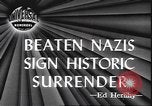
Germans surrender during World War II as General Jodl sign papers at the headquarters of Allied forces in Rheims, France.
Germany surrenders in Rheims, France during World War II. Nazi General Alfred Jodl arrives at the Supreme Headquarters of the Allied Expeditionary Forces. General Jodl and others enter the building. U.S. General Walter B. Smith, Allied Chief of Staff and other officers at a desk. German General Jodl signs the surrender papers. General Smith also puts his signature on the papers. The surrender document with the signatures of the two Generals. Supreme Allied Commander General Dwight D. Eisenhower smiles. He holds two pens in a V sign.
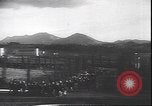
Members of the Nazi controlled Congress during a meeting at the Royal Palace in Tirana, Albania (WW2)
Congress meeting in Tirana, Albania during World War II. Members of the Nazi Germany controlled Congress enter the Royal Palace in Tirana for a meeting of the Congress. Priests seated at the meeting. Officials conduct the meeting. A priest with a rosary. An official speaks into a microphone.
CRITICALPAST.COM: About Us | Contact Us | FAQs - How to Order | License Agreement | My Account | My Lightboxes | Shopping Cart | Advanced Search | Featured Collections | Website Terms & Conditions | Privacy Policy ©2026 CriticalPast LLC.
License Agreement |
Terms & Conditions |
Privacy Policy
©2026 CriticalPast LLC.