


 Francais
 Deutsch
 Italiano

Refine Your Search
Kiribati Gilbert Islands 1943 stock footage and images
- Showing 151 to 156 of 6739 results more
 Hide
Color Sound

Famous astrologer, Belle Bart reveals her predictions for the year 1936 in New York, United States.
Belle Bart, famous astrologer at desk in her office, New York, USA. She speaks on her predictions for the Year 1936. She reminds viewers of her predictions for the year 1935. She says that the period of prosperity will extend from 1936-1943. She further says that although war is imminent in the far East, and that some nations will become eclipsed during this period, the general trend through 1943 will be "happiness and prosperity for all."
Scenes of Czechoslovakia beginning in 1918 and gradually moving into the era of World War II
Close-up images of a slide projector as it is turned on and as its Kodak zoom lens moves forward. A picturesque Czech town is seen with numerous historic looking buildings. View of Červená Lhota (Red Village) Castle in South Bohemia. (It has bright red roof tiles, not seen in black and white photos.) A town square and buildings nearby, including one that appears to be a cathedral. A bucolic hillside scene with sheaves of wheat stacked in groups and a village in far background. Farmers moving loaded wagons with teams of oxen. Farming scenes. Local people gathered around a church building, in a rural setting. Closeups of several young girls with their heads covered. A priest conducting mass at a section of the church with altar and backdrop open to the outdoors. Many women are attending and most have their heads covered. Closeup of a woman drinking from a bottle and girls at a marketplace. Girls and a man dressed in traditional costumes. A couple in traditional costumes. Glimpse of bridge over the River Vitava in Prague, Czechoslovakia. Glimpse of isolated church spire in area near city. Pedestrians and horse-drawn carts and wagons moving over the Charles bridge in Prague. Woman with baby in carriage and other pedestrians walking past Statue of Francis Borgia. on the bridge. View from bridge overlooking Wenceslas Square and statue of St Wenceslas, Prague. A tram moves below. Time moves to 1937. Police directing traffic and pedestrians at a busy corner in Prague. People at a flower stall. Glimpse of Adolf Hitler and Hermann Goering. People boarding and riding on trams. Children holding bouquets of flowers. A heavy gun barrel being raised. A backyard with line of wash and children playing in the field. Year is now 1938. German soldiers move a large artillery piece into position on a road. Agreements being signed related to the German annexation of the Sudetenland, portion of Czechoslovakia containing Germans who were incorporated into Czechoslovakia after World War I ). German troops moving into the Sudetenland. Czechs and Germans signing Munich Agreement documents, German forces driving into a city. Hitler meeting with Czech officials. Hitler heading a group including Hermann Goering and other high ranking German officials, as they walk along a road in a Sudetenland city where citizens welcome them enthusiastically. Momentary glimpses of persons being mistreated. Sudden change of scene to persons posing, including some in concentration uniforms. Hitler being overwhelmed by flowers. Empty street scene with flowers discarded on the road. Year advances to 1942. Concentration camp inmates pose behind barbed wire. Year, 1943. A young Jewish woman is seen with Jewish Star of David and word "Juden" displayed on her jacket and the number 671 on a tag around her neck. Year advances to 1943-1944. View of inmates crammed into a concentration camp barracks room.
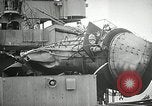
Damaged USS Louisville and men overhaul it in Okinawa, Japan.
Damaged USS Louisville (CA-28) hit by Japanese Kamikase in World War 2. Damaged forward stack of the ship. Float of its scout plane left on catapult, is jettisoned. Large stack of the USS Louisville knocked down. Engine of seaplane blown up by explosion on the signal bridge. Man welds in superstructure. View of other men working to repair damage to the Cruiser.. [Note: The following eyewitness account of the kamikaze attack was recorded by Seamen 1st Class, Enrico Trotta, who was a crew member on the USS Louisville (CA-28) from 1943 to 1946, "At 1923 (hours) two planes which were identified as friendly flew around and one kamikaze dove onto the battleship USS Mississippi BB 41. The other kamikaze plane turned to the Louisville and started to make a run on us. I was on No. #4 - 20 mm AA gun mount on the port side below #2 main battery and I fired 58 rounds to set the kamikaze plane on fire prior to hitting the Louisville’s front smoke stack bending and twisting it and killing 9 men on the 40 mm gun mount mounting on the forward superstructure tripod about 140 feet from our gun mount. The kamikaze also cut our sea plane off and left only the pontoon on the catapult. Three other 20 AA mm gun crews opened up firing 4, 11, and 20 rounds as well. We were not told to fire for we did it on our own. We were only manning the guns at the time and were not on general quarters. Later, the officers came by and said good job."]
U.S. troops landing at Tarawa during World War II.
U.S. Marine Corps forces landing at Tarawa during World War II. United Sates Navy Carrier fighters F6F Hellcats headed for landing in the Tarawa Islet a Japanese base. Scenes of Landing Vehicle Tracked (LVT) ferrying U.S. Marines to the beach. View from inside LVT of Marines preparing for beach landing. Views from moving LVT of many other landing craft on their way to beach during Battle of Tarawa.

U.S. troops maneuver on beaches of Tarawa during World War II.
U.S. Marines Corps soldiers crawling on beach at Tarawa during World War II. Landing Ship Tank (LST) on shore and smoke at a distance are seen. Marines following a low wire on the beach. U.S. Navy Destroyer (DD) firing. Marines taking position and advancing during Battle of Tarawa.
U.S. Marines launch the Battle of Tarawa, in the Pacific, during World War II.
U.S. marines engage Japanese during the Battle of Tarawa in World War II. Members of United States 2nd Marine Division walk up gangplanks, in full battle gear, and board ships. Convoy of ships underway in the Pacific Ocean, with weapons on deck visible. Fighter escort aircraft from U.S. aircraft carriers fly in formation over the convoy. A U.S. destroyer pulls alongside to deliver sealed orders on a line stretched between the two vessels. Officer briefs the Marines with a relief map on deck of ship. Marines load ammunition in belts for machine guns. They check and fire weapons. They exercise to relieve tension. Navy and coast guard assault boat coxwains receive last minute instructions from an officer. Chaplain conducts religious services for the Marines before the invasion day. Boats loaded with marines proceed toward the shore. Explosions occur. Aircraft in flight as they strafe and drop bombs on Japanese shore installations. American assault boats approach the beach. Heavy Japanese firing destroys several U.S. assault boats. Marines find some shelter behind a pier extending into the water. Marines are held down by heavy Japanese fire. They suffer heavy casualties and administer aid to wounded.
CRITICALPAST.COM: About Us | Contact Us | FAQs - How to Order | License Agreement | My Account | My Lightboxes | Shopping Cart | Advanced Search | Featured Collections | Website Terms & Conditions | Privacy Policy ©2026 CriticalPast LLC.
License Agreement |
Terms & Conditions |
Privacy Policy
©2026 CriticalPast LLC.