


 Francais
 Deutsch
 Italiano
Refine Your Search
Kiribati Gilbert Islands 1943 stock footage and images
- Showing 2209 to 2214 of 6726 results more
more Hide
Hide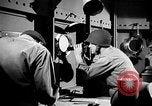
Walkie-talkies are rush-ordered as defective radio fails and American workers work on assembling of walkie-talkie in the U.S. (WW2)
Dramatization shows how one defective walkie-talkie can impair battle plans, United States. Troops battle on a Pacific Island in World War II. Soldiers move into action and fire artillery. Task Force team in manned radio operations room. Soldier talks on radio device from the island to headquarters. Soldiers move into building for counter attacks. Soldiers try to make contacts with headquarters. They fail to make contact as defective radio fails. Soldiers kneeling on island. Explosions and smoke rise. Shows Under-Sec. of War, Robert Porter Patterson; Chief of Services and supplies, Brehon Burke Somervell and Chief of signal officer, Olmstead in their offices. Walkie-talkies are rush-ordered for the invasion. Radios are being made in factory. American workers work on assembling of walkie-talkie instruments. A careless worker produces a defective set. Walkie-talkies are sold.
United States 1st Marine Division troops bomb Peleliu Island, Palau.
U.S. 1st Marine Division operations on Peleliu, during World War 2. U.S. F4U Corsair aircraft, flying low and slow, with gear down, drop napalm incendiary bombs on Japanese troops dug in on a ridge. Huge explosions seen. A C-47 transport airplane taxis on airfield. F4U Corsairs are seen parked and tents are pitched nearby.Several C-47s are parked on a ramp. Three F4Us taxi past them headed to the runway. F4Us take off and one is seen bombing Japanese positions on the ridge. Slate notes 1st Marine Division and D+24. Major General William Henry Rupertus,kneels on one knee, in sand, as another officer (shirtless) briefs him. They briefly discuss tactics and then walk away. Marine rifleman firing into burning wreckage of a Japanese position. Marine firing grenade from his rifle. Two Marines stand on beach with LVT (landing vehicle tracked) on the sand, nearby. They point at large ship offshore. Views of the Peleliu beachhead, with numerous ships and landing craft beached, including the second USS Seaward (LST 278) that collided with LST-129 and suffered considerable damage, On October 2, 1944. (LST-129 may be the LST seen next to LST-278.)
Recovery of wounded U.S. marines during amphibious assault on Peleliu, Palau Islands, in World War II
A DUKW speeds toward the USS Mount McKinley (AGC-7) in World War 2. It is seen tied up alongside with several wounded Marines aboard. Crewmen and Marines carry the wounded aboard the McKinley on litters (stretchers).
11th Marine Aircraft group drop bombs on Peleliu Island, Palau.
F4U Corsairs or U.S. Marine Aircraft Group 11, bombard Japanese positions on Prostitute Ridge, Peleliu, Palau, during World War 2. They fly a number of sorties, dropping general purpose bombs on fortified Japanese positions, very close to U.S. Marine positions. Marine pilots fly low and slow, with landing gear extended to assure accuracy in their bombing.
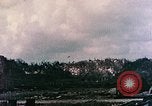
F4Us of Marine Aircraft group 11 use skip-bombing against Japanese dug in on Peleliu Island, Palau, during World War II.
F4U Corsairs of U.S. Marine Aircraft Group 11, use skip bombing to strike Japanese in fortified caves on Peleliu, during World War 2. They are seen striking targets on Prostitute Ridge. Meanwhile, Marines in Horseshoe Valley hurry as they carry a wounded Marine on a stretcher past some U.S. Army M4 Sherman tanks. Another view of Corsair making low slow bomb run. Scene shifts to a Corsair landing on the Peleliu airfield, while construction vehicles are still working to repair it. Scenes of the airfield, with mixture of tents, some still-standing buildings, and men working on the sand runways.
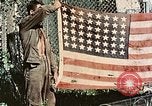
Aftermath of combat on Peleliu Island, Palau, during World War II.
U.S. First Division Marines, standing near a chainlink fence, display a large battle-scarred American flag, on Peleliu, during World War 2. Others display a large, captured (relatively unscathed) Japanese rising sun Naval ensign. Camera pans slowly over complete destruction left in wake of the combat on Peleliu.
CRITICALPAST.COM: About Us | Contact Us | FAQs - How to Order | License Agreement | My Account | My Lightboxes | Shopping Cart | Advanced Search | Featured Collections | Website Terms & Conditions | Privacy Policy ©2026 CriticalPast LLC.
License Agreement |
Terms & Conditions |
Privacy Policy
©2026 CriticalPast LLC.