


 Francais
 Deutsch
 Italiano
Refine Your Search
Kiribati Gilbert Islands 1943 stock footage and images
- Showing 2239 to 2244 of 6726 results more
more Hide
Hide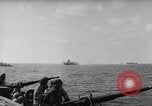
Aircraft of U.S. Navy Task Force 58, attack Kyūshū and Japanese home islands in World War II
Film begins showing sailors in battle gear manning Bofors 40mm anti-aircraft guns beside flight deck of U.S. aircraft carrier, during World War 2. Navy Task Force 58 ships, including a cruiser and another aircraft carrier, are seen in background. View of SBD Douglas Dauntless dive bomber aircraft on the carrier flight deck. Two have engines running.The rest are parked with wings folded. Next, the aircraft are seen being sent on takeoffs by a white shirt on deck. The number "6" on her flight deck identifies her as the USS Enterprise (CV-6). Views of several Douglas Dauntless aircraft flying off her deck. Glimpse of aircraft in formation from a different Squadron, bearing checkerboard markings on their tails. View from above of 5 of the aircraft in formation above the sea below. Gun camera views of U.S. aircraft strafing Japanese ships. One explodes in fireball and smoke. U.S. aircraft firing rockets that strike a Japanese carrier, setting it on fire, and causing an escort ship to blow up. Task Force 58 aircraft strike Japanese coastal installations and strafe several Japanese airfields destroying parked Japanese aircraft. They attack industrial sites causing fires and explosions. Gun cameras show aircraft firing rockets at lines of communication and striking more Japanese airfields.
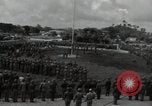
U.S. flag raising ceremony signifies official securing of the Okinawa Island, Japan during World War II.
Flag raising ceremony by U.S. Army at Okinawa, Japan during World War II. Troops at attention and salute the flag. Soldiers take pictures. Commander-General of USAFPOA (US Army Forces Pacific Ocean Area) Lieutenant General Robert Richardson, Jr. talks to other U.S. officers. Army jeeps parked.
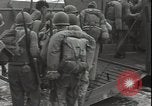
U.S. Marines leave Guadalcanal, Solomon Islands as army takes over during World War II.
U.S. marines departing Guadalcanal as they are relieved by U.S. Army troops of the 23rd Infantry Division. They board landing craft, vehicle, personnel (LCVP), aka Higgins boats, of the USS Neville (AP-16). Two of the marines scrambles aboard one of the boats as its ramp is almost closed. View of marines packed aboard the LCVP as it gets underway. Two transport ships are anchored in the background. The most distant one is the USS Neville (AP-16). Scene shifts to beach crowded with departing marines and Higgins boats. Closeup of a marine holding a cigarette while eating a sandwich, and another with a bandage on his forehead. Numerous views of the beach crowded with marine; palm trees overhead; higgins boats departing to the USS Neville, and two transport ships anchored in the background. Closeups of marines on shore waiting for more Higgins boats to transport them. Scene changes to U.S. Marine Corps Brigadier General William Rupertus, Assistant Commander, 1st Marine Division; U.S. Army Major General Alexander Patch, Commander, 23rd Infantry Division (Americal Division) and U.S. Army Brigadier General Edmund Sebree, his Assistant Commander, posing for the camera as they ostensibly discuss a map. They shake hands with each other. General Sebree exchanges salutes with General Rupertus, and they all walk away. Next, the three generals pose for closeups. Film ends showing columns of marines moving along the sides of a road cut through a forest of palm trees.
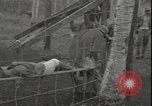
U.S. Army Military Police guard Japanese prisoners on Guadalcanal, Solomon Islands during World War II.
Japanese prisoners of war carry a wounded Japanese POW on a litter into a fenced prisoner compound on Guadalcanal during World War 2. A sign at the compound reads: "Prisoners of War Camp." Japanese prisoners, all dressed in the same prisoner uniforms, march in casual formation under guard by U.S. Military police.. They leave the compound and march down a road accompanied by MPs.

United States 10th Army invades Okinawa,Japan during World War 2
A film titled ' Invasion of Okinawa' shows Admiral Chester William Nimitz after his declaration to attack Okinawa in Japan. United states 10th Army launches an invasion on Kerama island in Ryukyu,Japan. Admiral Nimitz,General Buckner and Admiral Richmond Turner direct the operations. American soldiers take over the island after heavy bombardment. They invade Okinawa and land on the island behind naval bombardment.
Amphibious forces carried by U.S. Coast Guard, at Guadalcanal and in North Africa during World War II
United States Coast Guard operations in World War 2. Underwater views of ship's anchors being weighed, Convoy of U.S. ships in Pacific Theater, in July, 1942. The Attack Transport, USS Hunter Liggett underway, with crews doing amphibious training. Members of the 1st Marine Division aboard USS Hunter Liggett with Coast Guardsmen. Officers confer aboard vessel. Marines read books on ship. August 7, 1942, U.S. Marines begin amphibious assault against Japanese on Guadalcanal. Naval guns bombard Guadalcanal Island. Marines descend from the USS Hunter Liggett, on nets and enter LCVPs (Higgins boats) operated by Coast Guardsmen, to assault the island. Marines hit the beach from the boats. Marines firing small howitzers and advancing on the island. November 7, 1942, convoy of eight hundred ships en route to North Africa. Warships bombard the shore. An officer observes through binoculars. British and American troops descend on nets into LCVPs from Attack transports: USS Joseph T. Dickman (APA-13);USS Leonard Wood (APA-12); and USS Samuel Chase (APA-26). Troops hit the beaches of North Africa, under fire.
CRITICALPAST.COM: About Us | Contact Us | FAQs - How to Order | License Agreement | My Account | My Lightboxes | Shopping Cart | Advanced Search | Featured Collections | Website Terms & Conditions | Privacy Policy ©2026 CriticalPast LLC.
License Agreement |
Terms & Conditions |
Privacy Policy
©2026 CriticalPast LLC.