


 Francais
 Deutsch
 Italiano
Refine Your Search
Kiribati Gilbert Islands 1943 stock footage and images
- Showing 2275 to 2280 of 6726 results more
more Hide
Hide
View of Newport, Rhode Island, from Navy torpedo boat, "Morris" underway
View of Newport from steam driven Navy torpedo boat "Morris" underway. Sailors wearing hats seen on bow. Black smoke from the smokestack.
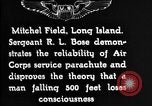
Sergeant R. L. Bose demonstrates reliability of Air Service parachutes at Mitchel Field on Long Island, New York.
Sergeant R. L. Bose demonstrates reliability of Air Service parachutes and disproves a theory that a man falling 500 feet or more loses consciousness. Civilians and military spectators watch the demonstration. Views from the airplane as Sergeant Bose free-falls from 3000 feet, delaying his chute opening until 1500 feet. Some of his free fall in slow motion. He makes a routine parachute landing. Spectators and an ambulance come as a precaution to his landing point.
Interview of Capt. William S. Parsons, U.S. Navy, crew member on Enola Gay, after the Hiroshima atomic bombing mission
Setting: North Field, Tinian Island in Mariana Islands, South Pacific, almost a week after the atomic bomb was dropped on Hiroshima Japan, August 8, 1945, during World War II. Public Relations Officer, Major John F. Moynahan (not seen) is interviewing members of the Crew of the B-29, Enola Gay, from which the bomb was dropped. Here he interviews Captain William Sterling "Deke" Parsons of the U.S. Navy who was weaponeer aboard the Enola Gay, during the mission. and who now serves as Scientific Head of the Atomic Bomb Project in the Pacific Theater. Captain Parsons describes the events of the mission from their early morning departure through the actual bombing. He notes that the actual bombing went smoother than earlier practice missions.
Colonel Paul Tibbets, Pilot of the Enola Gay, describes his mission dropping the atomic bomb on Hiroshima Japan.
Crew members of the B-29 Enola Gay are interviewed about their atomic bombing mission over Hiroshima Japan by the United States Army Air Force, during World War II. In this interview at North Field, Tinian Island in Marianas Islands, Public Relations Officer, Major John F. Moynahan (not seen) interviews Colonel Paul W. Tibbets, Jr., Pilot of the Enola Gay Among things Colonel Tibbets mentions, he recounts that he took a steep turn to avoid radiation from the explosion. When he saw the explosion he was surprised about its intensity. The cloud from explosion covered the whole city of Hiroshima.
Major Thomas Ferebee, the bombardier aboard Enola Gay shares his experience of the Hiroshima atomic bombing mission
Setting: North Field, Tinian Island, Marianas Islands. Major Thomas Ferebee, the bombardier aboard Enola Gay (B-29 that bombed Hiroshima) is asked about his experiences, by Public Relations Officer John F. Moynahan (not seen). He recalls - His navigator aligned him correctly with the target. Hiroshima was clearly visible to him and so he was able to deliver the bomb. (World War II period).
Interview of Major Charles Sweeney, pilot of the B-29 that dropped the atomic bomb on Nagasaki.
Setting: North Field, Tinian Island in Marianas Islands. Major Charles Sweeney, pilot of the B-29 that dropped the atomic bomb on Nagasaki, is interviewed by Public Affairs Officer, Major John F. Moynahan, who identifies Sweeney as the "pilot of 'The Great Artiste', the second B-29 to drop an atomic bomb on the Empire." (Note: Major Sweeney was the regular pilot of the B-29, "The Great Artiste", which was scheduled to carry the bomb. But it needed to be re-instrumented for the mission. So, instead, he and his crew simply switched airplanes with Captain Frederick C. Bock and crew, whose B-29 "BocksCar" was already properly configured. Thus, "BocksCar" was the airplane from which Sweeney and crew actually dropped the bomb.) In the brief interview, Major Sweeney describes their difficulties in three tries at the primary target and their decision to proceed to their secondary target, Nagasaki. With less remaining fuel than planned, they were forced to recover at Okinawa. (World War II period).
CRITICALPAST.COM: About Us | Contact Us | FAQs - How to Order | License Agreement | My Account | My Lightboxes | Shopping Cart | Advanced Search | Featured Collections | Website Terms & Conditions | Privacy Policy ©2026 CriticalPast LLC.
License Agreement |
Terms & Conditions |
Privacy Policy
©2026 CriticalPast LLC.