


 Francais
 Deutsch
 Italiano
Refine Your Search
Kiribati Gilbert Islands 1943 stock footage and images
- Showing 2311 to 2316 of 6726 results more
more Hide
Hide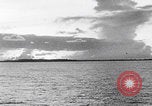
Grumman F6F Hellcat take off from the USS Essex (CV-9) aircraft carrier during the Battle of Angaur (WW2)
View of Angaur island at sunrise at start of Battle of Angaur in World War II. Aerial view of aircraft carrier. Conning tower on USS Essex. Crew member speaking on on radio headset. Pilot in cockpit of Grumman F6F Hellcat. Fighter planes gathered on deck of the USS Essex (CV-9) near the Palau Islands. Grumman F6F fighters on board start after signal from crew in conning tower. Fighters take off from flight deck. Another Grumman F6F fighter is raised to deck using aircraft lift and takes off. Fighters in formation in the air. Battleship USS Tennessee (BB-43) and four cruisers bombard Japanese positions in Angaur. Explosion on top of a hill. Trees destroyed on the coast as seen from a United States Navy ship. Naval artillery firing at Angaur. Landing craft being deployed from ships to land on Angaur.
81st Infantry Division “Wildcats” troops advance through Bloody Gulch to Suicide Hill during the Battle of Angaur (WW2)
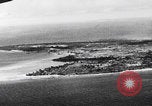
Aerial view of Peleliu Island during the Battle of Angaur in World War II. Map pointing to the location of Suicide Hill on Angaur Island. 81st Infantry Division “Wildcats” troops moving up a narrow gauge railway leading away from phosphate works into a narrow gorge called “Bloody Gulch”. Smoke from Japanese artillery is seen above the gorge. United States infantry soldiers advance along with tanks through Bloody Gulch. Tank operator talking through a radio microphone. Dramatized audio simulates tank communications while in Bloody Gulch. Infantry soldiers trail behind tanks. A tank is hit by Japanese artillery. Soldier runs past moving tanks. Wounded soldiers crawl and lay down in Bloody Gulch. Medics remove a casualty, running to avoid snipers. Infantry troops taking cover. Soldiers assemble a satchel charge. Soldiers run as explosion in front of tanks to clear the gulch. The second battalion resumes their advance. The second battalion splits up to start an encircling maneuver. Soldiers climbs while wearing flame thrower on his back. Machine gun fire towards Suicide Hill.
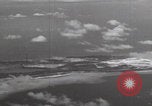
United States Army 7th Air Force Consolidated B-24 Liberator bombers and fighter over Koror (WW2)
Aerial view of Koror Island, Palau during a United States bombing mission in World War II. Aerial view of Koror Island shows roads. United States Army 7th Air Force Consolidated B-24 Liberator bomber squadron flies over Koror. A fighter aircraft escorting the bombers flies upward.
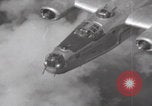
Consolidated B-24 Liberator bomber “Brief” is hit by anti-aircraft fire and crashes over Koror (WW2)
A United States Army 7th Air Force Consolidated B-24 Liberator bomber is hit by anti-aircraft fire over Koror, Palau during World War II. Consolidated B-24 Liberator bomber nicknamed "Brief" (Serial Number 44-42058) is seen in flight in aerial view from an aircraft above and ahead of it. Bombs being dropped from nearby Allied aircraft are visible in the same view. Suddenly, the B-24 "Brief" is hit from below by anti-aircraft fire, between the #2 engine and the fuselage (though at first glance it appears, incorrectly, that an Allied bomb hits the wing from above in a friendly-fire accident). The wing buckles upward. Flames engulf the doomed bomber. Aerial view showing fuselage falling in a flat spiral over Koror until it crashed. Aerial view of the mountains, military installations and roads in Koror Island. Smoke rises from various parts of the island.
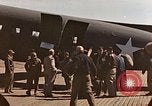
U.S. military transport aircraft operating from primitive airfield in the Aleutians during World War II
U.S. military personnel gather around the door of a Navy R4D (Navy DC-3) parked on marsden matting ramp at an airbase in the Aleutian Islands (possibly Adak) during World War 2. Camera shifts attention to U.S. Army P-47E aircraft parked near the runway. Tents are pitched nearby and mountains are in the background. The P-40s display the characteristic yellow propeller spinners of the 11th Pursuit Squadron, “Aleutian Tigers,” but do not display more elaborate tiger markings. Back at the R4D, one of the Navy crew is checking passenger names as they board the aircraft. Next, the R4D transport plane is seen starting number 1 engine (#2 is already running). It takes off raising considerable dust as it gains speed. Its identification number, 4-R-107 is visible below the cockpit. After takeoff, it flies past a nearby mountain and circles back and buzzes the field, flying over the runway at about a thousand feet, as it proceeds on its way
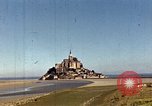
American troops and war correspondents at Mont Saint Michel and Saint Malo in France during World War II
American troops and war correspondents in France, during World War 2. They visit Mont Saint Michel, a small rocky island at the mouth of Couesnon River in Normandy, separating Normandy and Brittany. View of the island with a monastery at the top. War correspondent Robert Capa (of Life and of Time Magazines) looks on and takes pictures. Military jeeps leave the island. Madam Poulard stands under a sign at her Hotel Poulard. Sign for the Hotel and its reputed omelette. Soldiers on the street. Shops and French flags. GIs at the Benedictine Abbey and steepled church. An old French man points. U.S. Soldiers take a tour of the monastery with a woman guide. Steeples, towers, arches and other architectural features of the abbey and monastery. War correspondents including Charles Collingwood, Chicago Daily News' Helen Kirkpatrick, New Yorker Magazine's Joe Liebling (Abbot Joseph Liebling) and Warden Becker. Helen and Charles pose for the camera. Ernest Hemingway, covering for Colliers Magazine, drinks and talks to Bill Walton. War correspondents including Bill Stringer seated and walking on the street. They visit the monastery and take pictures. Civilians on the streets. Tall sticks in sand placed by German forces around the island to prevent Allied planes from landing at low tide. Three war orphan brothers whose parents were killed at the battle of St Lo, play on the beach as their grandmother looks on. Views of the island and patterns on the sand around the island from the receding waters of low tide. St. Malo, Brittany: Field near Saint Malo. American soldiers bathe and swim in a lake. They fool around in the water, taking a break from battle.
CRITICALPAST.COM: About Us | Contact Us | FAQs - How to Order | License Agreement | My Account | My Lightboxes | Shopping Cart | Advanced Search | Featured Collections | Website Terms & Conditions | Privacy Policy ©2026 CriticalPast LLC.
License Agreement |
Terms & Conditions |
Privacy Policy
©2026 CriticalPast LLC.