


 Francais
 Deutsch
 Italiano
Refine Your Search
Kiribati Gilbert Islands 1943 stock footage and images
- Showing 2443 to 2448 of 6726 results more
more Hide
Hide
2nd Sino-Japanese war, precursor to World War II in the Pacific. Pearl Harbor attack. Early phase of Pacific conflict between Japan and the U.S.
The film 'Sea power in the Pacific' showing Japanese dominance in China and at start of World War 2. Then it chronicles U.S. efforts to build Navy and fight back on sea and in the air. Opening scene shows Japanese Mitsubishi G3M (Type 96) bombers high overhead, and then closeup in formation. View from bomber of bomb bays open with bombs falling and view from ground of explosions and destruction. Overlay on film says: "China---1931." (This is not correct. The G3M bomber was not yet in service.) This film depicts Japanese attacks during second Sino-Japanese War, commencing 1937, Chinese civilians running to escape Japanese bombing of Singapore. Buildings destroyed and on fire. Next, Japanese troops, carrying the Rising Sun flag, are seen establishing a beachhead in an Amphibious assault. More scenes of Japanese infantry advancing through Singapore, ad it is being destroyed and burned. Soldiers charging along an alleyway, with pagoda in background. Next, Japanese soldiers are seen attacking Nanking, and committing atrocities and killing Chinese during the so-called "Rape of Nanking," in December, 1937. Chinese civilians being summarily shot and dumped into a large open grave after execution. Two Chinese prisoners with hands bound, being executed by rifle fire. Jubilant Japanese troops celebrating their victory. Map shows areas of China occupied during second Sino-Japanese war and the East Indies to the South. View of oil tanks; an open pit tin mine; a native cutting rubber tree bark to collect latex. Flags on map show regions of English, French, and Dutch colonial interest. It also shows Islands to the East, fortified by the Japanese. Cartoon shows Japanese soldier opposed by and American sailor (representing U.S. Sea Power). Next, famous images of the Japanese attack on Pearl Harbor, Hawaii, December 7, 1941, are shown, including the USS Arizona burning and sinking. Hawaii, Midway, Wake, and the Philippines Islands, are highlighted on a map and Japanese control of the Pacific is illustrated. Japanese soldiers are seen displaying a captured American flag. U.S. Lieutenant General Jonathan M. Wainwright is seen surrendering the garrison at Corregidor, on May 6, 1942. View of Japanese General Masahara Homma discussing surrender terms with Wainright. Map shows interlocking web of Japanese fortified bases in Pacific and need for seapower to oppose it. View of American shipyard with hundreds of workers, employed to build ships for the war effort, in World War 2. Views welding, metal fabrication, and other shipbuilding activity. A new ship going down the ways and a woman christening a new ship with splash from bottle of champagne. A new "Liberty Ship," the Richard Bassett, going down the ways at Bethlehem-Fairfield Shipyard Inc. Baltimore, Maryland. Closeup view as the stern of another ship enters the water upon launching. View of it from a distance. Shipyard workers knock supports from under what may be a landing craft, as it is launched. Japanese warships underway in the Pacific and firing their naval guns. Explosions on a shoreline from naval bombardment. Japanese infantry wading ashore during an amphibious assault. Map shows where Japanese forces attempt an amphibious assault on Southern New Guinea, thwarted by the U.S. Navy in the battle of the Coral Sea of May, 1942. In June, 1942, a Japanese attempt against Midway Island, was again checked by the U.S. Navy in the Battle of Midway. View of USS Wasp (CV-7) carrier deck filled with airplanes, including Grumman F4F Wildcats. A Douglas SBD Dauntless dive bomber being cleared for takeoff from the Wasp. Gun camera film showing Japanese airplanes being shot down by pursuing U.S. aircraft.
The Guadalcanal campaign in the Pacific during World War II.
Animated map shows Guadalcanal, where Japanese were building up a base to interdict Allied supply routes to Australia, in World War 2. U.S. marines in full battle gear board a troop transport ship. Convoy of transport ships headed to Guadalcanal. A Benham class destroyer bombarding the island from close range. On 8 August, 1942, the day after the amphibious assault on Guadalcanal, U.S. marines of the 3rd Defense Battalion, are seen descending rope net from the Transport ship USS Zeilin (AP-9, later designated APA-3) to enter landing craft headed ashore to reinforce marines fighting Japanese defenders on Tulagi, Gavutu, and Tanambogo, in the Solomon Islands. U.S. ship firing its guns. U.S. marines wading ashore, relatively unapposed at Guadalcanal, on 7 August, 1942. U.S. Douglas SBD Dauntless dive bomber taking off from Henderson Field on Guadalcanal. Two officers with large binoculars are seen aboard a Japanese warship flying her Naval ensign. A Japanese Nakajima B5N torpedo bomber (Kate) taking off from carrier. A formation of Japanese Nakajima Ki-43 Hayabusa (Oscar) or Ki-44 Shōki (Tojo) aircraft in flight. Closeup of two overhead in silhouette. Glimpse of U.S. carrier (USS Wasp?) taking evasive action. Sky filled with puffs of black Flak at low altitude and contrails from dogfights at high altitude. Closeup of a Japanese Mitsubishi B5M Type 97 Carrier Attack Bomber (Mabel) with others in formation in background. Bombs falling. View from carrier island of sailors running across deck of U.S. Carrier with smoke rising at site of bomb strike. Smoke obscuring the deck and beginning to clear. View from different U.S. carrier deck, past parked aircraft, to a camouflaged U.S. destroyer approaching astern. Carrier deck with Douglas SBD Dauntless dive bombers parked at its end, and black flak clouds overhead. Several night naval gun battle scenes followed by view of burning Japanese ship. Closeup of the wreck of the Japanese transport ship, Kinugawa Maru and views of other Japanese ships burning. U.S. army troops are seen marching along the sides of a road as they arrive in December, 1942, to relieve the marines on Guadalcanal. View of the embarkation operation on the shore as marines prepare to depart. Marines getting aboard Higgins boats (landing craft) for transport out to their transport ship, the USS Neville (AP-16, later redesignated APA-9).
Thick smoke rises from burning oil storage tanks and a refinery on fire as B-17s drop bombs on Hamburg, Germany.
U.S. Army Air Force Boeing B-17 Flying Fortresses bomb Hamburg, Germany during World War II. View of Heligoland island and its coastline. The B-17s in flight. Aerial views of target island. On Hamburg: Thick smoke rises from burning oil storage tanks and a refinery on fire. Coastal installations on islands. Smoke and fire from a coastal oil depot.
Aftermath of the Battle of Midway in World War II
Views of U.S. Navy pilots, their aircraft, and aftermath of Japanese bombing of Midway Island, in World War 2. Opening scene shows a formation of U.S. Navy Douglas Dauntless aircraft in flight. A U.S. Navy pilot climbs from the cockpit of an F4f Hellcat airplane on the deck of an aircraft carrier. His aircraft displays symbols for two Japanese aircraft downed. Another pilot in cockpit of his airplane that displays symbols for 7 downed Japanese aircraft. He climbs from his cockpit. Other pilots climbing out of their aircraft. One displays symbols for 6 kills. Three of them pose in front of an airplane. Scene shifts to Midway Island where a hangar is still burning from Japanese bombing. Glimpse of Gooney birds. Sentries stand on the airfield, with black smoke rising in the background. Closeup of wing from a downed Japanese airplane. Marines look through tangled pieces of crashed airplanes. One leans on a bent propeller blade. Heavy black smoke from petroleum fire is seen in background. Scene shifts to a PBY Catalina flying boat in flight, searching for survivors of the Battle of Midway. A U.S. Navy aircraft is seen floating in the sea, as a Navy warship heads toward it. A survivor is seen being helped from a PBY aircraft. Earlier picture of him smoking a cigarette inside the PBY aircraft. Sailors help him to a waiting ambulance. Other rescued survivors are seen standing about. Sailors place a litter aboard a PBY and use it to transport another survivor to sick bay. (Narrator states this is the 13th survivor rescued by the pilot of this PBY Catalina.) Ambulatory survivors being covered with blankets as they sit in the back of an ambulance, that then drives away with back door still open. Views of destroyed hospital on Midway Island. Red cross markings on are shown in the debris.
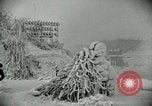
Scenes of Niagara Falls in Winter of 1919
The first scene shows a man and a woman standing on a bluff overlooking the Niagara River at Niagara Falls. The entire area is covered by snow and ice, including large clumps of grass and twigs. Behind them is a battery of 36 high intensity lights aimed at the American Falls. ((In 1907, William D’Arcy Ryan of the General Electric Company of Schenectady, New York designed battery of lights to illuminate the Falls. Comprised of 36 lights, they had the strength of 1,093,815,000 candela and were mounted on the Ontario Power Company access road north of the Ontario Power Generating Station near the base of the gorge.) Below the bluff, the Canadian Ontario Power Generating Station can barely be seen because of heavy mist rising from Niagara Falls. The same man and woman are next seen by an access ramp on Luna Island, where the Niagara Bridal Falls is seen in the foreground. Camera moves to a higher vantage point showing three people on Goat Island with Bridal Falls immediately behind them and the American Falls beyond. Goat and Luna Island are completely snow-covered. Glimpse of a woman standing on the bluff shown at the film start. Views of the boat, "Maid of the Mist," ice-bound at the base of the falls.
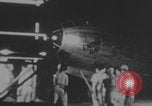
Enola Gay mission to drop “Little Boy” atomic bomb over Hiroshima, Japan (World War 2)
Enola Gay atomic bomb mission over Hiroshima, Japan during World War 2. The Enola Gay, a Boeing B-29 Superfortress bomber, prepares to leave for the Hiroshima mission. Army Armed Forces maintenance men and Enola Gay crew prepare the Enola Gay in Tinian, Northern Mariana Islands, checking their watches as the glance at the horizon. Maintenance men check bomb bay doors before closing. Pilot Colonel Paul Tibbets looks out of cockpit window of Enola Gay. Nose art of Enola Gay is seen. Close up of controls with hand show "starter" and "engine primer." Enola Gay engine starts and one of it propellers turns. The Enola Gay takes off from North Field, in the Northern Mariana Islands. Point of view through B-29 cockpit window as plane speeds down runway. Motion picture cameraman films the take off. The Enola Gay seen overhead as it leaves for Japan. Aerial View of Iwo Jima Island in Japan. The Enola Gay begins slow climb to bombing altitude over Iwo Jima. Crew member, possibly Tibbets, uses a pair of binoculars. Aerial view of Hiroshima. Enola Gay crew check instruments last time before dropping. The Enola Gay begins its bomb run. Crew bombardier turning a dial on a bomb site. View of Enola Gay with bomb bay doors open. Moving gauge pointer as bomb is dropped and seen exiting bomb bay. The Enola Gay banks away from Hiroshima at high speed. Aerial view in color of mushroom cloud forming over Hiroshima after the atomic bomb detonates in the city. (This actually shows the Nagasaki bomb blast from August 9, 1945, not the Hiroshima blast, despite the statements of the narrator in this edited film). Gigantic mushroom cloud from atomic bombing.
CRITICALPAST.COM: About Us | Contact Us | FAQs - How to Order | License Agreement | My Account | My Lightboxes | Shopping Cart | Advanced Search | Featured Collections | Website Terms & Conditions | Privacy Policy ©2026 CriticalPast LLC.
License Agreement |
Terms & Conditions |
Privacy Policy
©2026 CriticalPast LLC.