


 Francais
 Deutsch
 Italiano
Refine Your Search
Kiribati Gilbert Islands 1943 stock footage and images
- Showing 2497 to 2502 of 6726 results more
more Hide
Hide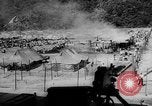
Prison riots in 1952 include North Korean POWs in Koji and U.S. prison riots in Michigan and New Jersey.
Major prison riots of the year 1952. North Korean POW soldiers of the Korean War stage a mass rebellion at POW camps in Koji islands and Pongam Island, off South Korea. U.S. and U.N. guards quell riots at the camps, resulting in death of North Korean prisoners and injuries. Medics are seen treating injured North Korean prisoners. U.N. guards escort prisoners in lines after the riots. Scene shifts to the the United States where damaged prison property in Michigan and New Jersey is seen after prison riots. Broken window glasses and furniture strewn about in a multi-story room of the New Jersey State Reformatory. Scene changes to Southern Michigan State Prison, also called Jackson State Prison, following riots there. Four prisoners including ring leader Earl Ward (second from left) are seen inside the building behind bars, during the standoff where they seized a cell block and held guards as hostages. A prison guard on watch with rifle in hand, looking from an elevated post downward onto a Jackson State Prison courtyard.
Coast Guard Rescue Stations along the Eastern and Southern coasts of the United States
After extensive slate of historical information, this film shows U.S. Coast Guard personnel launching a large dory (life boat) from the U.S. Coast Guard Gloucester Station in Gloucester, Massachusetts (Old House Cove, westerly side Gloucester Harbor). They slide the boat down rails, launching it directly into the water. Coast Guardsmen in foul weather gear are seen rowing a large lifeboat in rough waters near rocky shores. Eight men row, sitting in four pairs side-by-side on fixed thwarts (benches) and one stands in the stern (a coxwain) steering with a 16’ oar. A powered life boat is seen briefly, in extremely rough waters. Remainder of the film shows an animated map of the East and South coasts of the United States with dots identifying Coast Guard Stations on those coasts. At this point, the film concentrates on Rescue Stations in the Boston Division. A beached two-masted sailing ship is shown. A large steamship emitting black smoke from her funnel, is seen beached and listing on a shore. Aerial view of Light House on Block Island, off Rhode Island. Aerial view of a freighter run aground just off shore. Aerial view of a Coast Guard Station with a highway running past it. Aerial view of another Coast Guard Station located where narrator says is a dangerous point.
U.S. soldiers use natural vegetation to camouflage artillery and hide vehicles behind bare trees in Italy during World War II.
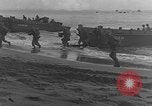
A film underlines the importance of tactical exploitation and counteraction of shadows and use of nets, underbrush and other camouflage during World War II. U.S. soldiers land on an island in Guadalcanal, Solomon Islands. The soldiers try to eliminate the black hole made by a tent opening by using a blanket. U.S. 5th Army in Italy. To remove shadows of oil tanks, engineers use steel wool on chicken wire. Soldiers use natural vegetation to camouflage artillery in Anzio, Italy. In Casino, U.S. soldiers use bare trees to hide vehicles. U.S. soldiers in Sicily. A garnished fish net is draped over a tank to hide it. At Anzio beach troops dig a trench to hide a tank and then cover it with hay. Soldiers try to camouflage a jeep.
Several ordnance men work on bombs aboard USS Ranger underway in the South China Sea.
Operations of U.S. Navy A-7A Corsair 2 aboard USS Ranger underway in the South China Sea during the Vietnam War. A small group of personnel watches the recovery of an aircraft. An A-7A aircraft comes to a halt on the flight deck of the aircraft carrier. The aircraft taxis on the flight deck. A tractor in the right foreground. An A-7A aircraft making a recovery, rolls to a stop. A wire is released from a tail hook. The aircraft taxis out. Ready bomb stowage area behind the island, a large amount of bombs secured to the bomb carts. Personnel working in the far background. Ordnance personnel working around the bomb fuse carts. An ordnance man holds a bomb fuse in his hand. Ready bomb stowage area behind the island. Ordnance personnel working in the background. Bombs and bomb fuses in the foreground. An ordnance man works with a hand full of safety wires attaching them to a fuse cart. The ordnance man wheels a fuse cart down the deck area. Personnel standing between the aircraft. The ordnance man wheels the cart down the deck toward the A-7A, stops at the A-7A. An ordnance man attaches two fuses to two separate bombs. A fuse being screwed on the nose of a bomb by the ordnance man. The ordnance man attaches the safety wire. A clip being put on the safety wire of the bomb. An ordnance man works with the safety wire on the bomb attached to the A-7A. United States Navy F-4J Phantom II and U.S. Navy A-6A Intruder in the background on the flight deck.
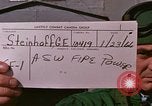
S2F anti-submarine warfare aircraft being maneuvered by tow tractors aboard USS Randolph.
Activities aboard USS Randolph (CV-15). Ordnance man works on torpedo attached to side of SH-3A helicopter. Ordnance man secures depth bomb to helicopter. Tow tractor moves over flight deck next to island. Another tractor comes from left towing an S2F (aka ""Stoof" by sailors). This plane is from squadron VS-27. Side view of the aircraft with name 'USS Randolph' on engine nacelle. Ship's island in the background. Tractor tows another S2F on flight deck. SH-3A helicopters in the background.
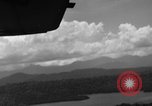
Stinson L-5 plane in flight over mountain jungles and water in Palawan, Philippines.
L-5 sentinel planes over jungle in Palawan, Philippines. Aerial view of mountains. An island as seen from L-5. Shoreline and clouds seen from plane. Islands below the L-5 in flight.
CRITICALPAST.COM: About Us | Contact Us | FAQs - How to Order | License Agreement | My Account | My Lightboxes | Shopping Cart | Advanced Search | Featured Collections | Website Terms & Conditions | Privacy Policy ©2026 CriticalPast LLC.
License Agreement |
Terms & Conditions |
Privacy Policy
©2026 CriticalPast LLC.