


 Francais
 Deutsch
 Italiano
Refine Your Search
Kiribati Gilbert Islands 1943 stock footage and images
- Showing 2797 to 2802 of 6726 results more
more Hide
Hide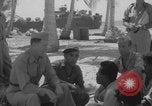
Commodore Ben Wyatt addresses natives of Bikini Atoll through interpreter
United States Commodore Ben Wyatt, the military governor of the Marshall Islands, addresses the natives of Bikini Atoll through his local interpreter James during “Operation Crossroads” (U.S. nuclear weapon testing program). Locals of Bikini Atoll sit down and listen to Wyatt. Other United States Navy personnel are present in the meeting. Interpreter speaks to the natives. A group of United States sailors gather outside a hut. They hold a sign that reads “CROSSROADS TAVERN”. Natives carry belongings and banana or pandan leaves toward LST. A woman carrying a large sack on her shoulders. Natives bring their belongings into a United States LST (Landing Ship, Tank). An outrigger loaded with boxes floats near the LST.
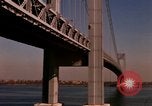
Vessels pass under the Verrazzano Narrows Bridge in New York. Views of the Verrazzano Narrows Bridge from Fort Wadsworth
Boats and ships in the "The Narrows" (tidal strait for Hudson River between Upper and Lower New York Bay) in New York. They pass under The Verrazzano Narrows Bridge. Ground Level views of the Verrazzano Narrows Bridge from Fort Wadsworth on Staten Island.
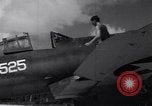
Pilot and plane captain of F4U aircraft perform engine start during World War II in the Pacific theater
Location looks like Espiritu Santo in the New Hebrides Islands, during World War 2. Palm trees in background. The weather is clear and sunny. Plane captain, in shorts, climbs into cockpit of an F4U corsair airplane of Marine Aircraft Group 11 (Number 525 on fuselage). Marine pilot hands him his seat pack parachute, which the plane captain places into the seat. The pilot climbs into cockpit, as plane captain stands on right wing and gives thumbs up for engine start. The engine does not start, so he walks along wing to check the engine. The scene is repeated, with plane captain scrambling over the fuselage again to a position on the wing for engine start. This time the engine starts. He clambers back to cockpit and helps pilot with his shoulder harness. Another view of this shown in closeup from left wing of the aircraft. View from in front of the aircraft, as engine starts, and plane captain steps up to help pilot with shoulder harness.
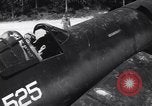
U.S. Marine Corps F4U aircraft returning from missions in Pacific theater in World War II
Location is probably Espiritu Santo in the New Hebrides Islands, during World War 2.The day is clear and sunny and palm trees are seen in background. Pilot sits in cockpit of Marine Aircraft Group 11 F4U Corsair airplane number 525 after returning from a mission. Plane captain, in shorts, climbs up to cockpit and gives the pilot a booklet in which he makes notes regarding any aircraft problems.He hands the booklet back to the plane captain and climbs out of the cockpit. He unfastens the chute leg straps and carries the chute in his arms. Scene shifts to another F4U that has just parked and is shutting down it's engine. Plane captain climbs up to the cockpit. A crew truck pulls up and a ground crewman picks up a parachute and places it on the truck fender.
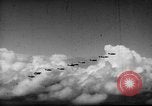
P-47s of the U.S. 318th Fighter Group return to the Aslito Airfield, Saipan, after Tinian raid in World War II
Twelve P-47 Thunderbolt aircraft, of the USAAF 318th Fighter Group, returning to Aslito Airfield (Insley Field) after completing strike missions over Tinian Island. Airfield showing dispersal area for the aircraft buildings surrounding area. New runway under construction at airfield. Aircraft spotter looking through binoculars. P-47s approaching airfield for landing. P-47s landing on airfield.

Charles Lindbergh takes off from Roosevelt Field for his famous solo flight from New York to Paris.
People gathered early on a misty morning at Roosevelt Field, Long Island, New York, to watch as Charles Lindbergh attempts to make a solo flight across the Atlantic Ocean in his airplane, The Spirit of St. Louis. The plane starts its takeoff role between groups of spectators, raising dust. The spectators move to get a better view as the plane continues, out of sight in the fog and mist. It is not clear where the plane is, although engine sound has changed. Spectators strain to see it through the mist. Then, some cheers are raised when the crowd realizes that Lindbergh has successfully taken off in his heavily laden airplane. The opening caption refers to Curtiss Field, where the Spirit of St. Louis was test flown and reportedly maintained in Hanger 16. there, from May 12th through the 20th. However, for the Paris flight, the plane was towed a mile to Roosevelt Field where, heavily loaded with fuel, it could take advantage of the longer runway for takeoff. (Note: Both fields were originally part of the old Hempstead Plains Field renamed Hazlehurst Field when taken over by the U.S. Army in 1917. U.S. Geological survey maps of 1918 show three areas named, respectively, Hazelhurst Aviation Field No. 1; Aviation Field No. 2; and Camp Albert L. Mills, abutting it. Field No. 2 was renamed Mitchel Field on July 16, 1918. The eastern part of Field No. 1 was dedicated as Roosevelt Field, on September 24, 1918. After the war, the western part of Field No. 1 became known as Curtiss Field, associated, as it was, with the Curtiss Aeroplane & Motor Company located there.)
CRITICALPAST.COM: About Us | Contact Us | FAQs - How to Order | License Agreement | My Account | My Lightboxes | Shopping Cart | Advanced Search | Featured Collections | Website Terms & Conditions | Privacy Policy ©2026 CriticalPast LLC.
License Agreement |
Terms & Conditions |
Privacy Policy
©2026 CriticalPast LLC.