


 Francais
 Deutsch
 Italiano
Refine Your Search
Kiribati Gilbert Islands 1943 stock footage and images
- Showing 3019 to 3024 of 6726 results more
more Hide
Hide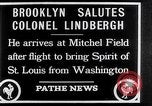
Charles Lindbergh arrives in New York to claim the Orteig Prize as the first Allied aviator to fly non-stop beteen New York City and Paris
View from the ground at Mitchel Field, on Long Island Spirit as the Spirit of St. Louis is seen circling to land. A small group of people stand near a hangar. Lindbergh's plane lands on the grass field and taxis toward three army soldiers there to help him park. Lindbergh, in flying gear, steps from his airplane. Closeups of him standing near it. Scene shifts to Brooklyn New York, where Lindbergh, now dressed in business suit, and surrounded by a crowd, descends wooden steps to enter an open car. He sits prominently in the back of the car, accompanied by Raymond Orteig and officials. Mounted police escort the car. View from rear as motorcade drives along a festooned Brooklyn street with a "Welcome Lindy" banner stretched across the road. Motorcycle police escort the cars. Spectators crowd the sidewalks. The motorcade continues through leafy boulevards and open highways. Everywhere enthusiastic crowds line the way. American flags decorate the lead car. A group of Boy Scouts with massed American flags lines one side of the highway. Crowds, waving American flags, teeter on the edge of the sidewalks along a commercial section of town. View from a high location overlooking Prospect Park in Brooklyn, where people throng the sidewalks and park paths. Camera pans across the park. A motorcade (now grown to include numerous cars) circles to enter at the Grand Army Plaza entrance to the park. A slate reads: At Knights of Columbus Building for a luncheon in his honor." Then the motorcade stops at a building festooned with patriotic bunting and a banner reading: "U.S. Council 126 K of C." Later, Lindbergh enters the open car again with Raymond Orteig and they leave. Next, at the Brevoort Hotel (owned by Mr. Orgteig) an elaborate check for twenty five thousand dollars is shown. It is dated June 17, 1927 and signed by Raymond Orteig. Lindbergh and Orteig shake hands and chat amicably while attempting to pose for a photograph. Glimpse of U.S. Capitol building overlaid by a "Welcome Lindy" sign. Closeup of Lindbergh superimposed on top of that along with a waving American flag.
Marines leave Pearl Harbor to invade Eniwetok Atoll (WWII)
United States Marines leave for Eniwetok Atoll from Pearl Harbor during World War II. travel to a dock by truck as they prepare to leave Pearl Harbor, Hawaii. Trucks and Jeeps pass by Quonset huts. The Marines prepare for invasion of Eniwetok Atoll. Sailors pull netting away. United States Navy ships are docked on Pearl Harbor. A sailor watches a ship depart for Eniwetok Atoll. Marines crowd a ship deck. Ships and attack transport attack Pearl Harbor. Submarine netting. Marines on deck of transport. Gun crew practice firing with naval machine gun. Machine guns fired. Bullets shoot upwards. Tracers seen near the target. United States Commanders Admirals Harry W. Hill, John T. Walker and Thomas E. Watson deliberate on plans to capture Eniwetok onboard. Boatswain's Mate blowing whistle. Sailors repair rope ladder. Sailors and Marines play boardgames such as checkers onboard. Invasion leaders studying models. Marines receive their K rations. A Marine cleans his rifle. Naval bombardment at Eniwetok Atoll. United States ships firing at Japanese positions on the atoll. A group of aircraft in flight. Shells exploding on atoll. Barges and landing crafts approach the island. Marines and soldiers watch as the landing craft approach the atoll. Marines crouch after landing on the beach. A soldier digging a dugout. An amphibious truck lands at Eniwetok Atoll beach.

Many people die as storm sweeps Caribbean
Many people die as storm sweeps Caribbean. The wind lashes the trees on the Jamaican island. The storm sweeps in. Uprooted trees and damaged buildings are seen. Ships are also damaged. The walls of a hospital collapsed and killed several patients. Many killed in the storm. Wreckage seen.
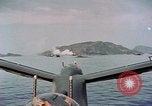
PBM Mariner aircraft involved in rescue operations
Air-Sea rescue by PBM Mariner aircraft. PBM planes land among ships lying off island. Smoke rises from an explosion on the beach. Men paddle in life raft. Line is thrown to him from PBM. Life raft pulled to PBM tail. Aviator in rubber life raft towed alongside PBM. The aviator climbs into plane head first. Empty life boat drifts freely. PBM taxis for take off. Tail of an aircraft. PMB towed to the stern of a vessel. Men watch aboard. Aviator floats in a rubber life raft. Rescued aviators and enlisted men in aircraft rearm boat. Officer interviews enlisted survivor and takes notes. Rearming boat gets underway and leaves.
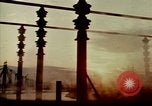
Film juxtaposes transportation of electricity, with transportation of people, and shows myriad uses of electricity.
Electric power lines and insulators. A bridge across a river in United States. Cars pass on it in wintertime, with snow at edge of road on a cold morning. High voltage long distance electric transmission lines and towers. Statue of Liberty from behind, with helicopter flying past it. Series of very close-up views of appliances and conveniences that use electricity: Chicken roasting on electric powered rotisserie. Clock hands moving on electric powered clock. Person turns on electric desk lamp. Electric powered beaters spinning. Electric powered industrial machining operation. A couple dancing to music powered by electricity. Several kinds of electric transmission lines. Electricity in the 1960s office environment: Hand dialing a rotary dial telephone; adding machine; close-up views of typewriter in operation; punch card sorter for punch cards of early computer; early computer tape drive spinning; warning lights. Closeup views of fingers pressing keys and dialing. Night view of Times Square on Manhattan Island, New York City with many illuminated commercial signs and neon signs.
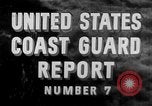
Worldwide operations of United States Coast Guard in World War 2
Overseas activities of United States Coast Guard in World War II. U.S. Landing Craft Infantry, LCI(L) 617, part of LCI Flotilla 22 in World War 2. She is seen underway in rough waters of the Pacific ocean during 1945. Coast Guardsman ordered to Battle stations. A Coast Guardsman observes approaching enemy aircraft through binoculars. Coast guard gunner fires Antiaircraft guns using foot trigger. Enemy aircraft crashes in ocean. A Coast Guardsman signals using semaphore flags. Beachhead supply operations. Coast Guard Picket Boat, CG-42022, seen patrolling around U.S. transport ships in a Persian port, while they carry lend lease supplies to the Soviet Union. Coast Guard combat patrol in jungle using canines (dogs). The Cactus (A) Class 180 foot buoy tender, USCGC Tupelo placing a buoy at sea. Releasing a weather balloon. A Coast Guard wooden 83 foot cutter ("83 footer"). Loading a Coast Guard B-24 aircraft on Guam. The plane takes off. Invasion task force of U.S. warships underway. Coast Guard crews at various duty stations aboard their ships during the war. The former luxury ocean liner, SS Manhattan underway, her decks crowded with troops, following her conversion into the U.S.Coast Guard-manned USS Wakefield (AP-21). U.S. Navy attack transport USS Arthur Middleton (APA-25) at sea in the Pacific. Coast Guard operating transport ships unloading cargo for Allied invasion forces and running inter-island shipping service in the Pacific, during World War II.Landing Ship Tank (LST-788) arriving at the beach next to Landing Ship Medium, LSM-242, on Iwo Jima. A Landing Vehicle Tracked (LVT) being driven off LST-760. USS LCI(L)-87, Flagship of LCI Flotilla 10. Her Captain, M. E. Imlay, USCG, is seen on her bridge, before departing from England for the Normandy invasion. U.S. Landing Craft Infantry, LCI(L)-668 at beach and troops wading ashore.
CRITICALPAST.COM: About Us | Contact Us | FAQs - How to Order | License Agreement | My Account | My Lightboxes | Shopping Cart | Advanced Search | Featured Collections | Website Terms & Conditions | Privacy Policy ©2026 CriticalPast LLC.
License Agreement |
Terms & Conditions |
Privacy Policy
©2026 CriticalPast LLC.