


 Francais
 Deutsch
 Italiano
Refine Your Search
Kiribati Gilbert Islands 1943 stock footage and images
- Showing 337 to 342 of 6730 results more
more Hide
Hide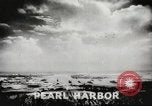
Japanese air attack on Pearl Harbor blows up U.S. battleships and destroyers in Honolulu, Hawaii during World War II.
A 1943 film about the December 7, 1941 Japanese air attack on Pearl Harbor in Honolulu, Hawaii during World War II. Film blends dramatized scenes with actual historic footage from the event. Formations of Japanese bombers approach Pearl Harbor. USS Arizona (BB-39) bombed. U.S. personnel aboard USS Arizona as the ship is bombed. Smoke billows up from the explosion. U.S. sailors aboard USS Oklahoma (BB-37). USS Oklahoma and USS California (BB-44) are bombed by Japanese aircraft. U.S. troops fire machine guns at Japanese aircraft. USS Cassin (DD-372), USS Downes (DD-375), and USS Pennsylvania (BB-38) bombed in the dry dock of Pearl Harbor. Ships in flames. USS Oglala CM-4 sinks after being attacked. Air raid alarms sound in Honolulu. Japanese people in Honolulu as the Japanese air raid on Pearl Harbor continues. A Japanese man being interviewed after air raid says he cannot think that Japanese aircraft attacked Pearl Harbor.
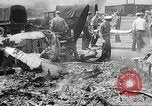
U.S. Navy officers and sailors attend prayer services for dead servicemen in Honolulu, Hawaii after the Pearl Harbor attack.
From a 1943 film blending dramatized scenes and actual archival footage about the conditions soon after the attack on Pearl Harbor in Honolulu, Hawaii in December 1941 by Japanese bombers during World War II. U.S. troops remove the dead bodies of soldiers who died in action. The U.S. flag on the grave of a U.S. soldier. Pictures and parents of U.S. service men of the Navy, the Marine Corps, the Army and Medical Corps who died during Pearl Harbor raid. The family of a U.S. Medical Corps Lieutenant who died during Pearl Harbor raid. Wife of the same lieutenant holds her baby born after the attack. Prayer services for the dead U.S. servicemen. Families of the dead servicemen lay wreaths and flowers around U.S. flags. U.S. Navy officers and sailors at shore attend the memorial services. Ceremony shows line of U.S. Navy sailors laying garlands around each U.S. flag bearing the names of U.S. servicemen who died during Pearl Harbor attack. An Army Chaplain and Navy officers attend the prayer services. Palm trees on the beach.
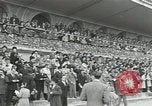
Scenes from German occupied Paris France; French collaborator Ferdinand De Brinon gives a speech to German officers (WW2)
Scenes shot in 1942 and 1943 from inside German occupied Paris, France during World War II. German officers and civilians at the Longchamps racetrack in Paris, France. Horses run on a dirt track. German troops at the Eternal Light for the Tomb of the Unknown Warrior at the Arc de Triomphe. A German Panther tank captured by the FFI (French Forces of the Interior) in 1944. French collaborator Ferdinand De Brinon speaks into a microphone. German officers listen carefully. Collaborators Marcel Deat, and Laval's son in law, Comte Rene de Chambrun also seen. French Regimental flag held by French collaborator militia. A crowd outside Notre Dame Cathedral. French Marshal Philippe Petain arrives in a car. French collaborationist troops stand at attention. Ceremony for the Legion against the Soviet Russia shows assemblage and German Swastikas on a wall.
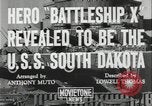
Views of USS South Dakota aka "Battleship X" during World War 2.
Slate reads, "Hero Battle Ship X revealed to be USS South Dakota" Aerial view of USS South Dakota at sea with airplane wing tip in foreground. Sailors assembled on the deck of the USS South Dakota. Overhead view of ship's guns. The ship had been dubbed "Battleship X' for reporting to the press around January 1943 when it was undergoing repairs. Guns firing on the USS South Dakota. An officer speaks.
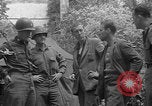
Escaped U.S. Army bomber pilots speak with officers after rescue during World War 2
Two escaped U.S. Army Air Force aircraft pilots, shot down in enemy territory in December 1943 during World War II, speak with U.S. officers after their rescue in 1944. Both pilots are dressed in civilian clothing, and one wears improvised shoes. (Footage shot around the time of the Battle of Cisterna).
A cameraman of U.S. Marines explains about taking footage of the Tarawa invasion in the Pacific Theater (WW2)
United States Army and Navy newsroom where combat films are processed. The combat films are made by U.S. Army, U.S. Navy, and U.S. Marines. A man with a roll of negative. A cameraman of U.S. Marines explains how the footage of the Tarawa invasion in the Pacific Theater was taken. Marines aboard the ships. Chaplains carry out a religious ceremony on the ship. Marines read prayer books during the religious ceremony on deck. Some Marines are seen kneeling in prayer. Marines hold a cake with inscription “A Jungle Plus Coconut Tree Equals Jap So Keep Your Eyes Open”. The Marines and the cameraman instructed about the operation. Officer points to a map. Naval guns fired. Heavy smoke and explosions. Invasion barges beached. The troops land on the beach. Some Marines wade on water. Troops fire. The wounded are carried on stretcher and evacuated on Higgins boat. Dead bodies of the Japanese soldiers. A bloated body of a Japanese soldier with arms and legs outstretched. Prisoners on beach. Soldiers clear airstrips. A kitten hides under a tank. Soldier feeds kitten. Naked soldiers washing themselves outside a village. Artillery on the beach. Troops go to see the raising of U.S. flag. (World War II period).
CRITICALPAST.COM: About Us | Contact Us | FAQs - How to Order | License Agreement | My Account | My Lightboxes | Shopping Cart | Advanced Search | Featured Collections | Website Terms & Conditions | Privacy Policy ©2026 CriticalPast LLC.
License Agreement |
Terms & Conditions |
Privacy Policy
©2026 CriticalPast LLC.