


 Francais
 Deutsch
 Italiano
Refine Your Search
Kiribati Gilbert Islands 1943 stock footage and images
- Showing 3583 to 3588 of 6726 results more
more Hide
Hide
The U.S. Army Signal Corps Signal Intelligence work during World War II.
The role and contribution of the U.S. Army Signal Corps in combat during World War 2. Soldiers on guard duty in a field. A soldiers talks over a radio receiver at the door of a cabin. An antenna on the cabin roof. Signal Officers intercept enemy transmission by the mean of radio and other electric equipment. Electrical equipment, radios, deciphering equipment, laboratory equipment and parts seen at work in Signal Corps facilities where intercepted enemy communications are analyzed and codes and ciphers are deciphered. Officers skilled in encryption and decryption work to decode enemy codes and messages. They use a microscope to read and write messages in microscopic writing on grains of rice. Signal Intelligence work in North Africa during World War 2. U.S. soldiers on tanks advance over rough terrain. A formation of U.S. B-17 bomber aircraft in flight. Tanks advance with the ground forces. The radio intercept picked up messages from a certain German Division headquarters. A soldier sets radio direction finders on the particular location. Officers receive the information and locate the headquarters on a map. The Allied troops attack the enemy. They hit them with tracers. Artillery and guns are fired. Smoke from fire due to explosions. Soldiers advance in prone positions. They lie low during the night assaults. German soldiers load and fire a mortar. Explosions in a field due to mortar attack. Dead U.S. soldiers and injured U.S. soldiers in foxholes and on the battlefield following mortar attacks. U.S. soldiers help a fellow wounded soldier in a jungle setting.
V-mail procedures including cutting, microfilming, transport, photographic enlargement, and processing during WWII.
The use of V-mail (Victory Mail) by the United States during World War II. V-mail procedures including cutting, microfilming, transport, photographic enlargement, and processing of V-mail letters and post. A poster promoting the use of V-mail. Women in a line at a post office. The post office staff at counter windows serves the customers. A woman collects a V-mail letter, writes her message and then addresses the letter. The preferred use of a softer pencil in V-mails. Cutting: Specially trained soldiers unpack the V-mails and use a cutting machine to open each mail. Processing: The experienced staff sorts mails into the respective destination groups at sorting tables. Soldiers open mails to photograph them. A soldier sorts mail that can't be photographed and are to be sent back. These mails include stamps, enclosures, snapshots and bad writing. The correct mails are then sorted into given numbers in bundles. Microfilming: Women use Airgraph machines to photograph each mail on 16mm films. 1600 mails on 100 feet of film. The complete reels are sent for developing. Women put in new reels of negatives into the cameras. Developers dry the film reels. Stacks of reels on a table containing images of thousands of letters. Soldiers packing and stacking many hundreds of sacks filled with V-mail letter microfilm images. A Boeing 314 Pan American Clipper flying boat sea plane (military designation C-98) is seen taking off to transport V-mail to major destination points. A bag of microfilm reels is delivered to an officer. He unpacks the reels and sends them to the printing room. Enlargement: Enlargement machines are used to enlarge the snapshots. Men and women operate the printing machines. Soldiers with the printed facsimiles on tables. Processing: Women slice the prints into separate letters. Machines used to insert facsimiles into V-mail envelopes and seal them. The mails are then sent to the exact destinations by ordinary post. Soldiers gather around as a comrade distributes mail at a U.S. military base in the combat area.
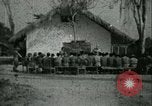
A U.S. OSS officer uses a black board to instruct Burmese students in Burma during World War if.
U.S. OSS (Office of Strategic Services) officers train Burmese recruits in Burma during World War II. An OSS officer instructs Burmese students on ambush and traps. Students seated on benches outside a hut. The instructor uses a black board. He explains the written matter and diagrams on the board. A Burmese instructor translates the information. A student stands up and asks a question. The instructor responds.
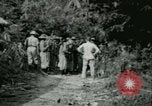
American and Burmese instructors train recruits in mine laying in Burma during World War II.
U.S. OSS (Office of Strategic Services) officers train Burmese recruits in Burma during World War II. American and Burmese instructors with the students on a path in the jungle. The instructor gives instructions and demonstrates mine laying near huts in a clearing. The students watch. The y mark positions on either side of the road and lay mines. The recruits in camouflaged hats. The instructors demonstrate and inspect. The students lay mines in the thick foliage. Dust flies on the jungle path.
OSS and Burmese officers train Burmese students in machine gun firing and grenade throwing in Burma during World War II.
U.S. OSS (Office of Strategic Services) officers train Burmese recruits in Burma during World War II. Instructors and Burmese students on tracks in a clearing. The students at attention. The U.S. and Burmese instructors talk to the students. The e students get into a truck. The officers in a military jeep and the students in a truck leave the ground. They reach the firing range, get off, get into formation and salute the officers. The officers give instructions and mark their positions. The recruits are trained in machine gun handling and firing as well as grenade throwing. The American instructor demonstrates the correct standing position and handling of a machine gun. The students watch, learn and follow the instructions. The instructors watch as the recruits hold machine guns, take aim and fire at targets on the range. The American instructor watches as students throw grenades on practice targets. They throw the grenade and fall into the prone position. Burmese soldiers smile and salute.
American and Burmese instructors train Burmese students in the uses of a compass and medical procedures during World War II.
U.S. OSS (Office of Strategic Services) officers train Burmese recruits in Burma during World War II. The students learn the uses of a compass and medical procedures for helping wounded comrades. A Burmese instructor shows them a compass and demonstrates its uses. The students listen as he gives instructions. The instructor demonstrates the uses of a compass on a map on the table. A Burmese recruit stands on a table as another wraps a bandage around his foot to demonstrate medical procedures. An American instructor and the other students observe. The American instructor then demonstrates tying of a bandage around the head. The Burmese instructor guides the students to follow the same steps. The American instructor looks on as the recruits demonstrate plastering a broken arm. He guides the students.
CRITICALPAST.COM: About Us | Contact Us | FAQs - How to Order | License Agreement | My Account | My Lightboxes | Shopping Cart | Advanced Search | Featured Collections | Website Terms & Conditions | Privacy Policy ©2026 CriticalPast LLC.
License Agreement |
Terms & Conditions |
Privacy Policy
©2026 CriticalPast LLC.