


 Francais
 Deutsch
 Italiano
Refine Your Search
Kiribati Gilbert Islands 1943 stock footage and images
- Showing 4243 to 4248 of 6726 results more
more Hide
Hide
U.S. Army Air Force pilots fly P-40 airplanes from the USS Ranger, to Casablanca, Morocco, during World War II
U.S. Navy provides aircraft carrier ferry service for the U.S. Army Air Corps during World War 2. View of the USS Ranger (CV-4) at sea with sunset and clouds in background. Scene shifts to the ship's company, turned out on deck in dress whites. An accompanying contingent of U.S. marines, is also seen presenting arms. Next. Rear Admiral, Ernest D. McWhorter,Commander Task Force 22, is seen conversing with Captain C. T. Durgin, Captain of the USS Ranger. Scene shifts to flight deck of the Ranger, where deck crews are readying Curtiss P-40L airplanes for flight to the former Vichy French Anfa Airport near Casablance (captured by the Allies in Operation Torch). One P-40 is named "Regina IV." U.S. Army Air Force 57th Fighter Group commander, Colonel Frank H. Mears, shakes hands with a navy officer, from the cockpit of his P-40. He then takes off. More P-40s follow. Closeup of an Army pilot in cockpit of a P-40, giving a thumbs up. P-40s forming up in flight overhead. Navy officers and sailors watch the departing P-40s and give thumbs up for approval. P-40s buzz the carrier as they depart for Casablanca, Morocco.
British R.A.F. bombing raids by A-20 aircraft in German-occupied France and over Germany in World War II.
World War 2 Newsreel footage of British air raids on German occupied France, titled "Day and Night R.A.F. makes Nazis take it !" Six Douglas DB-7/A-20 Havoc attack bomber aircraft (American made, but ordered by Britain) take off from England and are seen flying in formation over the English Channel. A-20 Havocs approach beach. A-20 Havocs over French countryside. Point of view footage looking out from cockpit of airplanes flying low over French countryside and approaching German held industrial and chemical plants in Lille making German munitions. View of bombardier pulling bomb release trigger, followed by bombs away view. Damage done by bombing seen. Port and buildings being bombed by A-20 bombers at St. Malo. Explosions seen in dock areas from the air. Back in England, RAF pilots suit-up in cold weather gear for night bombing flights over Germany. View of a line of carrier pigeons each in a box, to be carried in each plane and released if the pilot gets in trouble. A pilot carrying a pigeon in a box. Bomber crews consult together at their planes before boarding. U.S. airmen being trained join together with RAF flyers and board Avro Lancaster bombers for the night raids. Lancaster bombers taxi and takeoff. Halifax III taxiing and taking off. Hawker Hurricane or Spitfire fighters seen in flight ready to engage Nazi fighters. Views of actual bombing raid on a German city by Lancaster bombers. Incoming flak and anti-aircraft fire. Explosions on ground over targets in Germany. [Note: Interestingly, the film uses shots of a German Junkers 88 bomber, instead of a Lancaster, to illustrate the nose of the aircraft at night.]
Slow motion views of F4U Corsair mishap during landing on flight deck of USS Bunker Hill during World War II
Views from low on flight deck as a United States F4U Corsair of VF-17, comes in for a landing on the USS Bunker Hill (CV-17) during shakedown cruise. It engages several restraining cables, and noses over. The plane rights itself and is pulled back by the cables. Smoke seen coming from engine cowling. Sailors including firefighters in protective gear, rush toward the aircraft. Sailor sprays extinguisher into cowling area of the Corsair's engine. The pilot is seen apparently unhurt, in the open cockpit.
F4U Corsair landing mishap on USS Bunker Hill during World War II
F4U Corsair landing mishap during shakedown cruise of Navy Fighter Squadron VF-17, aboard the carrier, USS Bunker Hill (CV-17) during World War 2. The event is shown in seen in slow motion. A Douglas SBD Dauntless makes a normal landing. Next, a Corsair, marked 17-F-10, engages a restraining cable but noses over to completely vertical position, and then falls off toward left wing, before settling back. Smoke engulfs the airplane, but quickly clears. Sailors quickly respond, surrounding the aircraft.
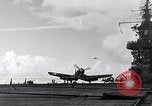
USS Bunker Hill shakedown cruise in World War II. F4U noses over while landing. SB2C Helldiver ditched next to the carrier
Mishaps during the shakedown cruise of the USS Bunker Hill (CV-17) in World War 2. A U.S. Navy F4U Corsair of VF-17, noses over but settles upright, while landing on the carrier. View from port stern of the Bunker Hill as she passes an SB2C Helldiver dive bomber from VB-17, in the water. The pilot and gunner climb over the sinking airplane to board their emergency life raft, already inflated next to the airplane. As the crew of the Bunker Hill watches, the air crewmen board their life raft, as the dive bomber sinks.
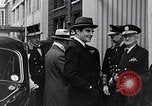
U.S. SECNAV Franklin Knox visits U.S. Admiral Harold Stark and British Vice-Admiral Sir Bertram H Ramsay in London during World War II
Franklin Knox, U.S. Secretary of the Navy (SECNAV) shakes hands with U.S. Navy Admiral Harold Stark, Commander of U.S. Naval Forces in Europe, British Vice-Admiral Sir Bertram H Ramsay, and other British and American naval officers, after visiting them in Stark's headquarters at 20 Grosvenor Square, London, England, during World War 2. Secretary Knox enters a car. Scene shifts to an RAF airfield where Secretary Knox stands with Admiral Stark and two military aides,near the wing of a U.S. Army Air Forces C-47 airplane. Stark and Knox stand together and then Knox bids Stark goodbye, as he prepares to board the C-47 airplane. Admiral Stark salutes as Secretary Knox climbs aboard the plane. Admiral Stark and aides wave goodbye as the aircraft taxis out. Several members of British Women's Auxiliary Air Force (WAAF) walk across the airfield ramp, as the C-47 taxis out for takeoff
CRITICALPAST.COM: About Us | Contact Us | FAQs - How to Order | License Agreement | My Account | My Lightboxes | Shopping Cart | Advanced Search | Featured Collections | Website Terms & Conditions | Privacy Policy ©2026 CriticalPast LLC.
License Agreement |
Terms & Conditions |
Privacy Policy
©2026 CriticalPast LLC.