


 Francais
 Deutsch
 Italiano

Refine Your Search
Kiribati Gilbert Islands 1943 stock footage and images
- Showing 451 to 456 of 6739 results more
 Hide
Color Sound

U.S. Nuclear test "Cherokee" in Operation Redwing, off Namu Island, Bikini Atoll, Marshall Islands.
First air drop test of a thermonuclear weapon. The Hydrogen bomb nuclear weapon was dropped from a USAF B-52 bomber (not seen) that flew from Fred Island, Eniwetak (sometimes spelled Enewetak or Eniewetok), on May 21, 1956. View appears to be from an aircraft flying above altocumulus clouds, below higher stratiform layers. The film begins with a complete whiteout from the initial fireball. As that subsides, local stratiform clouds take on a rosy hue and the center fireball is seen rising above them. As the fireball rises, it takes on a somewhat hemispherical shape, flat on the bottom, from which a straight stem-like column extends toward the ground. The light of the explosion slowly fades and complete darkness ensues. Official accounts state that the intended ground zero was directly over Namu Island, but the flight crew mistook an observation facility on a different island for their targeting beacon with the result that the weapon delivery was grossly in error. The bomb detonated some 4 miles off target over the ocean northeast of Namu. As a result essentially all of the weapons effects data was lost. ( Note: According to ancillary reports, the delivery error resulted in blast overpressures and thermal effects on the 6 structural response targets between Iroij and Namu Islands, greatly exceeding specifications for any use in scientific military modeling of high yield aerial detonations. Plans for graded damages analysis failed when all the structures collapsed. Effects cameras also failed from the intense fireball heat.)

German-American Bund Long Island German Day at Camp Siegfried in Yaphank, Long Island.
A Nazi gathering of men, women, and children members of the German-American Bund at Camp Siegfried in Yaphank, Long Island, New York, United States. The gathering is to celebrate "Deutscher Tag von Long Island 1937," aka Long Island German Day. Boys and girls and young men and women dressed in uniforms of the German-American Bund display Nazi salutes as they march on the grounds of Camp Siegfried in front of a memorial commemorating Long Island German Day. Nazi and American flag banners displayed on either side of the memorial.
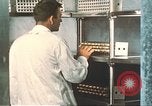
Research animals herded in research building at the Plum Island Animal Disease Center in Long Island, New York.
A film based on the Plum Island Animal Disease Center in Long Island, New York which is dedicated to study of foreign animal diseases. A technician works with bacteriological incubators to grow tissue cultures. Technicians inoculate a culture with foot and mouth disease virus of animal. The technicians carry out this procedure in a safety hood. Cattle are used as research animals and are held in quarantine for two weeks. Animals enter a research building after the quarantine period is over. The animals are herded through different doors in the building. A man dumps food for the animals in a chute. The cattle feed is processed in a hammer mill. Air passes through filters. Glass block openings in the research building. A guard patrols the area in a radio equipped vehicle. A fisherman's boat goes away from Plum Island coast. Two wire fences to isolate the area. A technician handles supplies.

Technicians carry out tests on foot and mouth disease virus at the Plum Island Animal Disease Center in Long Island, New York.
A film based on the Plum Island Animal Disease Center in Long Island, New York which is dedicated to study of foreign animal diseases. Animated map of the United States of America depicts the New England region of the U.S. affected with foot and mouth disease of animals during year 1870 and Mexico and Canada affected by epizootics in 1946 and 1952 respectively. A technician stores animal foot and mouth disease virus in a laboratory freezer.
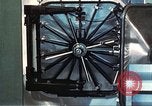
A scientist examines the internal organs of a dead animal at the Plum Island Animal Disease Center in Long Island, New York.
A film based on the Plum Island Animal Disease Center in Long Island, New York which is dedicated to study of foreign animal diseases. Incoming supplies and equipment needed to carry out research are admitted through autoclaves to achieve sterilization. Technicians at different machines handle glassware and other equipment to be used for the research. Scientists expose research animals to foot and mouth disease virus in an isolated room. The virus is injected below the tongue of the animals. A man takes out the internal organs of a humanely destroyed cattle. The scientist lays down his knives and wears rubber gloves. He examines the internal organs of the cattle during the post-mortem. The animal carcass is placed into an incinerator. A technician wearing red clothing operates the incinerator. The carcass burns in the incinerator.

Pictures and animation show U.S. fleet advancing towards Japanese acquired Saipan island in the Mariana Islands.
Animated map shows U.S. forces acquiring Saipan, Mariana Islands from the Japanese during World War II. Pictures of U.S. fleet underway. Aircraft drop bombs on target areas. Fire and explosions on a beachhead. Pictures of boats being lowered for soldiers to advance on the beachhead. Animation shows forces arriving at Tanapag Harbor. U.S. troops in landing crafts. Activity at a line of departure. Fire and explosions on a beach as aircraft drop bombs.
CRITICALPAST.COM: About Us | Contact Us | FAQs - How to Order | License Agreement | My Account | My Lightboxes | Shopping Cart | Advanced Search | Featured Collections | Website Terms & Conditions | Privacy Policy ©2026 CriticalPast LLC.
License Agreement |
Terms & Conditions |
Privacy Policy
©2026 CriticalPast LLC.