


 Francais
 Deutsch
 Italiano

Refine Your Search
Kiribati Gilbert Islands 1943 stock footage and images
- Showing 505 to 510 of 6739 results more
 Hide
Color Sound

USAAF P-47 fighter-bombers strike Japanese positions during battle of Tinian Island during World War II.
Battle of the Pacific during World War 2 on the island of Tinian, Mariana Islands. P-47 Thunderbolt fighter aircraft of the 318th Fighter Group drop Napalm fire bombs. Smoke billowing up from Napalm incendiary bomb explosions on island. Explosions on island viewed across the water from U.S. positions that are firing artillery. A dozen P-47s from the 318th Fighter Group seen in formation. One, from the 19th Fighter Squadron, is named "Apple Jack." Pilot can be seen clearly in the cockpit.
United States Navy ships and carrier planes bombard Kwajalein, Marshall Islands (WW2)
United States amphibious invasion and capture of Kwajalein, Marshall Islands during World War II. Supplies for the departure of ships. Goods, war material and vehicles loaded. Supplies loaded manually and by cranes. Boxes of supplies checked. Ships underway. Animation depicts the movement of ships. Aircraft on flight deck of the aircraft carrier. Aircraft takes off and in flight. Ships and carrier planes bombard the island. Explosions and smoke rises up. Kamikaze suicide planes attack ships. 4th Marine Division troops board landing craft. Marines land on the island. Marines and tanks advance on the island. Troops fire artillery. Dead bodies of Japanese soldiers. Landing craft beached. Marine troops on the beach.
The icebreaker, USS Burton Island, breaking her way through ice sheets Northeast of St. Lawrence island, Alaska
The icebreaker, USS Burton Island, heading Northeast from St. Lawrence Island, Alaska, through ice field. View from bow, as she follows "groove" where ice field has separated and refrozen enabling the icebreaker to easily make way. As she progresses, the ice thickens and she slows, until the USS Burton Island finally stops. The ship's helicopter cranks up and warms up preparing to scout out easier pathways through the ice field. View from the low-flying helicopter, of a polar bear moving across ice flows. view of the icebreaker from returning helicopter. Since no "leads" could be found, the ship must use engine power. View of the engine room where sailors start more engines to increase the icebreaker's driving power. The icebreaker backs down from the ice sheet, and then as Captain calls for more forward power, a sailor on deck advances control, and the ship begins to break her way forward, through the ice.
Aircraft fly over the island and drop paratroopers on Corregidor in the Philippine Islands.
Paratroopers landing on Corregidor in the Philippine Islands during World War II. A paratrooper descends. Many parachutes on the ground. An aircraft passes paratroopers descend to Corregidor. Aircraft pass over the island and drop paratroopers. Ships underway at sea. Paratroopers descend, many parachutes lay on the island in the background.
Japanese troops surrender Marcus Island and Wake Island in the Pacific Theater
Part of ceremonies marking Japanese surender and victory over Japan at end of World War 2. Japanese forces surrender Marcus Island on board USS Bagley (DD-386) in Pacific Theater. Japanese Rear Admiral M. Matsubara surrenders his garrison to U.S. Navy Rear Admiral Whiting. Japanese and Allied officers sign the papers of surrender. View in September of American flag being raised on Wake Island by U.S. Marines after Japanese surrender. Colonel Walter Baylor accepts honors at the ceremony, having been the last to leave Wake Island, and now the first to return. View of destroyed Grumman F-4 Wildcats that assisted in efforts to hold off Japanese forces for 14 days of attack, earlier in the war.
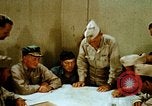
U.S. Navy fighter and bomber aircraft from USS Yorktown strafe Japanese bases and positions on the Truk Islands.
USS Yorktown CV-10 in the Pacific Theater during World War 2. U.S. Naval officers and sailors discuss over a map on a table. Animated map depicts Japanese fleet positions on the Truk Atoll of Islands. USS Yorktown Navy flier squadron and squadrons from other carriers take off for combat over the Truk Islands. Sailors talk over the radio aboard USS Yorktown. A map shows the heavily fortified islands surrounded by air strips, and naval anchorages among the islands. Crewmen aboard Yorktown prepare the planes for take off. Machine gun fire from the planes over the Truk Islands. They dive bomb the island. The aircraft are hit and descend to the ground. A plane drops into the ocean. U.S. airplanes bomb Japanese planes on fighter strips, bomb bases and sea plane ranches. Smoke due to heavy bombardment. Planes dive and drop bombs. Fire due to bombing of a fast fleet tanker hiding in a sheltered cove. U.S. bombers and fighter planes strafe other fleet auxiliaries including rice boats, transports and ammunition ships. They are set on fire with 50 caliber incendiaries and armor piercing plugs. The ships on fire sink into the ocean.
CRITICALPAST.COM: About Us | Contact Us | FAQs - How to Order | License Agreement | My Account | My Lightboxes | Shopping Cart | Advanced Search | Featured Collections | Website Terms & Conditions | Privacy Policy ©2026 CriticalPast LLC.
License Agreement |
Terms & Conditions |
Privacy Policy
©2026 CriticalPast LLC.