


 Francais
 Deutsch
 Italiano
Refine Your Search
Kiska Aleutian Islands Alaska 1944 stock footage and images
- Showing 7393 to 7398 of 9823 results more
more Hide
Hide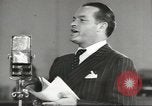
Bob Hope proposes a vote of thanks on a weekly radio program
comedian Bob Hope proposes a vote of thanks in a sing song manner on a weekly radio program as it is being recorded at a Hollywood studio in Los Angles, California.
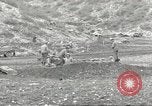
Soldiers of 2nd French Morocon Division in Italy during World War 2
Soldiers of 435th anti aircraft Battery attached to 2nd French Morocon division use a culvert under a road as a dugout in Italy. 40 mm anti aircraft gun and a culvert with two soldiers in the foreground. Inside the culvert a soldier reads a newspaper and another one smokes a cigar outside the culvert. French expeditionary forces receive PX ration to the west of Scapoli.
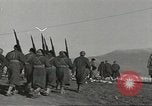
Honor Squad of 2nd French Morocon Division at a burial in Italy during World War 2
Burial of dead soldiers at French 3rd Reconnaissance Battalion as honor squad of 2nd French Moroccan division arrives at cemetery in Italy. Commanding General and soldiers attend the burial Soldiers carry caskets and place them before the Chaplain. He offers prayers and men sprinkle holy water over them. Caskets moved to burial sites. A French flag flies in background.
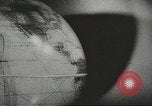
Japan expands its military presence and influence in the Pacific before World War II. U.S. employs air power early in the war.
Opening scene shows Emperor Hirohito of Japan dressed in military uniform, astride a white horse, riding along a path, followed by military officers. (Narrator cites Japanese declaration of war against the U.S. and Britain on December 7, 1941.) Japanese soldiers in two groups engage in local war games against each other. Animated map shows Japan and the expansion of her influence and military presence throughout the Pacific. Aerial view through scattered clouds, of Japanese fleet of warships. Aerial view of American warplanes in formation through scattered clouds. Closeup from cockpit of a U.S. A-20 Havoc aircraft, showing its left engine and prop and a second A-20 flying to its left in close formation. Swerving wake of a Japanese warship engaged in evasive maneuvers on surface of the sea, below. Several scenes of U.S. aircraft strafing Japanese warships. Aerial view from a U.S. B-25, flying above Japanese ships, of another B-25, with its bomb bay doors open as it launches a torpedo. Japanese ship is struck, explodes, and sinks stern first. Glimpse of more Japanese ships in a convoy.
Allied planning for the final invasion of Japan in World War II
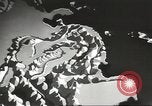
Scene opens with a map illustrating one possible Allied path for invasion of Japan. It proceeds from India and Burma to China and thence to Japan. A U.S. B-24 bomber is seen landing at a Far East Air field. Next, the Supreme Allied Commander of South-East Command (SEAC) Admiral Lord Mountbatten, is seen posing with Chinese General Li Zongren (AKA Li Tsung-jen) and other high ranking Chinese officers, and then walking with them. Next are views of U.S. General Joseph Stillwell working with staff as they consult maps. Then, Chinese laborers are seen engaged in construction of a bridge over a riverbed, that is to be part of the "Ledo Road,"traversing Burma and providing a highway from India to Chunking, China. Trucks moving over the already completed segments of the road, carry men and war materiel. One truck passes a local native drawing water from a well using a long counterbalanced pole. At the frontier of the roadbuilding, Chinese soldiers chop their way through dense jungles and battle Japanese forces firing at them. A fallen soldier. Allied soldiers shouting as run into a village engaging Japanese forces. Structures in the village burning and spreading in the area. Scene shifts abruptly to an animated map illustrating what are believed to be the Japanese plan for its last desparate defense. It shows them falling back to highly defensible boundaries encompassing sources of supplies needed to sustain their defense. Aerial views of Manchurian landscape. Japanese officials are seen at their administrative offices in Manchuria. Large numbers of Manchurian workers are seen headed to work near a factory. Others are engaged in open pit mining, where explosives are used to expose and ready ores for extraction. Views inside a Manchurian steel plant supporting the Japanese war effort. Japanese military forces are shown moving by horseback in the area, ostensibly to push further into China and add more protection against potential Allied offensives. Likewise, Japanese warships are shown at sea maneuvering to defensive locations. This is all summed up in a map showing the expected disposition and status of military defensives for Japan's final defense (Fortress Japan). Street traffic on a city street in Japan. A large group of Japanese women in traditional dress, carry banners and quietly bow. View of the Japanese Diet Building (Parliament) and political and Military leaders inside, including Prime Minister Tojo, Hideki.
Japanese people in all walks of life supporting their war efforts in World War II
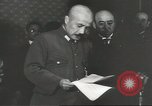
Japanese leader, Hideki Tojo addresses members of the legislature (Diet) saying their task is to set the Emperor's mind at ease. View of vast field full of Japanese soldiers performing supervised calisthenics. A kitchen preparing meals in boxes for Japanese soldiers. Soldiers hanging, one arm at a time, from a horizontal bar in a gymnasium. Radio antennas and smoke stacks are seen in Japanese industrial sites. Factory workers, all dressed alike, enter a war plant in Japan. Scientists seeking to invent new weapons of war. Japanese men and women workers in war production factories producing ammunition. Workers assembling artillery in a factory. Others building a new ship in a shipyard. Japanese boys and girls in school uniforms working on a farm. Women carrying harvested crop suspended from poles. Others threshing harvested grain and working in fields. Men and women operating Japanese fishing boats and hauling nets filled with their catches.
CRITICALPAST.COM: About Us | Contact Us | FAQs - How to Order | License Agreement | My Account | My Lightboxes | Shopping Cart | Advanced Search | Featured Collections | Website Terms & Conditions | Privacy Policy ©2026 CriticalPast LLC.
License Agreement |
Terms & Conditions |
Privacy Policy
©2026 CriticalPast LLC.