


 Francais
 Deutsch
 Italiano
Refine Your Search
Kiska Aleutian Islands Alaska 1944 stock footage and images
- Showing 1441 to 1446 of 9821 results more
more Hide
Hide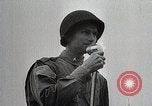
U.S. Paratroopers of 82nd and 101st Airborne divisions preparing to depart England the day before D-day in World War II
Film begins showing Brigadier General James M. Gavin, Commander of the Force A (parachute) contingent of the 82nd Airborne Division, standing on the hood of a jeep, at an airfield, to brief his paratroopers as they prepare for the D-Day invasion, during World War 2. A C-47 transport plane taxis behind the assembled group of troopers. Barbed wire is strung in the foreground. Paratroopers are issued French currency before departure. Some gamble with it using dice. Troops are seen playing volleyball on a field surrounded by trees. On an airfield, one trooper hits ground balls with a soft ball and several others field it. Some other troopers sit in grass next to the ramp, assembling wooden containers for airdrop. Two Army Air Forces mechanics fasten a tow bar on the nose wheel of a British-built Horsa Mk.II glider. They then tow it with a tug. View from above of Horsa gliders and C-47 tow airplanes, all in D-Day paint stripes, lined up on an airfield ramp. Paratrooper tent camp is viewed from above. Then, General Dwight D. Eisenhower and other senior officers are seen visiting paratroopers of the 101st Airborne Division, at the camp, on June 5, 1944, as they prepare to board their aircraft. Famous closeup of General Eisenhower speaking to a tall paratrooper who has his face camouflaged with grease paint.View looking down, as Eisenhower circulates among the troopers. Closeup of him conversing with another one directly.
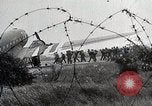
Beginning of the D-Day invasion of France, during World War II
U.S. Paratroopers boarding C-47 aircraft, on June 5th, 1944 during World War 2. Huge naval task force underway in the English Channel. C-47s loaded with paratroopers taking off, the evening of June 5th. C-47s taking off towing gliders. Formations of C-47s and gliders passing over the Naval task force in the English Channel. Three pet dogs with troops on one of the ships.
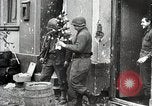
Battle of the Bulge and U.S. stand at Bastogne during World War II
U.S. Army forces during the Battle of the Bulge in World War II . American soldiers from the U.S. Army Headquarters Company, 75th Infantry Division celebrate Christmas, 1944, with a makeshift Christmas tree covered in ornaments. (The soldier at extreme left in the scene has been identified as T4 Jack S. De Rosa.) A pig moves on a muddy street. U.S. Army forces retreat during German breakhrough in the Ardennes. U.S. soldiers laying razor wire and then blowing up a bridge after crossing it. Belgian civilian refugees move with belongings on a road. A loaded bullock cart moves along with some refugees, some of whom are moving back into their villages according to the narrator. German aircraft bomb U.S. forces, who respond with antiaircraft fire. Bombs bursting in a village, as seen from outside buildings and looking through windows of a building. A partially destroyed home collapses. U.S. soldiers firing at aircraft using machine guns mounted on tanks. U.S. Army soldiers and medics carry wounded soldiers on stretchers during active combat. Numerous U.S. Army vehicles and weapons on fire and destroyed by the German attacks. Burning buildings in a town. A wounded U.S. Army officer with his face bandaged. Several dead American soldiers lie on the ground. Wounded American troops at a field hospital. U.S. Army holds the line at Bastogne. U.S. Army soldiers standby at machine gun emplacements, holding the line at Bastogne. Army tank in road near a road sign that says, "Bastogne." U.S. troops operating amid heavy snow. Several German soldiers or spies who infiltrated U.S. lines by American uniforms, are caught and held by U.S. soldiers. Three captured Germans are executed by firing squad. Americans fire 155mm long tom artillery pieces as they continue to advance, pushing back German forces. U.S. soldier using metal detector to mine sweep in a trench on snowy ground.
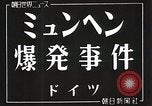
Adolf Hitler attends funeral of victims killed in bomb blast, Germany.
An official comes out from a building. Soldiers inspect the box in bomb blast. View of collapsed building and wreckage after bomb blast in Germany, July 1944. Soldiers find the casualties and killed people in wreckage. The German flag. Adolf Hitler attends funeral of victims killed in bomb blast. He with dignitaries, honors killed people in blast. He meets the people in funeral. (World War II period).
Indonesia is promised independence from Japan, at ceremony in Istana Gambir (Gambir Palace). Indonesian crowds celebrate news.
The promise of independence for Indonesia is broadcast throughout the city of Jakarta, following a ceremony at Istana Gambir, or the Gambir Palace (Merdeka Palace, Jawa Timur Jawa, Jawa Timur 65455, Indonesia). Exterior of Gambir Palace in Jakarta Indonesia. Indonesian leader Sukarno, head of the Japanese-created Poesat Tenaga Rakjat (POETERA - Concentration of People's Power) emerges from a car, climbs steps, and enters the Gambir Palace, presently known as Merdeka Palace. He stands together with other Indonesian officials. Imperial Japanese Army Lieutenant General Kumakichi Harada addresses the gathering and delivers news of Japanese Prime Minister Koiso's September 7, 1944 promise of future independence for Indonesia (the so-called Koiso Declaration). Large Japanese flag seen on the wall behind speakers. Sukarno approaches General Harada, bows and then speaks into a microphone. Scenes of jubilation in the streets of Jakarta as citizens hear the news that Japan has promised future independence for Indonesia (date undeclared). A man standing atop a truck announces the news over a megaphone. People stand near the truck, listen and cheer. A caravan of loaded trucks rolls slowly through a Jakarta neighborhood spreading the news about the promised independence. Citizens cheering and smiling. People standing at a railway station and at stopped trains hear the news and cheer. Citizens including men, women, and many children wave to the passing caravan. Sign on side of truck includes words "Bangsa Indonesia diperkenankan merdeka" meaning "Indonesia allowed Independence". Clip is from a Japanese newsreel during World War 2, with Japanese narration.
U.S. Army Air Forces employ air power in the India-Burma theater during World War II. Chinese troops are equipped and trained by U.S. soldiers.
Camera pans across scenes showing masses of Chinese. Narrator cites their large population as a war asset. Lt Gen. Daniel Sultan Commander of US Forces, India–Burma Theater (USFIBT) describes the Allied mission as simply "placing guns in the hands of men in order that they can kill our common enemy." He describes Japan's 1942 strategy of completely isolating China from outside help. Animated map shows Japanese forces attacking China from bases in Thailand and advancing north, driving British forces into India, and leaving Burma in Japanese hands.Glimpse of Japanese troops occupying Burma. Views of American troops evacuated to India. View of Chinese soldiers boarding U.S. Air Transport Command C-46 transport planes for flights from Kunming to Dinjan and Chabua, India. Closeup of some troops inside the cabin of a plane. Chinese soldiers await transport as a C-47 aircraft takes off in the background. Aerial view of two C-47 planes in formation. View from the air of high cloud covered mountains. Storm clouds over the mountains. Downward view from an aircraft flying over the Himalayan Mountains (called flying the "hump" by U.S. pilots). View of Chinese soldiers inside a transport plane. View out the window of a transport plane landing in India. A C-46 airplane taking off. A large formation of Chinese troops seen after more were brought from China to India, later in the war. American soldiers training troops of the Chinese 38th and 22nd Divisions. General Sultan speaks of the need to build up the U.S.Air Transport Command. Two C-47 airplanes on the ground. One named "The Joker." View of sky filled with B-24 Liberator bombers. Sky filled with C-47 transport planes. Chinese soldiers training in Kunming, climbing out of trench in live fire exercise with machine guns firing over their heads and explosive charges detonating near them. Air frame of a P-47 aircraft being loaded and several of Bell P-39 Airacobra aircraft being loaded aboard ship bound to strengthen the U.S. Army 10th and 14th Air Forces in Burma, in 1944. Covered P-47 aircraft without engines being towed by jeeps along a street in Burma. A large airfield with many U.S. fighter planes parked on its ramps. Engines being installed on P-39 aircraft. A flight line filled with P-40 aircraft displaying Chinese roundels. Some fly over a flight line of U.S. Army Air Forces P-39 aircraft. Glimpse of a fighter plane escorting a transport aircraft. A formation of B-24 Liberator bombers dropping bombs and exploding on Japanese ground targets. Workers are seen unloading large amounts of cargo from a B-24 bomber. Workers rolling a large bomb from the plane onto the tailgate of a truck.
CRITICALPAST.COM: About Us | Contact Us | FAQs - How to Order | License Agreement | My Account | My Lightboxes | Shopping Cart | Advanced Search | Featured Collections | Website Terms & Conditions | Privacy Policy ©2026 CriticalPast LLC.
License Agreement |
Terms & Conditions |
Privacy Policy
©2026 CriticalPast LLC.