


 Francais
 Deutsch
 Italiano
Refine Your Search
Kiska Aleutian Islands Alaska 1944 stock footage and images
- Showing 157 to 162 of 9823 results more
more Hide
Hide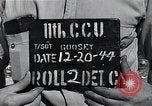
B-29 , tail number 42-224802 on Guam, Mariana Islands during World War II.
Camera pans across North airfield on Guam, Mariana Islands, in World War 2. Next a large group of Airmen are seen standing around a shiny B-29 bomber parked on the ramp. It has "K333" stenciled on left side of its forward fuselage. Its tail number is 42-224802. (This B-29 is named "Purple Shaft," but that is not stenciled on its left side.) The airmen walk around and examine it. Next, The aircraft commander, Lieutenant Warren Richard Aylsworth is seen speaking with a Captain, as they stand next to the plane. Others join in the conversation. (Note: The plane is scheduled to fly to Tinian this night, the 20th, but will land at Saipan, instead, because runway lights were not yet operational on Tinian. The "Purple Shaft" will be the first B-29 to arrive at Tinian, the following day, December 21, 1944.)
U.S. Army 1st Cavalry unit: reenactment battle against Indians at Little Big Horn; actual battle footage in World War 2 at Los Negros Islands, Pacific
A documentary titled 'Hell For Leather' shows combat activities of the U.S. 1st Cavalry Division during wars. Dramatization shows a 1st Cavalry soldier seated on a step and his son touches the insignia of the U.S. 1st Cavalry division on the uniform. Reenacted footage of Cavalry unit battling Native American Indians at the Battle of Little Big Horn. Next scene shows training of U.S. Army cavalry troops for World War 2, as they run an obstacle course and practice bayonet drills. The troops undergo combat training. They practice amphibious landings and crawling near razor wire. Animated map shows the amphibious attacks on Los Negros Island in 1944. A ship underway and soldiers on the deck of the ship. Ship guns are fired in Battle of Los Negros. The U.S. Army troops load a Landing Craft and it gets underway. They approach the shore and get off from the landing craft at the beach. The troops hold guns and advance in jungle region, firing rifles and machine guns, engaging enemy Japanese marines protecting the airfield. The U.S. Army troops firing and advancing against the Japanese. The wounded soldiers on a stretcher. The soldiers fire artillery and mortars. View of dead Japanese troops. The U.S. troops advance. U.S. General MacArthur praises a soldier. 'Bataan' written on the barrel of a gun.
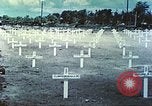
A U.S. Marine walks past 2nd Marine Division Cemetery in Saipan, Mariana Islands.
A U.S. Marine cemetery in Saipan, Mariana Islands during World War II. Crosses over graves. A marine armed with a carbine walks past a sign: '2nd Marine Division Cemetery'. Names of the marines who died on 15th June, 1944 engraved on the crosses.

Various "firsts" in U.S. aviation history from 1918 through 1924; early history of flight and vintage flight scenes
Shows several aviation "firsts" accomplished by U.S. Army Air Service aviators in the period from 1918 through 1924. A close formation of biplanes in flight. President and Mrs. Woodrow Wilson chat with Major Fleet, Officer in charge, on the occasion of the first air mail flight, inaugurated on May 15,1918 between Washington DC and New York.The mail is loaded into the Curtis JN-4 aircraft. Pilot in the cockpit. The aircraft takes off and in flight. Air Service. Mention of aviators helping spot forest fires. Smoke rising from forest fires and mountain ranges. In 1920, U.S. Army Captain St. Clair Streett is seen with some of his Squadron who flew four De Havilland DH-4 aircraft 9,000 miles, from New York City to Nome, Alaska. Two of the men play with pet dogs. Their itinerary is painted on the side of one of the aircraft, along with the names of pilot and mechanic (C.E. Crumline and J.E. Long). In 1923 the first non stop coast-to-coast flight was made in the Fokker T-2 aircraft. . A sign on the aircraft reads 'Army Air Service non stop coast to coast'.First Lieutenants Oakley O.Kelly and John A. Macready board the aircraft, at Roosevelt Field, Long Island, New York, on May 2, 1923. Their Fokker T-2 in flight. Their arrival at Rockwell Field, on Coronado Island (San Diego) California. In 1924, Lt. Russell Maughan is seen boarding his P-1 Hawk airplane at Mitchel Field, on Long Island, New York, and taking off , bound for Crissy Field at the Presidio, San Francisco, California. His goal is the first dawn-to-dusk, coast-to-coast flight. Views of his P-1 Hawk airplane flying over Manhattan, New York City.
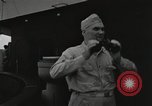
The amphibious assault on Peleliu in World War II
The invasion of Peleliu, Palau Islands during World War 2. A Marine Major General is seen on the bridge of the Flagship USS Mount McKinley, off the coast of Peleliu during the amphibious assault by U.S. forces on September 15, 1944. He is observing the action through a set of binoculars.The island under bombardment. Task force ships firing their Naval guns include the heavy cruiser USS Louisville (CA 28) seen at TC: 01:29, 01:46, & 02:13. Other officers on the deck also watch the action through binoculars. Smoke columns rise from the island under bombardment.
United States capture various islands in the Pacific Theater after defeating the Japanese during World War II.
Allied campaign against the Axis in 1944 during World War II. Exteriors of a building in Tehran, Iran where the Tehran Conference took place in 1943. Soviet Premier Joseph Stalin, U.S. President Franklin Roosevelt and British Prime Minister Winston Churchill seated outside the building after the conference. A map depicts United States campaign against the Japanese in the Pacific Theater. U.S. troops land at the Marshal Islands. Troops fire and advance in Palau islands. Soldiers wade through water. Flakes burst and explosions occur at sea near Saipan. U.S. troops advance inland in Guam. A blind soldier walks.
CRITICALPAST.COM: About Us | Contact Us | FAQs - How to Order | License Agreement | My Account | My Lightboxes | Shopping Cart | Advanced Search | Featured Collections | Website Terms & Conditions | Privacy Policy ©2026 CriticalPast LLC.
License Agreement |
Terms & Conditions |
Privacy Policy
©2026 CriticalPast LLC.