


 Francais
 Deutsch
 Italiano
Refine Your Search
Kiska Aleutian Islands Alaska 1944 stock footage and images
- Showing 1813 to 1818 of 9821 results more
more Hide
Hide
Development of an atomic test site at the Enewetak atoll in the Marshall Islands.
Operation Sandstone, the third American series of atomic bomb tests (tests number 6,7 and 8) at the Enewetak Atoll (sometimes spelled Eniwetok or Eniewetok) in Marshall Islands,Pacific Ocean. Shows development of an atomic test site at the Enewetak Atoll. American personnel dressed in protective suits perform tests and scavenge wreckage on the Eniwetok Atoll. View of men at the shore and distant convoy of U.S. ships at the horizon. An aerial view of the atoll. American army officials map the operation, back at home. Shows unloading of supplies at the shores of Enewetak atoll. Areas are cleared of trees and foliage. Coral soil is leveled by machines. Cement and tar added to harden the surface. Men detonate underwater obstacles. Aerial view of a causeway joining the two islands. Shows tent city for living quarters and quonset supply huts on the island. Workers build cubes of reinforced concrete. Tower in the middle of the lagoon. Man lays underground cables. View of a tower holding fissionable material on the island. Scenes of American scientists working in the Atomic Energy Commission laboratories, exterior of an American university and Mexico's desert.
Atomic bomb test of Operation Greenhouse on the Enewetak Atoll in the Marshall Islands.
Atomic bomb test (Operation Greenhouse) on the Enewetak Atoll (sometimes spelled Eniwetok or Eniewetok) in the Marshall Islands. Animation shows the effects of an atomic blast. Men suspend various reading instruments from a bomb-shaped plastic balloon that will provide valuable readings at the time of atomic blast. Banks of high speed cameras are planted close to the tower holding the fissionable material (Zero Tower). Radioactive measuring instruments are planted on the islands. Scientists and technicians perform a last minute check of the necessary instruments before leaving the island. A view of the Zero Tower. Men leave the island and detonate the bomb. Mushroom cloud of the atomic blast at a distance. Men in boats at a safe distance watch the explosion wearing protective eye glasses.
B-24s of U.S. 5th Bombardment Group operating from Munda Point airfield, New Georgia Island, in World War II.
A B-24 Liberator bomber with nose art painted name "Laden Maiden,"of the USAAF 5th Bombardment Group, sits with engines running,on Munda Point airfield, New Georgia Island, preparing to take off to bomb Japanese shipping near Truk, during World War 2. Broader view shows two squadrons of B-24s preparing for the mission as a rain storm sweeps the island. The aircraft begin taxiing for takeoff. One with nose art name "Tim-ber," shows 25 bombs, for missions, painted on its fuselage. One departing B-24 is seen to use a long takeoff run. Narrator describes difficulties encountered by one B-24 that had to ditch during the mission. Sequence shifts to post-mission scenes the day after the planes returned to Munda.Injured crew members from the ditched B-24, who had been rescued by a Navy PBY, are being transferred to a C-47 aircraft for evacuation to a medical facility. A B-24 is seen taking off on a new mission to bomb Japanese Naval base at Rabaul. View of control tower with several B-24s in formation overhead.
U.S. Navy Assault Force advances while U.S. aircraft bomb Japanese air bases and shore installations on Tinian Island.
USS Yorktown CV-10 in the Pacific Theater during the Battle of the Philippine Sea. The carrier advances towards the Mariana Islands. On the eve of battle, soldiers scrub up to lessen the danger of infection in case they're wounded. Sailors clean up, bathe and rest. Priests conduct services aboard the ship. Sailors take communion and pray. Crewmen read and sleep on their bunks. The carrier underway at dusk. Cooks and bakers prepare a hearty meal of stakes and eggs. Officers take their meal at a table. The alarm goes off to warn of an enemy attack. Sailors rush to their battle stations. Bombardment by Japanese torpedo bomber planes. Fire due to explosions around the ships. Black smoke rises up into the air. Anti aircraft fire from the U.S. ships, planes are hit and descend towards the water. The alarm sounds, pilots rush and board planes and take off. The Radio Plotting Room in charge Smokey and other operators tracks down enemy planes. A map depicts Japanese air bases and military installations in the Mariana Islands, including the Japanese fortified Guam. Radio operators at work. U.S. planes in flight. They swoop down upon Tinian Island and bomb enemy installations. Explosions due to bombardment. Shore installations and air bases bombed. Craters on the island. The U.S. Assault Force battleships including USS Colorado, USS Tennessee and USS Pennsylvania advance. Explosions due to enemy fire. (World War II period).
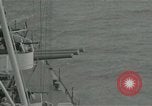
Naval guns fire at Peleliu island, Palau, Pacific Ocean, during World War II.
U.S. Battleships (BBs) and cruisers bombard Peleliu island in Palau, Pacific ocean during World War 2. 5-inch guns bombard the island. Views of guns mounted on ship. Island in background. USS Mississippi and USS Idaho underway. Smoke column rises from the island. (The ship shown at the 1:04 to 1:32 second mark is the heavy cruiser USS Louisville (CA 28 ). View of port side 5 inch 25 caliber dual purpose guns and a 40 mm quad mount. The Louisville's starboard side guns are shown from the 2:30 - 2:51 second mark.)
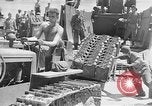
United States 7th Infantry Division troops and Marines invade islands in the Pacific Theater (WW2)
United States amphibious invasion of small islands in the Pacific Theater during World War II. Men load supplies for Marines. Equipment and trucks loaded. 7th Infantry Division troops on landing crafts. Troops land on island. Landing craft beached. Combat between Japanese troops and U.S. Marines. Wounded soldiers given aid. Several Japanese soldiers surrender. A man holds the forms 'Prisoner of War'. Japanese prisoners on island. Destroyed aircraft, equipment and buildings in view. Wounded soldiers carried on stretchers in landing craft. The wounded lifted in ships. Dead bodies on the island. The U.S. flag.
CRITICALPAST.COM: About Us | Contact Us | FAQs - How to Order | License Agreement | My Account | My Lightboxes | Shopping Cart | Advanced Search | Featured Collections | Website Terms & Conditions | Privacy Policy ©2026 CriticalPast LLC.
License Agreement |
Terms & Conditions |
Privacy Policy
©2026 CriticalPast LLC.