


 Francais
 Deutsch
 Italiano

Refine Your Search
Kiska Aleutian Islands Alaska 1944 stock footage and images
- Showing 2941 to 2946 of 9862 results more
 Hide
Color Sound
Colonel Paul Tibbets, Pilot of the Enola Gay, describes his mission dropping the atomic bomb on Hiroshima Japan.
Crew members of the B-29 Enola Gay are interviewed about their atomic bombing mission over Hiroshima Japan by the United States Army Air Force, during World War II. In this interview at North Field, Tinian Island in Marianas Islands, Public Relations Officer, Major John F. Moynahan (not seen) interviews Colonel Paul W. Tibbets, Jr., Pilot of the Enola Gay Among things Colonel Tibbets mentions, he recounts that he took a steep turn to avoid radiation from the explosion. When he saw the explosion he was surprised about its intensity. The cloud from explosion covered the whole city of Hiroshima.
Major Thomas Ferebee, the bombardier aboard Enola Gay shares his experience of the Hiroshima atomic bombing mission
Setting: North Field, Tinian Island, Marianas Islands. Major Thomas Ferebee, the bombardier aboard Enola Gay (B-29 that bombed Hiroshima) is asked about his experiences, by Public Relations Officer John F. Moynahan (not seen). He recalls - His navigator aligned him correctly with the target. Hiroshima was clearly visible to him and so he was able to deliver the bomb. (World War II period).
Interview of Major Charles Sweeney, pilot of the B-29 that dropped the atomic bomb on Nagasaki.
Setting: North Field, Tinian Island in Marianas Islands. Major Charles Sweeney, pilot of the B-29 that dropped the atomic bomb on Nagasaki, is interviewed by Public Affairs Officer, Major John F. Moynahan, who identifies Sweeney as the "pilot of 'The Great Artiste', the second B-29 to drop an atomic bomb on the Empire." (Note: Major Sweeney was the regular pilot of the B-29, "The Great Artiste", which was scheduled to carry the bomb. But it needed to be re-instrumented for the mission. So, instead, he and his crew simply switched airplanes with Captain Frederick C. Bock and crew, whose B-29 "BocksCar" was already properly configured. Thus, "BocksCar" was the airplane from which Sweeney and crew actually dropped the bomb.) In the brief interview, Major Sweeney describes their difficulties in three tries at the primary target and their decision to proceed to their secondary target, Nagasaki. With less remaining fuel than planned, they were forced to recover at Okinawa. (World War II period).
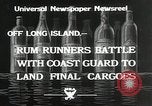
During Prohibition: A battle between the U.S. Coast Guard and liquor smugglers on boats off Long Island, New York.
Two boats move in water. A U.S. Coast Guard vessel approaches a liquor smuggler's boat (during Prohibition). Sound of guns firing. U.S. Coast Guard pursuing the bootleggers running liquor. Both the boats move fast in water.

American men and women do sand-planing along the Atlantic coast in Southampton, Long Island, New York
American men and women do sand-planing along the Atlantic coast in Southampton. Sand-planing is a combination of winter sledding and summer aqua-planing, with a mid sized board, reinforced with aluminum, dragged behind a jeep at 30 miles per hour. Ropes are tied to an Aluminum board at one end, and to a jeep at the other end. Jeep pulls the aluminum board on which a person stands and sand-planes. The boards in some views enter the shallows of the surf (early skim boarding or skimboard concept).

Models compete in Miss Modern Venus Beauty Contest at Steeplechase park on Coney Island.
Miss Modern Venus peagant undergoes at Steeplechase park. Glamorous models parade in swimsuits. First shots of girls filmed in distortion mirrors. Girls parade round ramp built on pool. Cameraman pulls on dolly along line. Girls are measured and judges mark them. Winner Anne Gervis of Brooklyn poses with cup for camera. July 1941.
CRITICALPAST.COM: About Us | Contact Us | FAQs - How to Order | License Agreement | My Account | My Lightboxes | Shopping Cart | Advanced Search | Featured Collections | Website Terms & Conditions | Privacy Policy ©2026 CriticalPast LLC.
License Agreement |
Terms & Conditions |
Privacy Policy
©2026 CriticalPast LLC.