


 Francais
 Deutsch
 Italiano
Refine Your Search
Kiska Aleutian Islands Alaska 1944 stock footage and images
- Showing 3421 to 3426 of 9821 results more
more Hide
Hide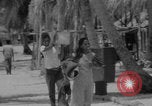
Native men and women carry belongings, push outrigger in shallow water during evacuation of Bikini Atoll
A man and a woman carry their belongings as they evacuate Bikini Atoll during U.S. preparations for nuclear weapon testing under Operation Crossroads. Their young children follow behind them. Native women carrying sacks and boxes on their shoulders. A man pushes a canoe loaded with boxes in the water. Bikini Atoll coast. A boy paddles with a small canoe. Native man pushes outrigger in shallow water (loaded with belongings). A moving DUKW. Belongings of island natives are gathered on the beach before evacuation. United States Navy personnel on LST (LST 1108) wait for natives.
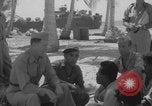
Commodore Ben Wyatt addresses natives of Bikini Atoll through interpreter
United States Commodore Ben Wyatt, the military governor of the Marshall Islands, addresses the natives of Bikini Atoll through his local interpreter James during “Operation Crossroads” (U.S. nuclear weapon testing program). Locals of Bikini Atoll sit down and listen to Wyatt. Other United States Navy personnel are present in the meeting. Interpreter speaks to the natives. A group of United States sailors gather outside a hut. They hold a sign that reads “CROSSROADS TAVERN”. Natives carry belongings and banana or pandan leaves toward LST. A woman carrying a large sack on her shoulders. Natives bring their belongings into a United States LST (Landing Ship, Tank). An outrigger loaded with boxes floats near the LST.
German Army officers visit the Monastery of Saint Panteleimon in Athos, Greece, during World War II.
Film opens with glimpse from a boat approaching Mount Athos, Greece, during World War 2. The Monastery of Saint Panteleimon ( known as the Russian Monastery) in Athos seen from the boat, with a German soldier wearing pith helmet in the foreground. Some buildings in the craggy slopes of the mountain. The Monastery complex seen in successively closer views from the boat approaching the shore. A closeup of the Monastery from nearby on the island. Camera pans part of the structure. Next, an Archbishop and other clergy are seen conducting some German army officers and members of their party on a tour of the Monastery. Closeup of the Archbishop and other clergy. Closeup of a German officer with a Clergy member. Closeup of another clergy member. A German officer descends stairs accompanied by six or more Clergy. The German visitors are escorted in a courtyard shaded by palm trees. The senior German Army officer points and asks questions of the Archbishop, who is seated on the edge of a line of roof tiles. What appears to be a fountain (without water) in a courtyard. Camera pans upward showing the main Monastery building. Scene shifts to sailing vessel tied up at the shore. Next, the German visitors are seen waving from a boat to The Archbishop and members of clergy standing on the shore as their boat pulls away from Mount Athos.
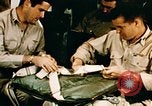
Sailors and crewmen work on weapons and load bombs into aircraft aboard the USS Yorktown in the Pacific.
U.S. Navy documentary highlights functions, duties and crew activities aboard 'The Fighting Lady', pseudonym for the USS Yorktown (CV-10) in the Pacific Theater during the Battle of the Philippine Sea. The carrier advances towards the Mariana Islands. Sailors work on weapons and special devices including magazines, bullets. They work on the bomb line. Sailors prepare the torpedo planes. Aircraft lined on the flight deck. Crewmen arm planes with 500, 1000, and 2000lb bombs, torpedo Iincendiaries, anti-personnel bombs called Daisy Cutters. Sailors pull trolleys with bombs towards the bombers, load the bombs including armor piercing bombs and bombs with delayed action fuses. A crewman pushes new rockets on trolley to be loaded onto the planes. (World War II period).
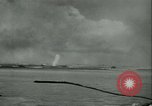
Mission of Joint Assault Signal Companies during amphibious assaults in World War II
Montage of military footage assembled to describe Joint Assault Signal Companies, in World War 2. Some inserts are inconsistent and anachronistic. Scenes of U.S. amphibious assault on a Japanese-held island in the Pacific theater. Camera focuses on small fast-moving assault boat carrying Army and Navy personnel of a Joint Assault Signal Company. A Japanese Aichi B7A Ryusei "Grace" aircraft flying low over the water in background. U.S. troops leaving an LST (Landing Ship Tank) and wading ashore. Some pushing a jeep through the surf. Members of a Joint Assault Signal Company running ashore with a spool of communications cable. Others carrying small arms climb out of an assault boat. Signal company soldiers laying communications cable as they move through jungle. Sailor aboard a U.S. warship ostensibly communicating with the signal company via light blinker. Naval gunfire bombarding enemy positions. Narrator's mention of air support is followed by anachronistic insert of U.S. Army B-10 bombers in formation flight; of bombardier in nose; and views of bombs falling. Next, a formation of B-25 Mitchell bombers is seen in flight and bombs falling. Back in the jungle, signal company men string wire on palm tree. Field artillery firing. Soldiers hunkered down in a shell hole. Signal company soldier using SCR-300-A Radio set.
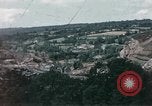
U.S. war correspondents touring France in the months after the Allied invasion near end of World War 2
U.S. war correspondents in France during the first few months after the Allied invasion to liberate France. Views of French countryside. Views in a village. People milling about on a street. Three young French children ride on the back of a mule as a boy pulls the mule. U.S. war correspondents pose with a French family. A woman with a child. A sign on a building reads 'Hotel and Restaurant Moderne' and a French flag flies out front. Small boats at a harbor of a coastal French town. U.S. Army jeeps on a street. Two French civilians walking with a bicycle and two U.S. soldiers together cross the wreckage of a partially destroyed bridge. A bicyclist on the street of a heavily bombed town with rubble and wrecked homes. Close and distant views of Mont Saint Michel, the small rocky island at the mouth of Couesnon River in Normandy. U.S. sailors aboard a vessel at sea.
CRITICALPAST.COM: About Us | Contact Us | FAQs - How to Order | License Agreement | My Account | My Lightboxes | Shopping Cart | Advanced Search | Featured Collections | Website Terms & Conditions | Privacy Policy ©2026 CriticalPast LLC.
License Agreement |
Terms & Conditions |
Privacy Policy
©2026 CriticalPast LLC.