


 Francais
 Deutsch
 Italiano
Refine Your Search
Kiska Aleutian Islands Alaska 1944 stock footage and images
- Showing 3463 to 3468 of 9821 results more
more Hide
Hide
Methods of communication used by United States Marine Corps in jungle warfare in Pacific Theater during World War II.
Reconstruction about deployment of U.S. Marine Corps on island of Pacific and precautions taken by them during jungle warfare in World War II. Marines camouflaged with foliage use camouflage make-up and hide under bushes waiting for Japanese troops. Japanese officers being attacked by Marines hiding under bushes. Marines come across a wire in jungle leading to ambush. They repair the broken wire temporarily. Jungle communications method as a Marine changing position of his canteen from right to left and carrying the message in upper left pocket which identifies him as runner or messenger. Two U.S. Marines search a wounded Marine lying in jungle and identify him as a messenger. Another method of communication depicts Marine using semaphore signal from a hilltop. Group of Marines receive the semaphore signal.
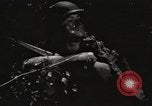
Methods of communications used by U.S. Marine Corps in jungle warfare in Pacific Theater during World War II.
Reconstruction about deployment of U.S. Marine Corps on islands of Pacific and methods of communication used by them at night in jungle warfare during World War II. A string system used by Marines to link a foxhole to another foxhole. Radio communication method being used as a radio operator sends code messages and receive message authenticator from answering operator. Radio operator turns the light off after he delivers the message.
U.S. Marine Corps counter the Japanese trick of attack in jungle warfare in Pacific Theater during World War II.
Reconstruction about deployment of U.S. Marine Corps on islands of Pacific and methods of communication used by them at night in jungle warfare during World War II. A group of Marines stand in bushes. One of them takes a compass reading to keep the direction. One Marine walks ahead. Group follows him. Japanese technique of attack depicts a Japanese soldier camouflaged with foliage and observes foxhole positions of U.S. Marines during daytime. Marines dig up fake foxholes and set up machine guns. Japanese soldier crawls at night towards a Marine foxhole and being attacked by a Marine. Explosions occur in jungle. Marines watch from a foxhole.
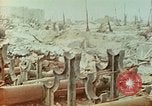
United States Navy officers aboard a U.S. ship in the Pacific Theater during World War II.
U.S. Naval operations in the Pacific Theater during World War II. A damaged Japanese fuel dump on a Pacific island. A damaged Japanese pillbox. A U.S. officer on the deck of a ship. A radar grid turns. U.S. officers come aboard. The group talks on the deck.
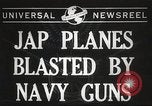
United States naval guns down Japanese torpedo airplanes in the Pacific Ocean during World War II.
A U.S. convoy underway in the Pacific Ocean heads for a raid on the Marshall Islands during World War II. F4U Corsair fighter airplanes with wings folded on the deck of a U.S. carrier underway. U.S. anti-aircraft guns down two Japanese torpedo airplanes. A Japanese airplane in flames falls in the ocean off the stern of the ship. A sailor lies down on the deck of the U.S. carrier as the flaming airplane passes. Another Japanese aircraft crosses behind the ship and also crashes in flames.
Promotion of war bonds in the United States during World War II.
A film titled 'What If They Quit' dramatizes promotion of war bonds in the United States during World War II. A man carries a box walks out of a building. He tries to convince a man named Joe who thinks that he cannot afford to buy war bonds anymore. Workers work in factories and on an assembly line contributing to war effort. A U.S. Task Force underway at sea. U.S. Marines hitting Pacific island beaches. Naval bombardment on sea waters. U.S. WACs (Women's Army Corps) parade in formation. U.S. troops advance on a beach under heavy fire. The man on the street convinces Joe to buy war bonds and says that if American troops can afford to fight then American citizens can also afford to buy bonds.
CRITICALPAST.COM: About Us | Contact Us | FAQs - How to Order | License Agreement | My Account | My Lightboxes | Shopping Cart | Advanced Search | Featured Collections | Website Terms & Conditions | Privacy Policy ©2026 CriticalPast LLC.
License Agreement |
Terms & Conditions |
Privacy Policy
©2026 CriticalPast LLC.