


 Francais
 Deutsch
 Italiano
Refine Your Search
Kiska Aleutian Islands Alaska 1944 stock footage and images
- Showing 3967 to 3972 of 9823 results more
more Hide
Hide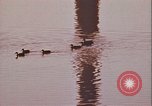
The Washington Monument and the U.S. Capitol in Washington DC, United States.
Monuments in Washington DC, United States. Several ducks swimming in the Lincoln Memorial reflecting pool (2 Lincoln Memorial Cir NW, Washington, DC 20024, United States) with the Washington Monument behind, and Capitol visible in distance. A street lighted in the night. View of the Potomac River, the Lincoln Memorial, the Washington Monument, and the U.S. Capitol, in single view, early morning. A street in downtown Washington DC. Cars moving on a road and buildings on either side of the road. The U.S. Capitol building (First St SE, Washington, DC 20004, United States) seen in the background. The Washington Monument (2 15th St NW, Washington, DC 20024, United States) in view. Equestrian statue at George Washington, at Washington Circle in Washington, D.C. The U.S. Capitol viewed at dawn, along an empty Pennsylvania Avenue. The Washington Monument, seen from space between buildings. Equestrian statue of Civil War hero, Major General John A. Logan (Washington, DC 20005, United States), at Logan Circle, Rhode Island Avenue and 13th St. NW. The U.S. Capitol dome. View from Memorial Bridge, of Lincoln Memorial and Washington monument (in distance).

People in the English colonies led by George Washington moving against the English Army during the American Revolutionary War.
The history of the United States. A pictorial map shows the path followed by Christopher Columbus in 1492 across the Atlantic Ocean. He found a group of islands where other explorers from Spain, Portugal, Netherlands, England, Italy and France found two continents. The representation of the area in the northern continent over which the English and the French fought and the French were defeated. The French gave up their colonies and in 1763 they belonged to England. People in the English colonies at work. English officials during a meet. The workers rebelling against English troops. Farmers, who became soldiers, moving with guns. The army led by George Washington moving against the English Army. The thirteen colonies of the English became independent, during the American Revolution, leading to the birth of American nation.
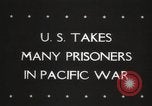
Japanese prisoners at a prison camp after being captured by American forces in the Pacific Theater during World War II.
The Japanese being taken as prisoners in the Pacific Theater during World War II. Allied soldiers cross a water channel and advance in Luzon, Philippines. Soldiers fire and advance. Explosions occur on the island. The soldiers fire rifles and guns. A soldier loads shells into a mortar and fires. A Japanese urges the natives over a loudspeaker to surrender. American soldiers aboard a ship as they look through binoculars to spot any Japanese soldier. Japanese soldiers swim towards the ship and come aboard as they surrender. Another local speaks into a loudspeaker as he urges the Japanese to surrender. A Japanese soldier waves a leaflet and surrenders to U.S. soldiers. A wounded Japanese soldier after surrendering to U.S. troops. Japanese prisoners at a prison camp. Prisoners eat and are lined up on the camp grounds.
German Generalleutnant Dittmar formally surrenders to U.S. soldiers in Magdeburg, Germany during World War II.
German General (Generalleutnant) Kurt Dittmar surrenders in Magdeburg, Germany during World War 2. German military commander General Dittmar, who was also Official Military Commentator of the German Armed Forces, stands with his party, including his son, young German soldier Berend Dittmar, Major Pluskat, and Major Werner, as American soldiers escort them. General Dittmar carries on an extended conversation with a French war corresondent. View of destroyed bridge span over the Elbe River, Magdeburg, Germany. German General Dittmar and his son, the boy soldier carrying a white flag with Red Cross on it, walk along sandy shore. They are met by U.S. Army soldiers of the 117th Regiment, 30th Infantry Division, including Captain Henry Abbes of Glendale, Long Island, New York, Commander of 'K' Company, who escort them. German General Dittmar conversing with captors while smoking a pipe, and then walking with his son, accompanied by American officers, through rubble strewn street of Magdeburg. (Records indicate that General Dittmar had traveled across the Elbe to ask for assistance in evacuating injured German soldiers and civilians from the east bank of the Elbe. U.S. Major General Leland Hobbs refused, and rather than returning across the River Elbe, Dittmar surrendered.)
A gunner fires a machine gun as an aircraft approaches Phu Quoc, Vietnam during the Vietnam War.
U.S. Navy aircraft in Vietnam during Operation Market Time of the Vietnam War. A small island in silhouette during the approach to Phu Quoc. Land as seen through the nose of an aircraft. A shoreline as seen from the aircraft. Rain squall as seen off to the right. A gunner fires a machine gun in the waist hatch of the aircraft.
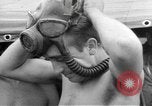
Men wearing diving masks dive underwater in the Pacific Ocean to salvage a Japanese submarine during World War II.
USS Ortolan salvages a Japanese submarine off the coast of the Solomon Islands in the Pacific Ocean during World War II. A man puts on a diving mask. He jumps into water. He removes the diving mask. U.S. Navy Captain Holland and Captain A.F. Loger at Japanese books. Holland thumbs through Japanese code books. The bow of USS Ortolan in the choppy sea.
CRITICALPAST.COM: About Us | Contact Us | FAQs - How to Order | License Agreement | My Account | My Lightboxes | Shopping Cart | Advanced Search | Featured Collections | Website Terms & Conditions | Privacy Policy ©2026 CriticalPast LLC.
License Agreement |
Terms & Conditions |
Privacy Policy
©2026 CriticalPast LLC.