


 Francais
 Deutsch
 Italiano
Refine Your Search
Kiska Aleutian Islands Alaska 1944 stock footage and images
- Showing 451 to 456 of 9823 results more
more Hide
Hide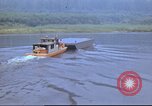
A tugboat hauls a loaded barge across a stream for the Canol Project in Fairbanks, Alaska.
The Canol Project in Fairbanks, Alaska during World War II. A tugboat hauls an empty barge across a stream. Workers stand on the barge. They load the barge with engineering equipment. An engineering vehicle loaded on the barge. The loaded barge leaves the harbor.
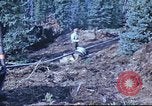
Workers weld a pipeline along a roadside and a road construction for the Canol Project in Fairbanks, Alaska.
The Canol Project in Fairbanks, Alaska during World War II. Workers lay a pipeline along a highway. They weld the pipeline. A fleet of airplanes flies overhead. The workers work on a dirt road with bulldozers and tractors. Trucks dump dirt along the roadway and graders level the road.
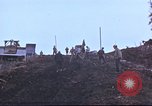
Workers operate bulldozers, tractors and graders to construct a road for the Canol Project in Fairbanks, Alaska.
The Canol Project in Fairbanks, Alaska during World War II. Workers work on a dirt road with bulldozers and tractors. Engineers work with instruments. Trucks dump dirt along the roadway and graders level the road. A number of trucks move on the dirt road.
Lieutenant Colonel Henry (Hap) Arnold and Major Royce plan photo-mapping mission to be flown out of Anchorage Alaska
YB-10 aircraft and crews, of the U.S. Army Air Corps 1934 Alaska Flight, preparing to depart Fairbanks for Anchorage, where they will fly a photo-mapping mission. Crew members around their B-10s. A USAAC Stearman model 75 parked at the field. Man uses a tractor to pull a dolly loaded with 55 gallon drums of fuel for the aircraft. Darkened tents set up inside a hangar to facilitate loading of unexposed film into aerial mapping cameras. Closeup of soldier placing roll of film into one of the cameras, and winding it into position for picture-taking. Lieutenant Colonel Henry (Hap) Arnold and Major Ralph Royce, discussing a large wall map of the areas to be photographed. Chart of the planned formation of five mapping camera planes at 8 mile horizontal separation, covering a strip of 60 miles width, from altitude of 16 thousand feet. The photo-mapping path from Anchorage being pointed out on the large wall map.
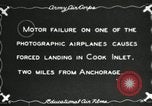
A YB-10 airplane of the U.S. Army 1934 Alaska Flight ditches in Cook Inlet after engine failure.
Engine failure forces a YB-10, of the 1934 U.S. Army Alaska Flight,to make a forced landing in Cook Inlet, two miles from Anchorage. View of the B-10 partly submerged in the water as men approach it in a small boat. The number 145 seen on the tail sticking out of the water. Boats moving near the stricken airplane and men wading in the water to assess ways of salvaging it. The aircraft on the beach after being pulled from the water. Men gathered around it starting repairs. A crane lifts a damaged propeller from the plane. Next, the crane lifts the right engine from the plane. View of the large crane with the engine suspended. A crewman walking under the nose of the repaired airplane. Another tapping a repair with a hammer.
Exxon Valdez oil spill in Prince William Sound, and men in communication room listen to Joseph Hazelwood in Valdez, Alaska.
Exxon Valdez oil spill in Prince William Sound in Valdez, Alaska. An oil tanker Exxon Valdez in Prince William Sound during the oil spill. Men in the control room of Valdez listen to the Captain of Exxon Valdez Joseph Hazelwood. A recorder in the communication room. The oil spreading in the sea. Underwater pictures show holes in the ship.
CRITICALPAST.COM: About Us | Contact Us | FAQs - How to Order | License Agreement | My Account | My Lightboxes | Shopping Cart | Advanced Search | Featured Collections | Website Terms & Conditions | Privacy Policy ©2026 CriticalPast LLC.
License Agreement |
Terms & Conditions |
Privacy Policy
©2026 CriticalPast LLC.