


 Francais
 Deutsch
 Italiano
Refine Your Search
Kodiak Alaska USA 1953 stock footage and images
- Showing 6949 to 6954 of 25600 results more
more Hide
Hide
A United States unmanned spy plane manufactured and tested
United States unmanned spy plane manufactured at a plant. Parachute attached to the plane. Plane tested as it takes off. A soldier fires machine gun at it and plane descends as a parachute opens. (World War II period).
Wartime nutrition public service film focuses on improving nutrition of American and British people. Also shows British war scenes.
Film on importance of good food and good eating habits during World War 2. Sweeping views of open farm land in the United States. Wheat harvesting by a harvester machine on a farm. Corn picked from stalks. Pigs in a pen. Cattle eat at a trough. Fish leaping on deck of a boat after being emptied from a net. Butcher weighs meat on a scale for a woman customer. Grocer puts meat, sugar, eggs, and other rationed items in a grocery bag. Scene changes to England, probably London, with smoking rubble on the ground from a blitz bombing run by German forces during World War 2. British firemen pour water on a blaze from fire hoses. A queue of British women and children citizens waits to receive food aid. Many of the British civilians look tired. A girl holds a large doll in her arms. A woman with a bandaged head holds a young girl child. Scene shows a British family at a table eating ration reduced portions of eggs, butter, and cheese. A British scientist holds a beaker and adds it to a large food preparation drum, adding vitamin enriched material to a food such as margarine, to aid with improving nutrition despite scarcity in the United Kingdom during World War 2. A box of butter is shown. Hand flips butter packet over to show label "Contains Vitamins A and D". British staples such as a wheat bread loaf and also beans, peas, and cereals are credited by the narrator as being "nerve conditioners, at a time when iron nerves are needed most." Footage of a British paratrooper in training jumping from a British aircraft. Next scene is in a steel mill as British men wearing protective glasses use shovels near a furnace. Scene of a British woman receiving cod liver oil and milk as a ration for a young child. Grocer at produce stand hangs sign saying "no tomatoes". But a victory garden sign behind shows someone pushing a shovel into the earth. People are shown working in victory gardens to grow fresh vegetables. All ages of older men and women and young children in England are shown working to tend victory gardens in plots large and small. Soldiers beneath a barrage balloon tend a garden with hoes. Scene in a community kitchen with a group of British citizens eating a meal. Next scene shows Americans in a restaurant and then in a diner ordering food at the diner counter. A woman orders and coffee is poured for her and two donuts are served. Narrator notes that the food nutrition choices made by many Americans are not good, and notes that malnutrition saps the strength of Americans. A woman secretary is seen typing and being frustrated and tired. A man welding lifts his helmet and rubs his head and face in exhaustion. A doctor and nurse examine and treat an eye of an American war worker. A U.S. Army recruitment or induction center is shown, with new recruits receiving medical examinations. Doctor uses a tongue depressor and examines a person's throat. A blood pressure machine takes a reading. An eye chart is shown. Doctor uses a stethoscope on a recruit's chest. Group of U.S. Army soldiers marching in formation. A group of new citizen recruits without uniforms marches.
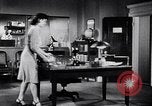
Dr. Thomas Parran, Surgeon general of United States Public Health Service advises to take a nutritious diet
Doctor Thomas Parran, Surgeon General of the United States Public Health Service speaks from a desk and advises Americans to eat a nutritious diet and to study the nutrition values of various foods available. He notes that war demands that we do not waste food. Women in a classroom learn about nutrition. Message on blackboard says: Protective Foods: Fruits, Vegetables, milk. Women taught how to prepare food with economy and about the ingredients of a balanced diet. Women are taught how to prepare food in an economical way that preserves nutrition. Women are taught about a balanced diet in which variety is essential. They are taught how to substitute various ingredients while some ingredients are unavailable due to wartime shortages during World War 2. Camera pans slowly across a poster with words and food pictures entitled "Foods that are the Principal Sources of the Food Constituents."
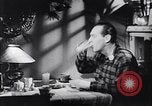
Importance of well balanced diet for American citizens at home and at work during World War II
Importance of well balanced diet during World War 2. American man seated at a table eats food. A housewife serves more food to him. Narrator talks about importance of nutrition, having three square meals each day, eggs and other protein foods, and vitamin B rich foods such as cereal of whole wheat, or enriched white bread. A worker on the job is shown taking a lunch break. Close up view of his open thermos with a hot drink and his sandwich and fruit and a chocolate bar. A couple dining together at a table for dinner are seen. Narrator suggest chicken, fish, liver, or sweetbreads as a main course, served with green leafy salad and also cooked vegetables like peas or carrots. A man carves meat. Men walk near a war materiel production factory gate, with a sign, "Let's step it up." Women at a factory production plant prepare large numbers of sandwiches for workers, with the help of automated machinery. Narrator says average workers need twice as many vegetables and fruits as they now consume. A group of men in an industrial kitchen work to prepare carrots, spinach, cauliflower, and other vegetables like squash, parsnips, and lima beans. African American cooks prepare food. Factory workers line up and take prepared food trays at a factory kitchen. Workers sit outside and enjoy food during a lunch break. Young men and women in a cafeteria line select foods to eat. War workers exit at the end of a work day. View of the U.S. Capitol dome. On screen public service message text says "U.S. Needs US strong. Eat nutritional food."
Mosquito insect squadron attacks enemy, in humorous animated cartoon during World War 2
An animation shows a mosquito squadron training for attack on humans. They stage mock attacks and navigate a mosquito obstacle course. With training complete, the mosquitoes attack their enemy, Private Snafu, who, as a result, gets malaria and is admitted to a malaria ward. A General pins up a medal onto a mosquito soldier for successfully accomplishing the task. (World War II period).
American civilians realize their war obligations and contribute to the war effort (WW2)
A World War II-era film shows Americans realize their war time obligations after the attack on Pearl Harbor and Fall of Corregidor in the Philippines. Crowds watch a marching band and newly enlisted soldiers in parade. A smiling woman waves at the marching soldiers. Women in car watch the parade. Tents in camp. Soldiers perform mass calisthenics and train with outdated tanks. Enlisted men learn how to fire machine guns and mortars. United State Army soldiers board a ship for their deployment. A ship departs for the Philippines. Soldiers arrive in the Philippines, a United States commonwealth in Asia. Japanese bombers drop bombs over Pearl Harbor. Civilians running on the streets during a Japanese aerial bombardment. United States Navy sailors firing machine guns and howitzers from ships. A ship explodes from Japanese bombing. A little girl runs to her father washing the car to tell the news about Pearl Harbor. The little girl runs across the street to tell her neighbor about Pearl Harbor. A woman writes a letter. A woman bakes a cake. People leave a church after service. An American soldier is shot by Japanese soldiers in the Philippines. A man reads a telegram. The man drives to a farm house, accompanied by a church minister. The man and minister tell the elderly couple living in the farm that their son was killed in action. Women selling war bonds on the street. A man silences his alarm clock and goes back to sleep. Cars racing on the street. Soldiers and civilians evacuating Manila. Japanese bombardment of Manila. A girl turns on the radio before Christmas dinner. Men and women congratulates a woman outside a law office. More civilians receive telegrams. Dead soldiers in the battlefield. A woman opens the Bible and writes the names of the dead. United States soldiers retreat in the Fall of Bataan. A woman shakes her head in disbelief after being told of a rumor her son was killed in action. A man hangs the United States flag on his porch. A bomb explodes near a makeshift tent hospital. Woman fixes bed. A woman eating on the dinner table alone. A soldier swats a mosquito from his neck in the Philippines. Forlorn men and women. Soldiers fighting in Corregidor. Soldiers surrender to the Japanese forces at Corregidor. A captured American soldier harasses a Japanese soldier while frisking him. He was apprehended by Japanese soldiers on guard. Despondent American civilians struggling after the Fall of Corregidor. A man despondently smokes from his bed. A depressed woman struggles to cut vegetables. A doctor treats civilians for shock and depression. A baseball game. A horse race. Boys playing on the beach. United States and Filipino soldiers march with United States and Philippine flags. People line up for blood donations. Civilians donate old rubber and hats. Men line up to punch their time in at work. Boys helping on the farms. Male teachers volunteer to fix civilians’ appliances and cars after school. A welder working at the shipyard. Civilians walking instead of using cars. An Allied plane landing. A woman sewing. A man opens a package of binoculars. People line up to buy war bonds. A majorette leading a marching band. Newly enlisted men with suitcases marching in parade.
CRITICALPAST.COM: About Us | Contact Us | FAQs - How to Order | License Agreement | My Account | My Lightboxes | Shopping Cart | Advanced Search | Featured Collections | Website Terms & Conditions | Privacy Policy ©2026 CriticalPast LLC.
License Agreement |
Terms & Conditions |
Privacy Policy
©2026 CriticalPast LLC.