


 Francais
 Deutsch
 Italiano

Refine Your Search
Kodiak Alaska USA 1953 stock footage and images
- Showing 841 to 846 of 25628 results more
 Hide
Color Sound
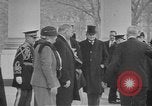
Franklin D. Roosevelt helps Americans to recover from the Great Depression in the United States.
Great Depression scenes and recovery efforts in the United States. U.S. President Franklin D. Roosevelt inaugurated as President on March 4, 1933. Scenes of Roosevelt and outgoing President Herbert Hoover leaving the White House together in a top-down convertible limousine before the ceremony. Roosevelt at the U.S. Capitol building during the inauguration ceremony as President of the United States. Roosevelt delivering the famous line in his speech, "The only thing we have to fear is fear itself." Jobless American men wait in unemployment relief lines to get work or jobs. Men in a bread line. Unemployed man with a large sign "Will take any job." Scenes of families migrating in the United States, with vehicles filled with belongings. Families and children suffering poverty and in makeshift camps and tenement dwellings during migration (usually migration west). Troops and bands march with American flags on Constitution Avenue during the Roosevelt Inauguration parade. Exterior view of U.S. Capitol Building framed by tree limbs. Men in an office empty heavy mailbags filled with letters (presumably to congress and senate). Government officials at a long table working on emergency banking laws in March of 1933. Scene of people flooding into a bank and making a run on the bank to retrieve deposits. President Roosevelt signs Emergency Banking Act in his office on March 9, 1933. View of White House lawn and White House. The CCC (Civilian Conservation Corps) is created to put unemployed young men to work on various conservation projects. CCC boys and men working on planting trees with pick axes and mattocks. Men and women in line to sign up for Emergency Work Relief programs. Officials write down the information for each worker as they are put to work in a variety of projects. Women and men, including white and African American men are seen getting assigned to work projects. A sign "USA Work Program WPA" advertising a suspension bridge work project of the Works Progress Administration in Los Angeles, California. People build roads, bridges and post offices. Cable fed out of a large spool as construction of a suspension bridge is shown. People work in factories. Four steam railroad locomotives preparing to run on parallel tracks. Close up views of railroad train locomotive wheels as they start moving and the train on tracks near factories. Various factory scenes including smokestacks, groups of workers entering factory for work shift and two different closeup views of a steam whistle blowing to mark the start or end of a work shift. A coal mining operation. Automated tools dig coal in shaft. Two coal miners take a break and eat. Crane hoists material at mine. A steel factory and hot molten steel pouring from a ladle.
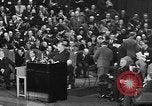
President Franklin D Roosevelt addresses crowd in Philadelphia during 1940 presidential campaign.
President Franklin Delano Roosevelt at the Philadelphia Convention Hall and Civic Center (3517 Civic Center Blvd, Philadelphia, PA 19104, USA) in Philadelphia, Pennsylvania. The President speaks from the podium and gives a political speech responding to what he characterizes as deliberate falsehoods promulgated by the political opposition. He talks about dictators and the practice of repetitions of falsehoods, saying, "Certain techniques of propaganda, created and developed in dictator countries, have been imported into this campaign. It is the very simple technique of repeating and repeating and repeating falsehoods, with the idea that by constant repetition and reiteration, with no contradiction, the misstatements will finally come to be believed. Dictators have had great success in using this technique; but only because they were able to control the press and the radio, and to stifle all opposition. That is why I cannot bring myself to believe that in a democracy like ours, where the radio and a part of the press — I repeat, where the radio and a part of the press-remain open to both sides, repetition of deliberate misstatements will ever prevail. I make the charge now that those falsifications are being spread for the purpose of filling the minds and the hearts of the American people with fear. They are used to create fear by instilling in the minds of our people doubt of each other, doubt of their Government, and doubt of the purposes of their democracy. This type of campaign has a familiar ring. It reminds us of the scarecrow of four years ago that the social security funds were going to be diverted from the pockets of the American workingman. It reminds us of the famous old scarecrow of 1932, 'Grass will grow in the streets of a hundred cities; a thousand towns; the weeds will overrun the fields of millions of farms.' The American people will not be stampeded into panic. The effort failed before and it will fail again. The overwhelming majority of Americans will not be scared by this blitzkrieg of verbal incendiary bombs. They are now calmly aware that, once more, 'The only thing we have to fear is fear itself.' I consider it a public duty to answer falsifications with facts. I will not pretend that I find this an unpleasant duty. I am an old campaigner, and I love a good fight."

Passengers aboard Stout airlines Ford Tri-motor passenger airplane; Ambassador Bridge under construction.
A male flight crew member inside a Stout Airlines Ford Tri-motor plane in the United States. He stands in the center aisle and adjusts luggage in overhead areas. View outside aircraft parked at Ford Airport, Dearborn, Michigan, as passengers board Stout Airlines Ford Tri-motor airplane NC9669 with name "Miss North Shore" (seen on nose) and "Stout Airlines - Detroit, Cleveland, Chicago" seen written on aircraft body. It is a a Ford type 5-AT-B. View of Ford Airport passenger terminal building in background. Plane taxis and takes off. The plane in flight. Interior cabin views while in flight as passengers inside the plane enjoy the view as they look out from the windows. Aerial view of aircraft in flight as seen from an adjacent flying aircraft (unseen). View of plane taking off again. Aircraft in flight over Detroit River. The Ambassador Bridge suspension bridge is seen, under construction, preparing to connect the USA and Canada between Detroit and Windsor, Ontario.
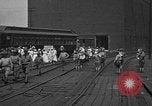
Red Cross Canteen Service serves U.S. soldiers in Midwest, before they go overseas in World War I
The tail end of a contingent of U.S. soldiers is seen marching away, along the tracks, after visiting a Red Cross canteen rail car during world war 1. Red Cross women volunteers in white dresses stand in front of a Wabash Railroad car marked with red crosses and a sign reading "Canteen Services." A U.S. Army brass band is playing in the center of the train yard. The Red cross workers step away from their rail car to wave goodbye to the departed troops. Scene shifts to a Red Cross woman handing out, what appear to be photographs, to U.S. soldiers standing in a line with their personal mess kit cups. A waterway is seen behind the line of soldiers. Afterwards, the soldiers assemble and drink their coffee. (Location is likely in the midwest USA.) (World War I; World War 1; WWI; WW1)

First Church of Christ Scientist in Seattle, Washington.
First Church of Christ, Scientist, (First Church of Christ, Seattle, WA 98122, USA) in Seattle, Washington. A car drives past the church as a man walk towards the church.

Queen Elizabeth II and Prince Phillip receive a warm welcome by President Eisenhower at the White House in Washington DC.
Queen Elizabeth II of the United Kingdom visits Washington DC and New York City, USA. United States President Dwight D Eisenhower and the First Lady Mamie Doud Eisenhower welcome Queen Elizabeth and her husband Prince Phillip at the White House. Crowds gathered outside the White House during Queen Elizabeth’s visit. Mamie Eisenhower speaking to Prince Philip. The Queen visits the New York harbor. The motorcade moves down the street as large crowd gathers to welcome the Royal couple.
CRITICALPAST.COM: About Us | Contact Us | FAQs - How to Order | License Agreement | My Account | My Lightboxes | Shopping Cart | Advanced Search | Featured Collections | Website Terms & Conditions | Privacy Policy ©2026 CriticalPast LLC.
License Agreement |
Terms & Conditions |
Privacy Policy
©2026 CriticalPast LLC.