


 Francais
 Deutsch
 Italiano
Refine Your Search
Kodiak Alaska USA 1953 stock footage and images
- Showing 10645 to 10650 of 25600 results more
more Hide
Hide
Lessons from microscopic science lead to advances in antiseptic surgery, pasteurization, and vaccinations.
1930s narrated feature about scientific advances made possible by the microscope. View of a microscope. Chemist or scientist looks through a microscope in laboratory. Microscopic view of the living organisms. Milk pasteurized by heated coils in large drums. Milk graded with pasteurization label. Boy drinks a glass of milk. Narrator describes milk as "the most valuable of all our foods for health." Sterilization techniques introduced in surgical operations: Doctor Joseph Lister of London (dramatized by an actor) shown with a spray can administering a "poison spray" to kill germs and disinfect a surgical or operating theatre. Surgeon performs antiseptic surgery on patient. Surgeon sterilizes the instruments to be used in an operation by pouring carbolic acid solution over them. View of operating instruments being removed from a heated steam chamber used to kill germs on the instruments. Doctors performing a surgery. Dramatized scenes of a doctor arriving at a home in Berlin to treat a girl suffering from Diphtheria. View of sick girl in a bed, through an outside window with snow falling, and the girl's mother and a nurse assisting her. The doctor gives the girl a diphtheria inoculation. Girl is shown recovered and walks outside of her home and gives a hug to her mother. Public vaccination clinics: Young children, including a young boy and an infant, receiving immunizations in a doctors office.

Animated telescopic view of a Solar Eclipse. Citizens and astronomers preparing to view an eclipse
Animated view of sun and description of a total eclipse. Animated picture of moon passing across the sun. Citizens preparing to watch an eclipse. Astronomers from all over the world watch the sight. Moon covers the image of sun with halo of light around it. (Solar Eclipse). Tongues of flame in the halo of light visible through telescope. Animated view of earth from the moon.
Houses, mountains, and rural people living in the southern Appalachian mountain region of the US
Part of documentary "Below White Top" depicting missions of the Lutheran Church in southern Appalachian areas of the United States. View of rural homes and shacks in amongst the Appalachian mountains of Smyth County Virginia. A man and woman seated on a front porch while three boys in front play with a puppy dog. A young man wearing overalls is busy crafting a fiddle or violin. Parts of the fiddle lay beside him. View of mountains and a stream flowing over rocks.
Industrial development in Appalachian Mountain, United States.
Depicts industry and modernization coming into rural Appalachia in the early 1900s. A steam locomotive pulling a long line of train cars moves along the mountain side, leaving a trail of smoke in the Appalachian Mountain, near Smyth County Virginia. Man, woman and children wave at the coming train. Cow grazes in field. A steam shovel excavating a site. Vehicles drive past on a dirt road newly carved into a mountain side. Two men sawing a tree with a two-person saw. The tree falls. Horse carries wooden logs from the forest area. Logs being milled into lumber pieces at a saw mill. Giant saw blade spinning and cutting the wood. Factories with smoke spewing from chimneys. Rural coal mine buildings, some up high on stilts. A man operating an electrically powered, belt-driven lathe to turn lumber into round handles for tools. A rural preacher with a bible at an outdoor site, preaching in front of a corn field. Slates indicate that he is preaching against worldly education, and in favor of biblical learning only. reaches to people. A stone on a building with the words, "Marion Junior College. 1873." The preacher waving the bible in his hand. A teenage boy seated in a rocking chair on a porch reading a book.
Poverty in Appalachian regions after industrialization of early 1900s
Depicts rural families in southern Appalachian regions like Smyth County, Virginia after the industrialization of the early 1900's came to an end and widespread unemployment set in, especially during the Great Depression. A large factory cog coming to a stop. A giant saw blade coming to a stop. Barren areas with tree stumps from a clear cut. Vacant industrial sites. Stream flowing through part of mine works. Men out of work, outside, some carving, some just sitting. Women and children stand outside houses. Woman holds toddler in arms. Men dig grave in cemetery. A rural preacher preaching.
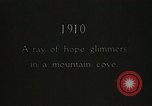
Rural water mill and the rise of Kenneth Killinger as a preacher in the southern Appalachians
Depicts life near the southern Appalachian region of Marion, Virginia in Smyth County, and specifically the path of Kenneth G. Killinger from being a mill operator to becoming a mountain missionary of the Lutheran Synod of Virginia. Man carries sack of corn to a water powered mill. Sign "Corn Ground." Young man actor portraying Kenneth G. Killinger weighs the corn with a simple scale and then pours it into the stone grinder. He gives the ground corn to the customer, along with a booklet that reads, "The Augsburg Sunday School Teacher, 1910." Close view of the contents page of the booklet. The young man standing at the edge of the mill, water wheel turning beside him. Scenes portraying two memories from his youth: A woman taking a paddle to a boy as punishment. Next scene is a group of teenage and younger boys gathered together and taking drinks of moonshine whiskey alcohol from a bottle. They cringe from the taste and pass the bottle around. Scene of men digging a grave in a graveyard beside a rural church. Killinger reenters the mill. Scene of young Killinger sitting on the porch of a rural home, reading to young children. Killinger counseling a bed-ridden elderly woman. On screen text reads, "Kenneith G. Killinger. 'The Mountain Missionary' of The Lutheran Synod of Virginia. Marion, Virginia. July 24, 1921." View of Killinger in 1921, preaching to congregation sitting under a tree. The congregation entering a small makeshift church building. The congregation entering an abandoned rail car turned into their church. The congregation later in a larger church building. Killinger preaching. Rural children singing from hymnals. Churchgoers exiting the church.
CRITICALPAST.COM: About Us | Contact Us | FAQs - How to Order | License Agreement | My Account | My Lightboxes | Shopping Cart | Advanced Search | Featured Collections | Website Terms & Conditions | Privacy Policy ©2026 CriticalPast LLC.
License Agreement |
Terms & Conditions |
Privacy Policy
©2026 CriticalPast LLC.