


 Francais
 Deutsch
 Italiano

Refine Your Search
Kodiak Alaska USA 1953 stock footage and images
- Showing 1063 to 1068 of 25628 results more
 Hide
Color Sound
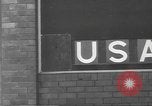
Baseball game being played by British teams in the UK during World War II.
Scoreboard reads ‘Next Saturday - USA Bears Vs Brad Bros’. The opposing teams run side by side toward home plate to start the game. One team's bench with players, and bat boys (some barefoot) seated in front of a picket fence, with spectators on benches and a club house behind them. View of game action from spectators perspective, behind home plate. Batters hitting and driving in a run. A lone American soldier watching in midst of the spectators. Players coming off the field to their bench at end of an inning. Spectators in stand watching the game. Items left after the game include several English shilling coins. A man's hand reaches down and picks up two shillings.

U.S. AP (Air Police) and Viet Nam Air Force MP (Military Police) check bars in Saigon in Vietnam during Vietnam War.
Activities of USAF (United States Air Forces) 377th Air Police Security Squadron at Tan Son Nhut Air Base near Saigon, Vietnam during the Vietnam War. USAF AP (Air Police), U.S. Army MP (Military Police) and VNAF (Viet Nam Air Force) MP walk past bars and shops on a street in Saigon. A sign on tree reads 'Off Limits To U.S. Forces'. AP, USA MP and Vietnamese MP walk and check bars to see if they are closed. They come to an open bar. Two U.S. Army enlisted men exit and AP write up a violation, then the security guards move on. The name of the bar reads 'Snack Bar Tokyo'. Sentry dog compound shows a sign which reads 'OFF LIMITS, SENTRY DOG AREA, DANGER and KENNEL AREA'.
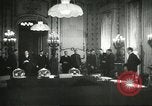
William Strang, F.T. Gousev and John Winant head a European Advisory Commission in London, England.
Three representatives of the United Nations, heading a European Advisory Commission, in talks at Lancaster House in London, England during World War II. Sir William Strang of Great Britain, F.T. Gousev of the Union of Soviet Socialist Republics ( USSR) , John Winant of the USA and others seated at a table.
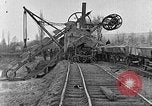
African American troops of the U.S. 501st Army Engineers, build port facilities at Brest, France, during World War I
Army Engineers of the American Expeditionary Forces (AEF) use a rail-mounted conveyer-type bucket dredge to deepen a channel for Allied ships on the Penfeld River at Brest, France, during World War 1. In the background, the Kerguillo mansion in the suburb Bohars, can be seen. The dreged spoils are being emptied into a string of open rail cars. Men work around the base of the dredge, loosening soil with long poles. Army engineers, including African American soldiers of the U.S. Army 501st Engineers work with French civilians to build wharfs on the Penfeld River. They stand with a rail car of concrete at the job site, and manually remove it when emptied. Construction supplies are piled up at the port, where 501st Engineer members are seen with other U.S. soldiers and French soldiers. View from rail car (not seen) moving along track, away from the port. A locomotive is seen with "USA" painted on its side,next to a newly constructed rail platform. A French workman carrying a large can walks next to the tracks. A railroad crane stands on a siding. Workmen build a station on the platform. (One raises his arms out wide for the camera.) An open rail car sits by the platform. A soldier from the 501st crosses the track near a rail car filled with wooden ties. View of U.S. troops running from work on a train of rail cars, as they respond to noon mess call. African American soldiers of the 501st Engineers getting lunch and eating at an outdoor mess. Four of them tap dance for the camera, as their comrades watch and clap.

U.S. Army with African American stevedores handling military cargo in Bordeaux, France, supplying Base Section Number 2.
Transfering U.S. Army cargo from ships to rail cars, at seaport in Bordeaux,France. Freighters and cranes at dock for supply of Base Section Number 2 during World War I. Warehouses buildings in the background. Dock cranes operate and unload military cargo from ships. U.S. Army troops, using tractor, haul trailer loaded with crates. One soldier holds on back of trailer with his feet up, getting a ride. African American stevedores of U.S. Army Service battalions, using hand carts, load a railroad car, with USA written on its side. Others throw wooden cargo cartons into a cargo net. They attach it with crane sling. Crane pulls it up and places it near railroad car. World War 1 African American stevedores load cargo in railroad car.

The U.S. Pavilion at an Industrial exhibition in West Berlin's central exhibition site.
A scientific exhibition at the United States' pavilion at West Berlin's central exhibition site. People lined up at the entrance to USA exhibit. Exterior view of the U.S. Pavilion. U.S. flag flies at the building and signs reading: "United States" and "ERF" are displayed above the building. Signs in the pavilion read: 'ATOM' and 'George C. Marshall - Haus'. People assembled to watch the exhibition. People lined up on stairs. U.S. representatives demonstrate how a nuclear fission assembly works, with simulated fuel and control rods and an instrument for reading radiation levels. A technician demonstrates how radioactive materials can be handled remotely, in a laboratory, using a robotic machine to manipulate delicate glass funnels and bottles. An inflatable laboratory suit is demonstrated, that one could crawl out to and work in while in a toxic environment.
CRITICALPAST.COM: About Us | Contact Us | FAQs - How to Order | License Agreement | My Account | My Lightboxes | Shopping Cart | Advanced Search | Featured Collections | Website Terms & Conditions | Privacy Policy ©2026 CriticalPast LLC.
License Agreement |
Terms & Conditions |
Privacy Policy
©2026 CriticalPast LLC.