


 Francais
 Deutsch
 Italiano
Refine Your Search
Kodiak Alaska USA 1953 stock footage and images
- Showing 13717 to 13722 of 25600 results more
more Hide
Hide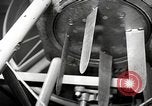
A new propeller, to change the course of the ship, is developed and tested for the U.S. Navy in Bremerton, Washington.
Testing of a new propeller in Bremerton, Washington. View of the newly developed propeller for the U.S. Navy. A professor of Washington University, the inventor of the propeller, beside the device. View of the blades of the propeller, changing the pitch of which changes the course of the ship. A landing craft on which the propeller is tested. The landing craft moving forward on the water. The professor with another man on the craft. The craft turning the direction by changing the pitch of the blades. Men beside the propeller.
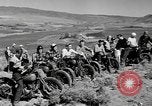
Motorcyclists ride up a rocky hill and people watch them in Wenatchee, Washington.
Motorcycle hill climbing in Wenatchee, Washington. Motorcyclists lined up for a rocky hill ride. Several people standing behind the motorcyclists. Men riding the motorbikes on the rocky hill. One of them falls down. People stand around and watch the dangerous stunt riding. A motorcycle races leaving trails of mud and dirt. A man watching the motorcyclist.
A U.S. Army aircraft on an airfield during an experiment of a rescue operation for stranded airmen in the United States.
Testing of an aircraft rescue operation in the United States. Several airmen on an airfield during an experiment of an aircraft rescue operation for stranded airmen. A U.S. Army aircraft airlifts a sack from an airfield while in flight. A sheep being harnessed by a few men for a live test. The tied up sheep on the ground beside a small fence on the airfield. The U.S. Army aircraft in a low flight airlifts the sheep and flies away. The aircraft parked on the airfield with its door open. A few men take the safe sheep out from the aircraft and untie the ropes around it. A few men tying a pilot for a human rescue experiment. The man placed on the airfield beside a small fence. The aircraft in low flight airlifts the man. The aircraft in flight with the man hanging in a sling. The man is pulled into the aircraft. The aircraft lands on the airfield and the rescued man gets off the aircraft.
Ocean liner SS Flandre arrives at New York Harbor in the United States after an engine failure during her maiden voyage.
French ocean liner SS Flandre at New York Harbor in the United States. SS Flandre arrives at New York Harbor after an engine failure during her maiden voyage. A U.S. official shake hands and receives the Captain of the ship. Other naval officers and officials standing behind the men. Men trying to anchor the ship in the harbor when electric winches fail to raise its anchor. The ship leaves the harbor with its passengers standing at railing. SS Flandre underway in the harbor.
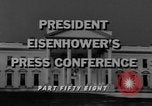
U.S. President Dwight Eisenhower answers queries of press men during his 130th press conference in Washington DC.
U.S. President Dwight Eisenhower's 130th press conference in Washington DC, United States. Newsmen from different nations arrive for President Eisenhower's 130th press conference. Men seated in a hall inside a building. President Eisenhower arrives with officials. The President speaks during the conference. Press and media representatives take notes. Chalmers M. Roberts, a pressman, asks the President that with the summit issues in the impasse between the U.S. and the Soviet Union, does the President see any initiative to break it or would the arms race go on indefinitely. President Eisenhower says that they should seek some common ground where there is a beginning made towards agreement in which they can work better co-operatively. The men gathered in the hall take down notes. View of the President speaking. Photographers taking pictures. The President unfolds a document and says that it is the list of subjects that the United States has proposed unilaterally with respect to the Allies. He cites the Baruch Plan - '46, the preparation of inspection and control measures, the Open Skies proposal, the peaceful use of outer space, the transfer of nuclear weapon stocks to peaceful use such as for power, freedom of travel and the limitation of the UN Veto. The President further says that he does not think he is being negative just by being firm and believing in what is right for the welfare of the United States.
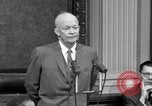
U.S. President Dwight Eisenhower answers queries of newsmen during his 130th press conference in Washington DC, U.S.
U.S. President Dwight Eisenhower during his 130th press conference in Washington DC, United States. Donald J. Gonzales, a newsman, says that when the President said he was unaware of the possibility of a Soviet statement on ending nuclear weapon tests, the U.S. Secretary of State John Foster Dulles said just on the previous day that this has been discussed in the previous days. The pressman asks the President for his reaction to the Soviet announcement. The President replies that he did not say that he was unaware of anything about it but did not have any proof that it was going to occur. He says that he cannot say anything more than what the Secretary said after complete discussions. The President further says that they had discussed this as a possibility on their own side, that is unilateral abandonment of tests and decided that it was not good for the United States at that time. Pressmen seated during the conference. Another pressman, Henry N. Taylor, gets up and puts forward a query to the President. He asks that last week the President had told them that he was convinced any nuclear test could be detected if there was a test ban. Yet the President, in the response to Russia, says test bans could be evaded in secrecy. The pressman asks the President if he could clear it. President Eisenhower says that the U.S. Secretary of State Dulles might have said that they are not certain there have not been tests, particularly underground tests or so small and in remote regions where there would not be debris and instruments would not be sensitive enough to pick them up. The President says he does not believe that explosions can happen in huge megaton character and not have evidence of it. Cameramen taking pictures. The President shakes hands with the officials and meets the pressmen.
CRITICALPAST.COM: About Us | Contact Us | FAQs - How to Order | License Agreement | My Account | My Lightboxes | Shopping Cart | Advanced Search | Featured Collections | Website Terms & Conditions | Privacy Policy ©2026 CriticalPast LLC.
License Agreement |
Terms & Conditions |
Privacy Policy
©2026 CriticalPast LLC.