


 Francais
 Deutsch
 Italiano
Refine Your Search
Kodiak Alaska USA 1953 stock footage and images
- Showing 14665 to 14670 of 25600 results more
more Hide
Hide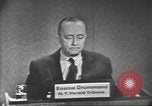
John Kennedy and Nixon debate over the prestige of America prior to the presidential elections in the United States.
Presidential election debate held between Democratic nominee Senator John F. Kennedy and Republican nominee U.S. Vice President Richard Nixon in the United States. New York Herald Tribune newspaper correspondent Roscoe Drummond asks Senator Kennedy that how can American prestige be measured abroad. Senator Kennedy responds stating that America is identified with the cause of freedom and if other countries have to choose between America and a Communist country, they would choose America. He further speaks that there are many indications that prestige of the United States is not as high as it once was. Kennedy summarizes some of these indications and relates to it by mentioning the example of Sputnik space program by the Soviet Union in 1957 (during the Space Race). Kennedy speaks about the economic development of the Soviet Union. He says the Soviet Union will be ahead of any other country scientifically and militarily by 1970. He mentions votes by different countries in the United Nations dealing with Red China. He says that Guinea and Ghana, two independent countries now are supporting Soviet foreign policy at the UN. NBC correspondent Bill Shadel asks Richard Nixon to speak on the topic. Vice President Nixon responds by speaking about the economic development of the Soviet Union. He speaks that the Soviet Union is a very primitive economy and that the United States is well ahead economically. He says that if the United States is going to maintain its strength and its prestige, they must not only be strong militarily and economically but must be firm diplomatically also. Bill Shadel says that an entire hour was devoted to answering questions from the reporters. He says that each candidate was questioned in turn and each had the opportunity to comment on the answer of his opponent. Shadel says that the reporters were free to ask any question on any subject, neither candidate was given any advance information on any question that would be asked. He says that the fourth debate is scheduled for Friday, October twenty-first.

U.S. President Richard Nixon addresses people in the United States on withdrawal of remaining U.S. troops from Vietnam.
Television broadcast of U.S. President Richard Nixon's speech from the White House in Washington DC, United States on the withdrawal of remaining U.S. troops from Vietnam on 29th March 1973 during the Vietnam War. The White House. The Seal of the President of the United States. The President talks about that period of the Vietnam War when he joined the office and speaks about the program he initiated to end the war. He says American prisoners are on their way from Vietnam and people of South Vietnam are now free to choose their government. He says North Vietnam is not complying with few provisions of the Peace Agreement. He says that they should honor all those American soldiers who died during the Vietnam War. He refers to the difficult days of the war including the moratorium to end the war which was organized on October 15, 1969 when millions of Americans took day off from work and schools to participate in local demonstrations against the war. Nixon refers to the period of April 1971 when he ordered attacks on Communist bases in Cambodia. He talks about the period of May 1972 when he ordered air strikes in North Vietnam and the period of December 1972 when he ordered more air strikes.
U.S. President Nixon speaks about inflation and federal budget during his address from the White House in Washington DC.
Television broadcast of U.S. President Richard Nixon's speech from the White House in Washington DC, United States on the withdrawal of the remaining U.S. troops from Vietnam on 29th March 1973 during the Vietnam War. President Nixon talks about prosperity in the United States without war abroad and without inflation at home. He says that inflation is a terrible cost of war with which the United States is battling at home presently. He speaks about cutting the rate of inflation by controlling meat prices. He says that the U.S. has increased imports from abroad and production at home which will increase meat supply and he has ordered Council of Cost to impose ceiling of prices so that the meat price does not increase any higher. President Nixon says he has submitted 268 billion dollars of federal budget to the Congress this year and if this budget increases as proposed by the Congress then that would mean an increase in taxes by 15% or an increase in the prices. He says he shall veto bills which will break the federal budget he has submitted.
President Nixon speaks about reduction in defense budget while addressing the nation from the White House in Washington DC.
Television broadcast of U.S. President Richard Nixon's speech from the White House in Washington DC, United States on withdrawal of the remaining U.S. troops from Vietnam on 29th March 1973 during the Vietnam War. President Nixon speaks about progress that the U.S. has made towards peace and the end of the Vietnam War. He says that the United States should not reduce its defense budget. He speaks about negotiations with the Soviet Union regarding elimination of nuclear arms. He says that cutting down defense budget before the negotiations would increase the danger of war and there should be mutual reduction in defense. President Nixon says that the U.S. should maintain its strength.
President Richard Nixon address the nation from the White House in Washington DC, United States at the end of the Vietnam War.
Television broadcast of U.S. President Richard Nixon's speech from the White House in Washington DC, United States on withdrawal of the remaining U.S. troops from Vietnam on 29th March 1973 during the Vietnam War. President Nixon speaks about the end of the Vietnam War. He speaks about differences about war which divides a nation. He talks about bringing peace and reducing the burden of armaments. He refers to nations in past which fell at the height of their wealth and strength and assures that it would not happen to the United States. He shares his experience of speaking to an American prisoner who survived in a communist prison during the Vietnam War.

Julie Nixon Eisenhower speaks to Goodwill Worker of the Year Mrs. James Klotz in the White House Library in Washington DC.
Goodwill Worker of the Year Mrs. James Klotz in the White House Library in Washington DC, United States. Mr. James Klotz stands. He gives a rose to Julie Nixon Eisenhower, the daughter of U.S. President Richard Nixon. Julie then greets Mrs. Klotz and talks to Mr. Klotz. Julie poses for pictures with two men.
CRITICALPAST.COM: About Us | Contact Us | FAQs - How to Order | License Agreement | My Account | My Lightboxes | Shopping Cart | Advanced Search | Featured Collections | Website Terms & Conditions | Privacy Policy ©2026 CriticalPast LLC.
License Agreement |
Terms & Conditions |
Privacy Policy
©2026 CriticalPast LLC.