


 Francais
 Deutsch
 Italiano
Refine Your Search
Kodiak Alaska USA 1953 stock footage and images
- Showing 1819 to 1824 of 25600 results more
more Hide
Hide
United States soldiers set off explosive bomb in Okinawa, Japan
Various activities of the Explosive Ordnance Disposal Teams in Okinawa, Japan. Staff sergeant Dixson and Technical sergeant Ross are loading large dud shell onto truck carefully using a chain and hoist. Officers close the tailgate of the truck. Truck tailgate words read “U.S. Air Force”. Sign reads “Explosive Disposal”. Man turns sign that reads “Explosives Bakuhatsu butsu (detonation products)” in English and Japanese. Truck drives away. A technical sergeant setting off blast from bunkers, personnel squatting by same. A sergeant wearing sunglasses setting off blast from bunker. A broad demolition explosion.
United States soldiers carefully lay down a large shell into a pit in Okinawa, Japan
Various activities of the Explosive Ordnance Disposal Teams in Okinawa, Japan. A United States Air Force (USAF) military truck loaded with emergency crewman backing out of parking position. A truck leaving the area. Men unloading a large dud shell out of the truck carefully using a chain and hoist. The dud is carefully laid to the pit. Men carefully place dud shell into the pit. Crewmen place a charge on top of the shell in the pit.
United States Explosive Ordnance Disposal Team respond to remove a bomb in Okinawa, Japan
Various activities of the Explosive Ordnance Disposal Teams in Okinawa, Japan. A staff sergeant takes a phone call. Staff sergeant Irwin talking on the phone. An alert crew chatting and laughing in the background. The staff sergeant hollers at the crew. Crew enters their truck. Truck front end reads “Explosive Disposal”. The staff sergeant handles location and data to truck driver. Sergeant climbs aboard the truck. Man holds the location paper. Th truck reverses out of the parking position. Crewmen in truck. An airman speaks to an Okinawan guard about the shell. Both the airman and the Okinawan guard point to the position of the shell in the grassy field. The emergency crew arriving on truck to the scene. Okinawan guard standing on roadway watching. Crewmen remove the grass surrounding the shell. Truck back up to the shell.
United States Explosive Ordnance Disposal Team tossing shells and landmines out of a sailing boat.
Various activities of the Explosive Ordnance Disposal Teams in Okinawa, Japan. Explosive Ordnance Disposal Team dispose shells and explosives into the ocean. Barge front gate lifting. A man closes the front gate on landing craft loaded with shells. Landing barge leaving shore. View of the barge as it travels out to sea. Water splashing on front of sailing landing barge. United States personnel on the barge are throwing shells and land mines overboard. Other men watch the personnel throwing shells. Shirtless personnel pick up a shell and throws it overboard. Men tossing shells and landmines into the water.
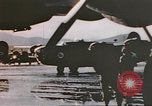
U.S. Air operations from Adak, and views of.the island's defenses during the Aleutians campaign of World War II.
As film begins, two U.S. B-24 bombers are seen taxiing across the Adak airfield to takeoff on a bombing run against the Japanese airfield at Kiska Island. Closeup of B-24 with engines running. About an inch of water covers the ramp. The two bombers take off (followed by others unseen). Airmen on the ground watch them depart. Scene shifts to the port of Adak. A cargo ship and a tugboat moving a barge are seen in the water. Trucks drive along the beachfront. Mountains loom in the background. Military supplies, including munitions are seen piled along the beach. Soldiers carry some goods over their shoulders. Closeup of items piled on the beach. A dog trots along with soldiers walking the beach. Change of scene highlights guns installed as coastal defense on the island, including fixed heavy guns, anti-aircraft guns and machine guns. A sailor viewed through a life safer buoy, paints part of a warship. A Navy PBY Catalina on patrol is seen overhead. U.S. gunboats patrol the harbor. Crew members are seen aboard a U.S. destroyer patrolling deep waters off Adak. They exchange blinker light messages with a Bancroft-class (four-stacker) destroyer. Glimpse of the Bancroft-class destroyer flashing blinkers lights. Sailors on a destroyer respond to alarm of sonar sound contacts and man battle stations. Closeup of a Bancroft-class destroyer, followed by views of depth charges being launched from a destroyer underway. Exchanges of blinker light messages between camera destroyer and a Bancroft-class destroyer.
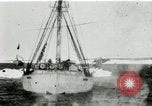
Captain Pedersen trades guns and other items for furs with the Eskimo natives of Indian Port.
Cruise of the whaler Herman to the Arctic. The whaler at sea. Crew members eat walrus meat on board. They arrive at Indian Point. Native Eskimos arrive in large whale boats and come aboard the whaler. Captain Pedersen trades guns and other items for fur with the natives. Skin and fur from the trade on the ship deck. Eskimo natives are landed on the ice after the trade. The whaler leaves the port. Men in boats, pack purchases to be taken to the village. A native Eskimo is seen.
CRITICALPAST.COM: About Us | Contact Us | FAQs - How to Order | License Agreement | My Account | My Lightboxes | Shopping Cart | Advanced Search | Featured Collections | Website Terms & Conditions | Privacy Policy ©2026 CriticalPast LLC.
License Agreement |
Terms & Conditions |
Privacy Policy
©2026 CriticalPast LLC.