


 Francais
 Deutsch
 Italiano
Refine Your Search
Kodiak Alaska USA 1953 stock footage and images
- Showing 20179 to 20184 of 25600 results more
more Hide
Hide
U.S. President Richard Nixon talks about raising funds for the defendants of Watergate sandal in San Clemente.
U.S. President Richard Nixon answers to journalist's questions during a press conference regarding Watergate Scandal in San Clemente, California. A journalist questions the President about his conversation with White House Counsel John Wesley Dean on raising funds for the Watergate defendants on March 21. The President responds that Dean was not concerned about raising money for the defendants which is legal rather he was concerned for the hash money given to the defendants for the purpose of keeping them silent which is illegal. The President also states that he had a discussion with the White House Chief of Staff Harry Robbins Haldeman about raising funds for the defendants which certainly would require million dollars.
U.S. President Richard Nixon talks about his defense and that of Haldeman and Ehrlichman during the Watergate scandal.
U.S. President Richard Nixon talks about the defenses during the Watergate scandal at a press conference in San Clemente, California. A journalist states that the President had asked White House Chief of Staff Harry Haldeman to listen to one of the Watergate tapes, so as to be sure that they are correct. The journalist then questions the President about his involvement in co-ordinating his defense and the defense of Haldeman and President's Assistant for Domestic Affairs John Daniel Ehrlichman. The President clarifies that he makes his own defense and the lawyers take care of the defense for Haldeman and Ehrlichman.
U.S. President Richard Nixon responds to journalists' questions about the resignation of Vice President in San Clemente.
U.S. President Richard Nixon talks about Vice President Spiro Agnew during a press conference in San Clemente, California. A journalist questions the President whether Vice President Spiro Agnew, one of the suspect in Watergate investigation, will or be expected to resign. The President responds that the Vice President has not been indicted, that he has denied the charges against him both personally as well as publicly. The President also finds it inappropriate to comment upon the issue of the Vice President's resignation.
U.S. President Richard Nixon talks about the President's privileges in the Watergate scandal in San Clemente, California.
U.S. President Richard Nixon talks about the President's privileges with reference to the Watergate Scandal during a press conference in San Clemente, California. A journalist questions the President regarding the check on authoritarianism by the executive. He also asks the President whether he will follow the Supreme Court orders if asked to submit the Watergate tapes or other documents to the Senate Committee or to the special prosecutor. He then inquires about the limitations of the President, short of impeachment, to compel the production of evidence of a criminal nature in the Watergate Investigation. The President responds that the limitation is of public opinion as well as congressional pressure and that this is further accompanied by waiving of the executive privileges by the ITT (International Telephone and Telegraph) administration. The President clarifies that the White House Press Secretary Gerald Warren has already responded to the Supreme Court orders and that the statement made by Warren with regard to the President's position still stands.
U.S. President Richard Nixon talks about people he thinks would exploit the Watergate issue in San Clemente, California.
U.S. President Richard Nixon talks about people who would exploit the Watergate issue during a press conference in San Clemente, California. Journalist Jerry Landay questions the President regarding his statement about people who the President thinks would exploit the Watergate issue to keep him from doing his job. The President suggests that they could be political figures, members of the press and television or any individuals who do not agree with his policies and do not want him to do his job properly.
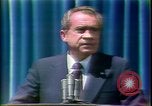
In San Clemente, California U.S. President Nixon talks about the existence of wiretaps during the Kennedy administration.
U.S. President Richard Nixon talks about the role of wiretaps in national security during a press conference in San Clemente, California. A journalist questions the President about his statement regarding the 10 additional wiretaps that could have been initiated by late U.S. Senator Robert F. Kennedy, which would have lead to the discovery of the Oswald plan and thus prevented U.S. President John F. Kennedy's assassination. The President responds that 10 more wiretaps could have found the conspiracy, if it was a conspiracy in the first place, then it would have been worth it. The President also talks about the high number of wiretaps in the National Security area during the Kennedy administration for national security purposes. The taps on news organizations, news people and civil rights leaders were all justified. The journalist then asks the President if he thought that President Kennedy's assassination threat mattered more to the national security wiretaps. The President does not agree with this and believes that the assassination was a breakdown in the President's security. He also states that he personally does not prefer to have secret service.
CRITICALPAST.COM: About Us | Contact Us | FAQs - How to Order | License Agreement | My Account | My Lightboxes | Shopping Cart | Advanced Search | Featured Collections | Website Terms & Conditions | Privacy Policy ©2026 CriticalPast LLC.
License Agreement |
Terms & Conditions |
Privacy Policy
©2026 CriticalPast LLC.