


 Francais
 Deutsch
 Italiano
Refine Your Search
Kodiak Alaska USA 1953 stock footage and images
- Showing 20887 to 20892 of 25600 results more
more Hide
Hide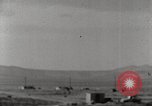
Effect on metal tower during Operation Cue nuclear test conducted at Yucca Flat region in Nevada,United States.
Operation Cue conducted at Yucca Flat region in Nevada, United States. The test conducted to examine the effects of atomic bomb explosion on civil infrastructure, buildings and houses. View of small buildings and towers near test site. Several views of a large steel tower including a view from inside it looking upward as a nuclear bomb blast detonates and topples part of the tower.
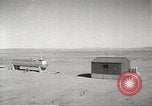
An explosion at a house,and tanker during nuclear atomic test of Operation Cue conducted at Yucca Flat region in Nevada.
Operation Cue conducted at Yucca Flat region in Nevada, United States. The test conducted to examine the effects of an atomic explosion on buildings and houses. A tanker and a house at the test site. The house explodes. Smoke rises from the nuclear test explosion.
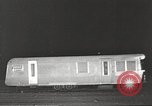
A test vehicle overturns due to a nuclear atomic test during Operation Cue conducted at Yucca Flat region in Nevada.
Operation Cue conducted at Yucca Flat region in Nevada, United States. The test conducted to examine the effects of atomic bomb explosion on buildings, houses and cars. A dummy or test bus vehicle (a recreational vehicle or motor home) parked at the atomic bomb blast test site. The vehicle overturns due to the nuclear bomb explosion blast wave. Smoke rises from the nuclear test explosion.
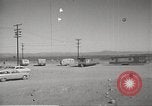
The impact on assorted vehicles due to a nuclear test during Operation Cue conducted at Yucca Flat region in Nevada.
Operation Cue conducted at Yucca Flat region in Nevada, United States. The test conducted to examine the effects of atomic explosion on buildings, houses and cars. Dummy vehicles including 1950s cars and motor homes parked at the test site. Nuclear bomb explodes at the site and vehicles are destroyed. Smoke rises from the atomic bomb explosion.
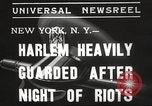
Workers repair broken shops and rioters are arrested by police following Harlem riots in New York City, New York.
Harlem being guarded by New York City police forces after March 19, 1935 race riot in New York City, New York. Workers repair broken glass of the S. H. Kress and Co store. People walk on street outside the damaged shops. Broken glass on the ground. African American men who are the accused rioters come out of police cars and paddy wagons to enter a court room. One of the accused men has a bandage on his head. (This incident is sometimes called the first modern race riot in the United States. A Mayor's Commission investigated the cause and issued a report, "The Negro in Harlem: A Report on Social and Economic Conditions Responsible for the Outbreak of March 19, 1935." The report concluded that the riot was spontaneous and had no organized leadership behind it. It also identified "injustices of discrimination in employment, the aggressions of the police, and the racial segregation" as conditions leading to the riot.)
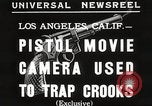
Men demonstrates a revolver fitted with a film camera in it to record and confront criminals in Los Angeles, California.
Pistol movie camera used to trap criminals and record their movements in Los Angeles, California. Demonstration of a revolver fitted with a motion picture camera in it. Man points the pistol at would-be criminal and films the criminal attacker as he approaches the police man holding the combination handgun and camera. Police officer checks the film reel.
CRITICALPAST.COM: About Us | Contact Us | FAQs - How to Order | License Agreement | My Account | My Lightboxes | Shopping Cart | Advanced Search | Featured Collections | Website Terms & Conditions | Privacy Policy ©2026 CriticalPast LLC.
License Agreement |
Terms & Conditions |
Privacy Policy
©2026 CriticalPast LLC.