


 Francais
 Deutsch
 Italiano
Refine Your Search
Kodiak Alaska USA 1953 stock footage and images
- Showing 469 to 474 of 25600 results more
more Hide
Hide
B-17 and B-24 bomber drop bombs over Japanese positions in Aleutian Islands, Alaska
United States B-17 and B-24 bombers loaded with bombs to be dropped over Japanese position in Aleutian Island during World War II. Planes take off and drop bombs over Japanese position and return after the air strike.
U.S. aircraft take off and U.S. Army officers in the Aleutian Islands, Alaska.
The Aleutian Islands Campaign of World War II. A map shows the Aleutian Islands situated in the North Pacific Ocean forming the southern boundary of the Bering Sea. Volcanoes in the Aleutian Islands. The rocky coast of the island. A man stands on an ice covered ship. A boat carries some people. An aircraft lands on sea. A ship in the rough seas. In 1942: Animated map depicts Japanese invasion of Midway Island and Dutch Harbor and U.S. response to the attack. U.S. Army Air Force PBY Catalina flying boat aircraft takes off. U.S. Army officers who participated in the Battle of Dutch Harbor include Lieutenants Charles H. Briggs, Jack Todd, Jep C, Jonson, James E. Breeding, Virgil Alleman and Jack S. Marks. Active volcanoes in the background. Army camps in the Aleutian Islands.

Equipment being unloaded with the help of a crane in the Aleutian Islands, Alaska during the Aleutian Islands Campaign.
The Aleutian Islands Campaign of World War II. U.S. Army Service Force (ASF) provides logistical support to fight the enemy. A flag of the United States. A United States Army Air Forces B-25 Mitchell bomber flies. Various goods like timber, vehicles being unloaded from a cargo ship with the help of a crane. A ship carries troops. Soldiers disembark from a ship. A soldier carries a guitar.
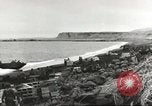
U.S. troops and supplies land at Attu Island in Aleutian Island, Alaska, during World War II
U.S. army troops and supplies being landed by Higgins boats at Massacre Bay, in preparation for battle to dislodge Japanese forces that invaded Attu Island in the Aleutians during World War 2. American forces landing at this Southern landing site included elements of the 17th and 32nd Infantry Regiments.. Troops and supplies are seen being brought to the shore by Higgins boats. Boxes of supplies are piled up and several Higgins boats are beached, including one from the Attack Transport Ship, USS Barnett (APA-5) and one from the USS Zeilin (APA-3). Weather is bleak and snow covers mountains in background. Most of the supplies are in wooden crates. Some building materials are also seen. There is no sign of Japanese resistance. The Higgins boats, aka Landing Craft, Vehicle, Personnel (LCVP) are shuttling back and forth from the attack transports seen anchored offshore. As the sequence progresses, more and more troops and supplies are seen on the beachhead. Troops form a chain to unload cargo from the landing craft. U.S. army troops and supplies being landed by Higgins boats at Massacre Bay, in preparation for battle to dislodge Japanese forces that invaded Attu Island in the Aleutians during World War 2. American forces landing at this Southern landing site included elements of the 17th and 32nd Infantry Regiments.. Troops and supplies are seen being brought to the shore by Higgins boats. Boxes of supplies are piled up and several Higgins boats are beached, including one from the Attack Transport Ship, USS Barnett (APA-5) and one from the USS Zeilin (APA-3). Weather is bleak and snow covers mountains in background. Most of the supplies are in wooden crates. Some building materials are also seen. There is no sign of Japanese resistance. The Higgins boats, aka Landing Craft, Vehicle, Personnel (LCVP) are shuttling back and forth from the attack transports seen anchored offshore. As the sequence progresses, more and more troops and supplies are seen on the beachhead. Troops form a chain to unload cargo from the landing craft.

Allied troops take over Kiska Island in Aleutian, Alaska
"Allies take Kiska" Canadian troops on the move and join American troops to take over Kiska from Japanese possession. Admiral Thomas C. Kinkaid with a Canadian General. Troops on board a ship and put on camouflage make up. A map shows location of Kiska. Allied troops loaded in landing crafts arrive at Kiska Island and regain it without any Japanese opposition. Wrecked Japanese planes and American flag. (World War II period).
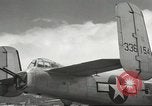
United States B-25 bomber and crew at Alexai point Landing Field, Attu Island, Alaska
Shown is tail section of a U.S. B-25 medium bomber, tail number 43-36154, assigned to the 11th Air Force, 77th Bombardment Squadron (Medium). Twin tails and tail gunner position and guns visible. Snowy slopes seen in background. In the first scene that shows members of the flight crew standing in front of number two engine, they are believed to be: starting back left (moving to the right behind the propeller): Armorer/Tail gunner: Samuel Ward Craig (Shelocta, PA), Pilot: Willard L. Castledine (Three Rivers, MA), Radioman/Waist Gunner: Hugh W. Wilson (Paducah, KY), (coming around to the front of the propeller on the right moving left), Navigator/Bombardier: Kemmer W. Schricker (Davenport, IA), Co-Pilot: Kenneth H. Wait (Rickreal, OR), Engineer/Turret Gunner: Roman F. Ales (Luling, TX) The crew members pull engine #2 through, with the propeller, to assure against hydraulic lock, before starting. (World War II period).
CRITICALPAST.COM: About Us | Contact Us | FAQs - How to Order | License Agreement | My Account | My Lightboxes | Shopping Cart | Advanced Search | Featured Collections | Website Terms & Conditions | Privacy Policy ©2026 CriticalPast LLC.
License Agreement |
Terms & Conditions |
Privacy Policy
©2026 CriticalPast LLC.